


Who’s the greatest golfer of all time? It’s hard to have this conversation without acknowledging Tiger Woods. It’s an impressive feat just to have his name mentioned amongst greats like Jack Nicklaus, Ben Hogan and Walter Hagen – but perhaps even more so when you consider that he’s the only non-white name on the list.
The lack of black and mixed race contenders for this title isn’t surprising when you consider just how much the odds were stacked against non-white golfers in making it as professionals. Long after Jackie Robinson broke through the baseball colour barrier in 1947, there were still restrictions in place for golf up until the late twentieth century.
For instance, the Masters – the sport’s biggest event – didn’t allow black players until 1975. Even then famous courses such as the Augusta National Golf Club in Georgia didn’t allow non-white members until 1990. It’s hard to overestimate Tiger Woods’ remarkable career when you consider that he first won the Masters on that very golf course just seven years later in 1997.
So, how did a young Woods’ pull off such a valiant victory– ultimately etching his name into the history books for both golf and for improving racial relations in the United States? Well, it all began 21 years earlier with the birth of a young boy who would go onto have an unrivalled talent for golf.
Woods was born in Cypress, California in 1975. The only child of a mixed race couple, Woods – who was named Eldrick Tont Woods – would reject the term ‘black’ and ‘African American’ in his youth, instead coining the word ‘Cablinasian’ to acknowledge all the different facets of his identity. The term reflects his Caucasian, Black, American Indian and Asian heritage.
Woods didn’t just grapple with his racial identity growing up, but instead struggled with the burden that came from being a non-white golf prodigy being raised in the United States. He’d exhibited an incredible knack for the sport from as early as two-years-old and was already competing in national competitions by the time he was a teenager. It was, unfortunately, not without opposition from other members of the golf community.
During an interview with Trans World Sport when he was just 14, Woods confessed that he’d already began to deal with aspects of racism when he competed in different parts of the country. He admitted:
“People are always staring at you.”
He added:
“People are always saying ‘why are you here? You’re not supposed to be here’.”
The fact that Woods’ didn’t allow these comments to deter him from greatness is just more evidence of his inspiring tenacity. In fact, in the same interview he freely declared that – despite his race – he was capable of becoming the greatest golfer the world had ever seen. Arguably he wasn’t wrong.
Woods quickly became a force to be reckoned with during the 90s and officially turned professional in 1996. Success wasn’t too far in the distance, with the 20-year-old winning three PGA Tour events by early 1997. Woods’ crowning achievement would come just a few months later when he won the 1997 Masters Tournament that April. In true Woods fashion he did it in style.
In his first tournament, he shattered records for his 12-stroke margin and for becoming the youngest player to ever win. Perhaps most importantly, he was also the first non-white competitor to come first in the prestigious contest.


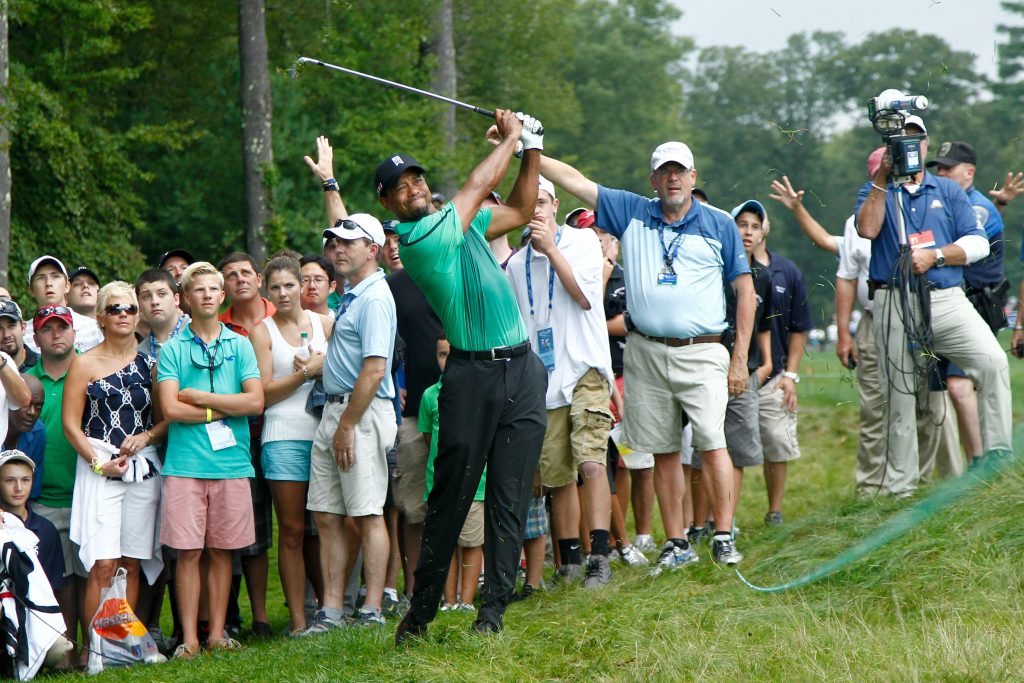
The latter years were filled with similar glory – in the process establishing Woods as one of the most famous athletes in the world. In June 1997 he would become number one in the world golf rankings. Following this, he’d go on to have an incredible run as the top-ranked golfer in the world for 264 weeks between August 1999 and September 2004. He would top his own record again when he took the same title for 281 weeks between June 2005 and October 2010.
Tiger could have retired in 2010 and there likely would have been no questioning his impact on the world of golf. However, he would go onto make a spectacular comeback when he won the Masters for the fourth time in 2019. The last time he’d done so was when he had back-to-back wins in 2001 and 2002. This time he was 44-years-old.
Discussing his awe-inspiring comeback in an interview with GolfTV, a humble Woods said:
“No one is perfect and everyone is dealt with cards in their life where they have obstacles they have to overcome and some are different than others. And to fight, to get back up and know that this is all not done alone. I’ve had a fantastic group around me, and their love and support has helped.”
Woods’ star power eventually made him a valuable ambassador for the non-white community in the United States. This was seen most recently when he made an impassioned plea for there to be a discussion about the murder of George Floyd in May 2020. In a post to his six million followers on Twitter, he wrote: “I hope that through constructive, honest conversations, we can build a safer, unified society.”
Meanwhile, the world saw a different side to Woods when he opened up about growing up with a stutter. In an open letter penned to a young child who was struggling with similar speech problems, Woods’ candidly revealed that he knew what it was like to feel like an outsider.
He wrote in Golf Digest:
“I know what it’s like to be different and to sometimes not fit in. I also stuttered as a child and I would talk to my dog and he would sit there and listen until he fell asleep. I also took a class for two years to help me, and I finally learned to stop.”
It’s this sense of humanity –as well as his amazing golf record – that makes him such as beacon of hope and inspiration for all sorts of people across the world. He’s a shining example that people do overcome the odds and can achieve great things at any point in their lives.