


Creoles make up 28% of the population of Mauritius, the subtropical island nation located 1,130 km east of Madagascar in the Indian Ocean. The main island is a popular tourist destination known for its sandy beaches, coral reefs, and blue lagoons.
The population of Mauritius is around 1.26 million people, including 42,000 inhabitants on the outlying territory of Rodrigues Island. Other smaller islands in Mauritius’ regions include the Cargados Carajos Shoals and the Agalega Islands.
Creole culture plays a significant role in the nation’s history, as the current population can trace their roots to Malagasy and Continental Africans, who were brought to Mauritius, sadly as enslaved people, between the 17th and 19th centuries.
The mixed culture of Mauritius includes people of Indian, Pakistani, Chinese, European and African descent. Despite English being the official language, around 80% of the population speak a French-based patois version of Creole daily.
Origins of the Creoles in Mauritius
The island was uninhabited and undiscovered for centuries, although historians suggest Arab sailors visited it in the Middle Ages. It appeared on maps dating from around 1500, with the Arabic name Dina Arobi. Portuguese sea captain Domingo Fernandez Pereira was believed to be the first European to land in Mauritius in around 1511.
The group of islands comprising Mauritius, Rodrigues and Reunion was named the Mascarenes by another Portuguese explorer, Don Pedro Mascarenhas. However, the Portuguese only stayed briefly and weren’t interested in colonising the islands.
A Dutch convoy of ships, under Admiral Wybrand Van Warwyck, docked at Grand Port in 1598. He called the island Mauritius to honour Prince Maurice Van Nassau of Holland. In 1638, the Dutch East India Company built a settlement in Mauritius.
They planned to create a trade centre and plant sugar plantations, bringing slave labour from Madagascar in 1639. The influx of enslaved people diversified the society in Mauritius, creating a mixed culture that saw the birth of the Creole people and language.
Hardships of slavery
Life was callous for the enslaved people, who were torn from their homes and families and forced to do backbreaking work for little money and life as captives. The first ship in 1639 brought 105 enslaved people. As well as working on the new sugar plantations, they were set to work picking tobacco and felling trees to export ebony.
Within the first week, around 60 enslaved people made an escape bid into the forest. Only 20 of them were recaptured. This resulted in 95 more enslaved people being shipped over from Madagascar.
There were many challenges for the enslaved people, including simply staying alive and healthy. They suffered months of severe hardships in 1644 when Mauritius was hit by cyclones, leading to poor harvests and delays in receiving shipments of supplies.
The population relied on fishing and hunting to feed themselves. In 1645, yet more enslaved people arrived from Madagascar. By 1652, the hardships suffered by the enslaved people, such as a lack of food, spread to the colonists and local community too.
The commercial potential of the land declined, leading to the Dutch pulling out in 1658. They made several further attempts to colonise Mauritius, but none were successful. In 1672, an effort to rekindle the island as an agricultural colony failed.
This was a time of great upheaval for the enslaved population, who tried to eke out an existence, despite poverty and illness. Mauritius was hit by cyclones frequently, followed by droughts. Pest infestations and the cattle struck the crops fell sick.
Enslaved people who tried to escape, or organise any rebellion, received horrific punishments, such as being left out exposed to the sun all day without any shelter or water to deter other rebels.
Finally, in 1710, the Dutch abandoned the colony of Mauritius altogether, leaving behind three things they had introduced: sugar cane, deer and domestic animals.


French and English rule of Mauritius
In 1715, Mauritius became a French colony after Guillaume Dufresne D’Arsel arrived and claimed possession of the island, becoming the first French governor. The French had realised it was strategically located on the route to India.
This introduced further mixed cultures and the evolution of the French-based version of Creole that is widely spoken today. The change in colonial rule did little to improve life for the enslaved people.
The French administration ordered the construction of many new buildings, including the Government House, the Line Barracks and the Chateau de Mon Plaisir at Pamplemousses. Plenty of manual labourers were needed to carry out the work.
The French East India Company administered the island until 1767, followed by the French government until 1810. However, during the French Revolution, the inhabitants of Mauritius set up their independent government for a brief period. Privateers and pirates descended on the territory and raided British commercial ships on the busy trade route.

In 1810, the British forces descended on Mauritius in large numbers, overpowered the French and began a long period of British rule until 1968. The British pledged to respect the inhabitants’ language, laws, customs, and traditions, many of whom were of Creole heritage and spoke the French dialect of the language.
Rapid social changes occurred during the 19th century, most notably the abolition of slavery in 1835. The plantation owners received around £2 million in compensation for giving up their slaves. The plantation owners brought in labourers from India and Pakistan to work in the sugar cane fields after slavery was abolished.
Today’s Mauritian population is mainly descended from a mixed culture of European and Asian settlers, enslaved Africans and Indian and Pakistani immigrants. Later, Chinese traders joined the community, creating today’s rich and culturally diverse heritage.

Of mixed heritage, the Creole population makes up 28% of the population today, while around two-thirds of the community is of Indian and Pakistani descent. There are also a small number of people of Chinese heritage.
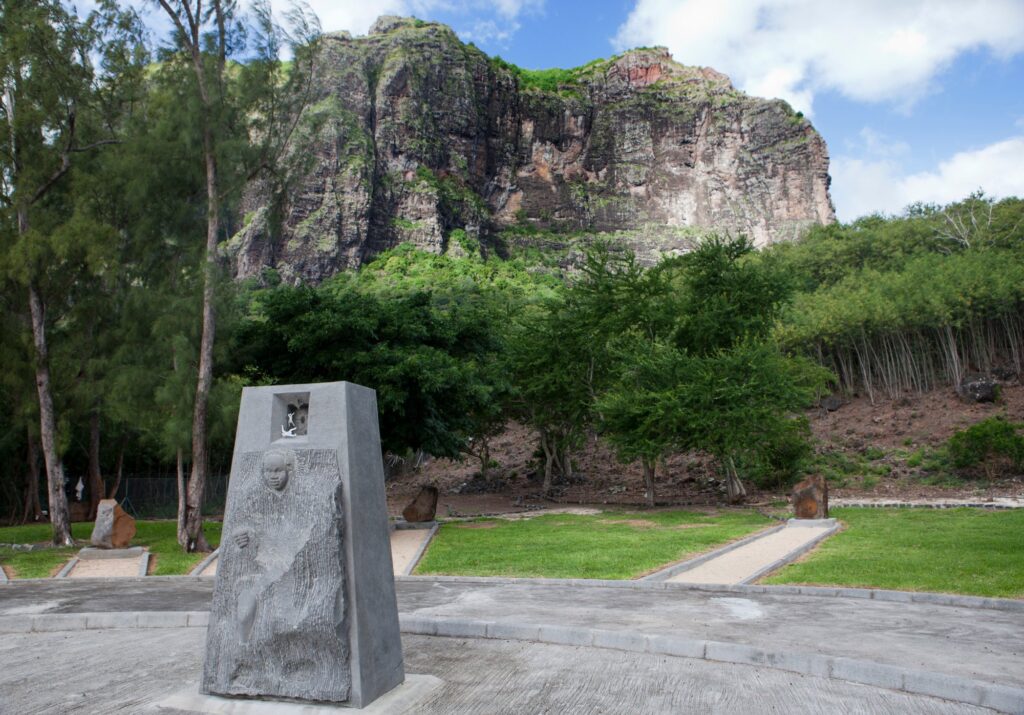
A monument, Le Morne Brabant, located at the southwestern end of the island, symbolises Mauritius’ resistance to slavery. The location had been a refuge for enslaved people, who would hide on the cliffs after running away from cruel enslavers.
At the mountain’s base, the International Slave Route Monument comprises ten sculptures made by artists from Mauritius, Reunion Island, Mozambique, Madagascar, India, China and Malaysia, so future generations will never forget.

Language of Mauritius
English is the official language of Mauritius but is spoken in day-to-day life by only a tiny percentage of the population. French-based Creole is spoken by around four-fifths of the population. It is the lingua franca of Mauritius, making communication possible between people who don’t share a first language.
Mauritian people commonly speak two, three or more languages, while the education system provides lessons in many different languages. Other dialects include the Indo-Aryan language Bhojpuri, French, Chinese, Hindi, Urdu, Tamil, Marathi, and Telugu.
The term Creole refers to more than just a group of people. It also describes the language that almost all Mauritians speak. In 2017, Étienne Sinatambou, Mauritius’ Minister of National Solidarity, proclaimed, “We are all Creole.”
In doing so, he invoked a spirit of national identity encompassing the island’s many cultures and traditions. The original population of Mauritius who identified themselves as Creole numbered less than 100 when the first Madagascan enslaved people arrived in the 17th century.
Today, almost everyone speaks the language, and censuses since 1944 have indicated a “remarkable shift to Creole”, with many local publications and advertisements now written in Creole.
Although English remains the one official language of Mauritius, an officially approved spelling for the Creole dialect is now used in schools, including for primary-age children, ensuring the dialect will continue for future generations.

Creole heritage in Mauritius
Mauritius is filled with the Creole architecture of bygone times, with many historic buildings dating from the French colonial era. As the French administration expanded, the islands witnessed the emergence of properties that combined European designs with additions borrowed from Creole culture.
In the capital, Port Louis, in particular, houses featured the typical detached kitchens, wrap-around porches and few interior hallways that typified Creole architecture. Historians have recognised hundreds of these Creole dwellings across Mauritius. The towns have stylistically identical dwellings, combining French architectural and distinctly Creole elements.
There was a massive building programme utilising Creole architecture from 1659, when the French founded Saint-Louis, until 1810 when French rule ended.
Historians today have described the architecture of Mauritius as having some of the most economically relevant building traditions from the colonial world. They typify the emergence of the covered porch, known as the Creole gallery.
Creole cuisine of Mauritius
Every Mauritian eats Creole cuisine, which has influences from African, Indian and French cuisine. Mauritian Creole meals involve plenty of seafood, corn, fresh vegetables, beans and pulses. The most commonly used vegetables are onions, tomatoes, eggplants – known locally as brinzel – chayote or “chou chou”, chillies and garlic.
Rice is a staple of many meals, while the most common seafood includes salted fish, shrimp, smoked blue marlin, octopus, crayfish and prawns. Spices such as cloves, chilli peppers and cardamon are added for the distinct Creole flavour.
Side dishes include noodles, boulettes – a combination of meatballs, fish balls and vegetables in broth – a dish known as roti served with tomato sauce and pickles and vinnday, a spicy accompaniment made with mustard seeds, vinegar and turmeric.
The Mauritians have their versions of chutney, curry, rougaille and pickles, with a unique local Creole flavour that can differ significantly from the original Indian recipes.
Creole music and dance in Mauritius
A bright and vibrant style of music and dance, known as sega, is the traditional Creole music of Mauritius. It blends musical aspects from Africa, Europe, India and Madagascar, creating lively rhythms combined with Western harmonies and melodies.
Just as the Creole heritage has evolved over the centuries through the interaction of people with mixed cultures, music has evolved similarly. Today’s sega music originated among the slave population of Mauritius in the 1700s.
It seamlessly blends rhythms influenced by the simple beat of European dance music with the more complex syncopation and traditionally African rhythms. Typical sega music mixes a smooth vocal melody with a string accompaniment and lots of percussion.
A sega band favours traditional rhythmic percussion instruments. These include a rattle known as a maravanne; the moutia hand drum; a large shallow-framed drum, often made of goat skin, known as a ravanne; a metal triangle and a musical bow called the bobre, with a single string stretched end-to-end along a wooden stick to make an audible twang.
Sega music usually includes dancing, when typically, the women will dance together simultaneously, using loosely coordinated movements as a group.


Importance of Creole culture in Mauritius
The Creole ancestors of today’s islanders have influenced almost every aspect of modern life and are extremely important to Mauritius. The heritage has grown across the islands, from 105 enslaved people arriving in the 17th century to an estimated 353,000 people who class themselves as Creole today.
Around 80% of the population already speaks the French-influenced Creole dialect. With an officially recognised version being used in primary schools, the language looks set to continue gaining ground in Mauritius.
Monuments such as the moving International Slave Route Monument at Le Morne Brabant are a continual reminder for future generations of how the nation’s heritage began. They mark the hardships suffered by the ancestors of today’s Creoles to turn Mauritius into a modern-day vibrant community.