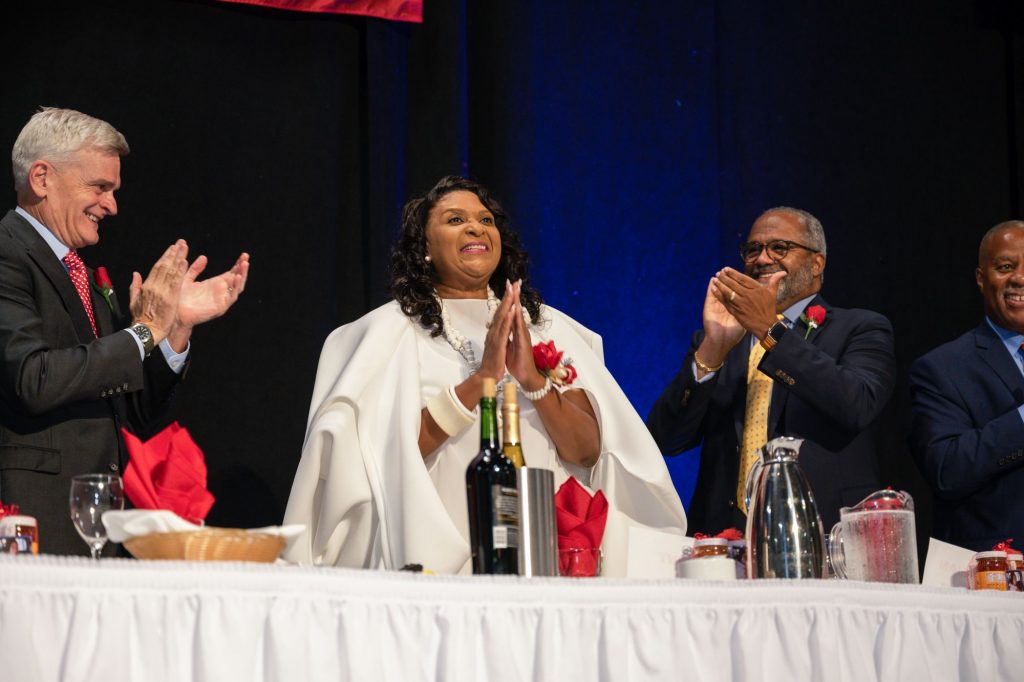
A Lady with a Heart for the People
“Fortune favours the brave.” So said the Roman poet Virgil in The Aeneid, his laudatory Latin epic poem about the Trojan hero Aeneas and the founding of Rome. Albeit on another continent and in another age altogether, the same can be said of Jennifer Vidrine, the remarkably high achieving, courageous and self-assured Mayor of Ville Platte, Louisiana, whom fortune has munificently rewarded for her brave, sustained and unyielding commitment to helping the inhabitants of her town.
She might not have founded Ville Platte herself, but, like Aeneas and his connection to the Eternal City, she is synonymous with the town and its population of 8000 people. And her presence, not to mention her impassioned leadership over more than a decade in office, has been positively transformational to its burgeoning success, uplift and amelioration.
In fact, Virgilian and epic are both epithets which can be applied to Jennifer Vidrine herself. Her myriad trailblazing accomplishments, her moral dynamism and her profoundly humbling level of altruistic dedication to assisting others are indeed worthy of such fulsome, canonical comparisons.
Hers is a ground-breaking tenure as Mayor. As both the first African-American and the first woman to occupy the office in Ville Platte – she was first elected in 2011 – she has naturally (but also sadly) had to overcome both antediluvian racial animosity and outdated gender-based hostility, but has done so with a humane, conciliatory and philanthropic demeanour – one which radiates genuine warmth and engenders receptivity in those around her. Currently, in her third term as Mayor, she is now running for her fourth term. With her effulgent, welcoming smile, kindly, inclusive gaze and powerful aura of affability, she both animates and captivates, as well as inspires when she talks.


Upbringing
Mayor Vidrine was herself brought up in Ville Platte, a place she lovingly refers to as “a small town where everyone cares about everyone.” She quickly ascribes her success in life to the strong, positive values she imbibed at home and church during her childhood. As she explains,
“I was either at church or at school. If I wasn’t at school, I was at church. If I wasn’t at church, I was at school. And that is really what brought me to where I am today – the values that I was taught.”
Deeply influenced by her robust Christian faith, Mayor Vidrine often references God when she talks, not – as with many of today’s Machiavellian politicians – to ingratiate themselves with the electorate, by dint of faux-piety, but with genuine reverence and evident devotion to the Lord’s message. As a result, be they believers or non-believers, she connects with her audience since they can see her palpable sincerity.
Predictably, her Mom, Pop and grandmother were all seminal influences on her childhood and instilled in her values which duly shaped her into the God-fearing, a confident, tenacious and indefatigable woman she is today. As she relates, her grandmother “taught me how to be strong and how to deal with anything that would come before me.”
Her mother, a teacher, naturally taught her the importance of excelling in education. Pop – a businessman, church deacon chairman and a thoroughly good man whom she evidently idolises, was a constant in her universe and helped her develop her moral compass. As she says touchingly, in a phrase worthy of a Pauline epistle,
“Pop taught me, unconditional love. He loved me with a tenderness and a gentleness that I would want every little girl to grow up with.”
He equally gave her much sagacious counsel and peerless life advice. She credits him with teaching her how to care about people and how to help them. One of the things he repeatedly said to her was the following entreaty to kindness, which rapidly became a cornerstone of her philosophical outlook on life: “When you get, give. When you learn, teach. And never pass up an opportunity to help somebody because it’s the right thing to do, and because you can.” This intensely noble, humane and compassionate exhortation – almost biblical in its wisdom, reminiscent of the good Samaritan story- profoundly shaped her thinking and can arguably be seen as the mainstay of the humanistic way she now conducts both her personal life and her professional one as Mayor.
An Ardent Desire to Help Others
Thus an animating principle of Jennifer Vidrine’s childhood – and one which has gone on to resonate throughout her adult life and in her long, distinguished career as a dedicated public servant – was her ardent desire to help others.
This sense of compassion, generosity of spirit and care for those less fortunate was demonstrated from an early age, when her parents took her to visit people in rural communities who didn’t go to school and who, due to the pernicious legacy of slavery, poverty and limited access to education, were unable to read for themselves. To alleviate their burden of illiteracy, she would read the mail aloud to them.
This task, undertaken through sheer charitable kindness, also showed her the importance of clear and effective communication – finding an appropriate style of conveying information best suited to her audience – and in this case, one devoid of “big words.” What better training could a future leader have asked for than that? Moreover, what she found truly gratifying was the look of pride on the faces of the people she read to, given that
“it just made them feel so good that they could see a little Black girl that could read and could understand, but then could explain it to them in a way they could understand.”
It was also in such rural areas, where folks were often without basic modern amenities such as inside toilets, that she learnt another invaluable life lesson that has stuck with her to this day. “Don’t look down on people who didn’t have the opportunities you have.” From there, she realised that all she wanted to do for such people was “to help them have a better life.”


Another powerful example from her childhood shows her evident humanitarian concern for others, even at a young age. She was instructed by her Pop to talk English aloud on the school bus in the mornings so that the Creole-speaking children from rural communities who were not exposed to English at home would, therefore, at least be able to learn some words and would thus not have their education retarded. Moreover, on those long school bus journeys, she magnanimously passed from seat to seat, doing the Creole-speaking pupils’ homework for them, and assisting those who lacked comprehension because English was not their mother tongue.
To this day, she still runs into some of those Creole-speaking children from the school bus, and they have been known to pay her the most beautiful of compliments. “You never looked down upon us because we were poor. You never looked down upon us because we didn’t have our homework. You always treated us as equals, and you always treated us like we were no different from you.” In all honesty, could anyone ask for a more stellar character reference than that?
Education
The gargantuan importance of education as the bedrock for future achievement and success in life was firmly conveyed to her at home. After attending (and excelling at) local schools in Ville Platte, she studied Psychology as an undergraduate at Louisiana State University. She then gained a Masters in Public Administration at Southern University.
Spurred on by a desire to fulfil her undoubted intellectual potential and study at some of the most prestigious academic institutions in the world, she duly continued her educational journey by completing the Senior Executives in Local and State Government Executive Education Program at the John F. Kennedy School of Government at Harvard University and an International Studies SMU-in-Oxford at Oxford University in England. Yet despite her elite Ivy League qualifications and Oxbridge experiences, she remains hugely approachable and a consummately grounded woman of the people.
Return to Ville Platte
Following her education, it was her Pop who was instrumental in her return to Ville Platte. He called her up and told her of a position going at the Evangeline Community Action Agency, urging her with the immortal words to “just come to try it for one year, and if you don’t like it, then you can leave.” But, reader, need I tell you, she returned home and never left!
And so, in a thirty-plus year career, first as the Asst. Executive Director with the Community Action Agency, and then as Mayor, doing work which has allowed her to utilise her “heart for others”, be it serving the poor, the disabled, the elderly, the less fortunate and the marginalised populations of the town, Mayor Vidrine has consistently been a staunch and eloquent advocate for the voiceless, the overlooked and the disenfranchised.

Altruism
Mayor Vidrine’s desire to live altruistically and in the service of others is both immensely humbling and also contagiously inspirational. Embodying the instruction by Mary Church Terrell to “Lift as you climb”, she possesses a nobly public-spirited disposition – almost ancient Roman in its conception of civic virtue. She is thus animated by a visible desire “not for any glory and not for any fame, but simply because you can do it and it’s the right thing to do.”
In fact, one would not be at all surprised if Mayor Vidrine’s unofficial mantra was that of Stephen Grellet, the 19th-century French missionary who famously declared,
“I expect to pass through this world but once. Any good thing, therefore, that I can do, or any kindness I can show to any fellow human being, let me do it now. Let me not defer nor neglect it, for I shall not pass this way again.”
Becoming Mayor
Ironically, becoming Mayor of Ville Plate was never on her list of aspirations. On the contrary, it was the people of Ville Platte who begged her to run for the position. Moreover, Ville Platte had never had an African-American or a female Mayor before, so both in terms of race and gender, she was not so much demurely dismantling as actively smashing her way through centuries-old glass ceilings and blazing a trail for others to follow. After repeatedly praying about whether she should run for office over three months, one night, she had an intense communion with God and duly announced her candidature the next day. Amen to that!
Challenges on the Road to Becoming Mayor
Sadly, the prevalence of racism in Ville Platte hindered her on the campaign trail and stymied her being accepted by voters for the thing she wanted to be seen as most – a human being, not judged by her colour or her gender, but by her common humanity. As she explains with a hint of melancholy in her voice,
“There was a lot of racism going on back then, and to be the first Black person and the first woman, one of the challenges was getting people to accept me as a human being, as a person, not as a Black person, not as a woman, not as a Democrat.”
Her bold yet intensely practical solution to overcome such myopic attitudes was to walk the streets of Ville Platte (all 182, to be precise), knock on doors and to engage in frank dialogue and honest communication with the town’s residents, thus asserting her willingness and openness to listen and talk, but also crucially her own humanity. She was even prepared to sit down and dialogue with an octogenarian white supremacist, convinced of his own theologically ordained racial superiority, who began the conversation by telling her that he would never vote for her, since he believed that black people “were not supposed to be over white people.” Yet after talking to her at length – and getting to know her as a person, he somewhat miraculously reneged on his inveterately racist words and subsequently voted for her – the first black person he had ever voted for. She remarks, somewhat philosophically, ”Because I’m a firm believer that if everybody could just sit down and talk, we can accomplish something.” Moreover, keen to understand why the octogenarian bigot had seemed so fearful of a black woman in a position of power, she asked him whence sprung his fear. His reply was remarkably candid: “Ms. Jennifer, we are scared that y’all are going to treat us the way we treated y’all.”
Her conciliatory attitude, especially in the face of such egregious and distasteful prejudice – speaks volumes about her temperament and her professionalism, not to mention her optimistic desire to see the good in people. Underlying her belief in racial equality is her muscular Christian faith. As she makes it abundantly clear, “I am a Christian human being, and I have to treat everybody the same. It doesn’t matter what colour you are.” Thus fairness and equality for all are her bywords.
When running for Mayor, indicative of her humility and her conception of public service, she “wanted to make sure that the people knew that I was not there for the title. So to me, it was a responsibility that I had to them to make life better for them, to make Ville Platte better for the people.”
Disarmingly down to earth, wholly devoid of any vestiges of the hubris which usually affects politicians in high office, she is keen to be with everyone and is conscious of who she is and where she has come from. She remarks, a matter of fact:
“You still remember the kids you went to school with, even though they’re standing on the corner, you don’t just pass by them, like I don’t know them, because no matter what, I’m still Jennifer that they knew in grade school, Jennifer they knew at Ville Platte High.”
To quote a song title from some years back, she is indeed Jenny from the (Ville Platte) block!
Her view that leaders need to be genuinely interested in the people they represent is almost astonishingly old-fashioned, given the tawdry world of contemporary politics we inhabit, where many run for office for tireless self-aggrandisement, shameless self-promotion and lucrative fiscal gain. She articulates her opinion on the matter with a probity and a beguiling earnestness. “That’s how I think a leader should be, mayor, or any elected official for all of the people. It doesn’t matter their credentials, their educational level or their socio-economic level. The fact that they are people and they matter, and you need to care about them; you need to make their problems your problems.”
Her explicit (and intensely laudable) aim as Mayor is to “enhance the quality of life for the small town rural communities because for so long the small towns have been neglected, especially when federal funds or federal resources come.” She explains further, with brio and passion evident in her voice:
“All of the money would go to the big cities, and by the time it would trickle down to the small communities, there was nothing left, so we would always fall through the cracks.”
What she then adds is illuminating but also somewhat unsurprising. “What was so sad, was that there were not a lot of people who were in positions that could ask who cared enough about poor people, about Black people, about people who were less fortunate, about the people who were disabled, and who cared enough to go that extra mile and drive to Baton Rouge and ask for money.”
Of the people of Ville Platte, whom she serves as Mayor, she says, almost belligerently, in a line worthy of that stirring speech delivered on the eve of battle in Henry V, “I’m going to fight for them, and I’m not going to stop when I’m tired, I’m going to stop when I’m done.” Positively Shakespearean stuff!
The reasons underlying her ingrained desire to use her position as Mayor to help others are remarkably simple:
“It’s a gratification because it feels so good because when you help, it comes back to you in so many ways. And when you give, the good just comes back to you over and over again.” She continues, articulating with lucidity her rationale, “I think that is the most gratifying thing that a person can do, knowing that they can go through their day and make a difference in someone’s lives.”

Girls and Boys Place
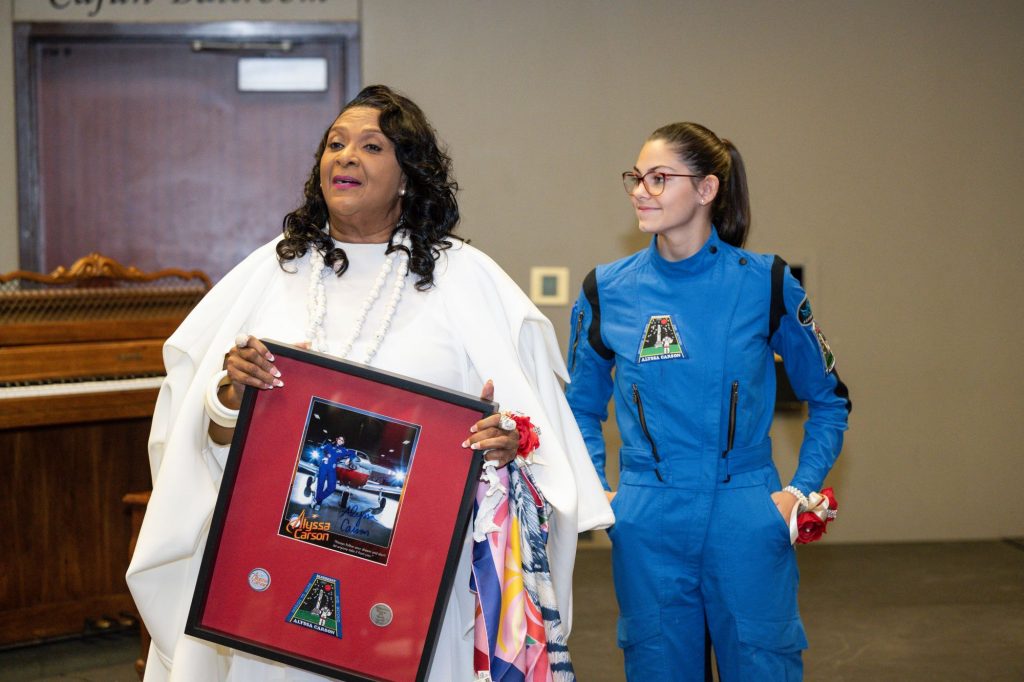
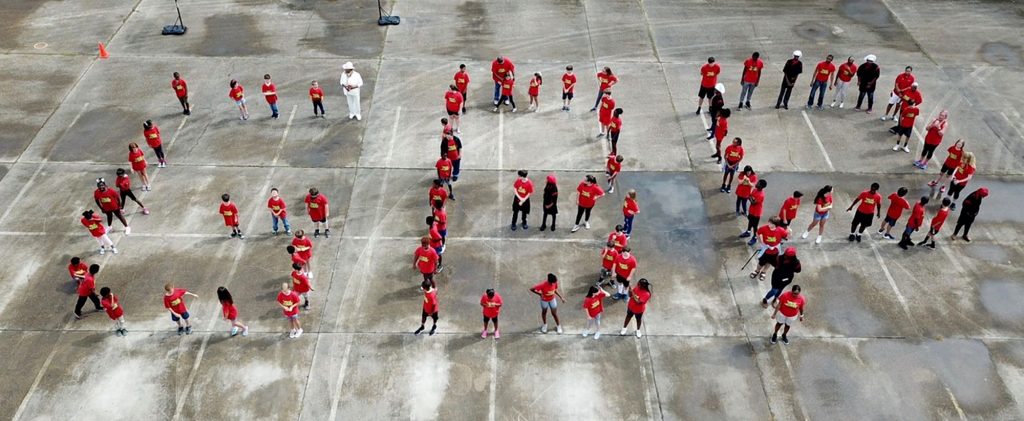
In 2016, Mayor Vidrine started the Girls and Boys Place in Ville Platte – a structured summer programme for young people with the conscious aim of expanding their cultural horizons outside the ken of their rural, small town knowledge and thus increasing the young people’s cultural literacy and capital – something which traditionally led to greater intellectual development, personal fulfilment and increased job prospects. The program also invites inspirational guest speakers from a variety of backgrounds and professions – not just athletes, basketball and football players, but also astronauts in training, scientists and mathematicians.
Mayor Vidrine sees the unerringly positive effect that these guest speakers and positive role models have had on the students. “To hear low-income kids from a small rural area say that they want to go to space, makes me want to work even harder to make sure that we provide the resources that they need to get to space or to get to college. A lot of them don’t want to just be on a plane; now they want to fly the plane. They’ve never even been on a plane, but they want to be a pilot now!”
Written on the children’s T-shirts this summer were the words “Endless possibilities. I want to change the world.”
Such is Mayor Vidrine’s energy, galvanising zeal and unwavering commitment to the youth that one is left in no doubt that some of those children, whom she affectionately calls “Sha Babies”, one day actually will.

Maintaining the Creole Language in Ville Platte
Having grown up speaking Creole with her grandparents, Mayor Vidrine is inordinately proud of her linguistic and cultural heritage. She fully understands the importance of the Creole language, not just in terms of its historical legacy but also for the sake of enhanced community cohesion. Speaking Creole enables her to connect with – and of course, to help – elderly residents of Ville Platte who only speak the French-based patois with an African syntax.
She is keen to stress, her eyes twinkling as she says, “I am so proud of my Creole heritage. Even in City Hall now, we’ll have some of the elderly people who come in because we have the younger people who do not know how to speak Creole and say, “Well, go get the mayor. The mayor’s going to know what I’m saying.” Mayor Vidrine has a natural affection and protective quality for the elderly, and she believes wholeheartedly and unequivocally that,
“WE SHOULD TAKE CARE OF THOSE WHO TOOK CARE OF US!”
It is evident that preserving Ville Platte’s Creole-speaking heritage is vital to Mayor Vidrine. She also wants Creole to be actively spoken instead of being merely preserved in aspic. To that end, she has ensured street signs in both English and Creole and brags about a local radio station, KVPI, which leads with the news in Creole every morning at 7.30 am.
Achievements to Date as Mayor
Given Ville Platte’s overtly racialised history, Mayor Vidrine has made fixing up the hitherto neglected, predominantly black part of the city her priority. As she explains, with an evident sadness in her voice, “Parts of the city, especially the south side of the city, the low income, predominantly Black part – had been neglected for so long. So I really made it a priority to make sure that section of town got the resources and the infrastructure that they needed.”
The ethos of the wholly dedicated, bona fide public service which thoroughly imbues her mayoral duties is both refreshing and humbling – a far cry from the vainglorious, self-serving politicians whose inflated egos and hubristic tendencies lessen their ability to do the job well, let alone to help others – according to Vidrine, the role’s very raison d’etre.
Moreover, she is adamant in her view of the Mayor’s role:
“Because it’s not a title to me, it’s a responsibility to the people. It’s not about position. It’s not about power. It’s about caring for the people and serving the people. It’s about public service. Because it’s not about you, it’s not about me; it’s not about me having 60 seconds on the news, it’s not about me having my name in the newspaper, it’s not about me getting a good parking spot at the football game. It’s about the people. It’s all about the people.”
On her tendency to reach out and embrace difference, she is succinct but spot on: “I don’t have a problem talking to a Republican, a white woman or a white man, it doesn’t matter. I look at people and gauge them according to their personal conduct, heart, and feelings for the people.”
As she movingly explains, her powerful humanism and universal outlook come through in her words, “I don’t look at colour, I don’t look at party affiliations, I look at people. Let’s sit down around the table and talk because we will find out that we are more alike than we are different. WE ARE BETTER TOGETHER! WE ARE STRONGER TOGETHER!”
Other Notable Achievements
Jennifer Vidrine has accomplished many things during her time in office, which have tangibly “given back” to the local community and unquestionably improved their quality of life.
Be it the introduction of a walking curfew (which has thus far substantially reduced crime), ridding the city of abandoned and overgrown property, bringing Christmas lights back to Main Street, adding Christmas lights to the low-income, impoverished side of town, cracking down on those who steal water and gas utilities, installing smart meters or replacing all of the antiquated water lines in the city (as part of the water renovation project), Mayor Vidrine is understandably proud of such achievements.
Other accomplishments as Mayor include the purchase of 17 new red city trucks with tracking systems, a new street sweeper, new dump trailers, new heavy equipment, a new state-of-the-art telephone system, drive-thru payment window, online bill and property tax payments, a city garden, the establishment of a random drug testing program for city employees, giving away 10,000 daffodil bulbs to beautify the city (indicative of her aesthetic sensibilities and of her wanting to democratise beauty for everyone), gas accountability for city vehicles; becoming one of only eight cities completing the Ready City Challenge for economic development, and the use of the city’s message alert system, which she uses to keep the local community informed of what is going on the city.


Her Plans for Ville Platte in the Future
In the future, Mayor Vidrine’s goals are to bring a movie theatre, a bowling alley, an arcade and even a water park to the area for the community’s entertainment, joy and delight.
In 2018, when she was re-elected for her third term in office, she also set her sights on developing more affordable housing for Ville Platte. Thus Vidrine’s administration is currently partnering with the Louisiana Housing Corporation to transform abandoned lots throughout the city into affordable single-family homes that are available to residents as rental properties or rent-to-own properties.
Another of her highly laudable Mayoral initiatives is the Ville Platte Pocket Park Plan, which consciously aimed to address the town’s increasingly stark racial divisions. This plan will create a system of neighbourhood recreational areas anchored by a centralised meeting space where the end goal is safe recreation and social interaction between users. At the heart of this plan is the belief that physical barriers can reinforce social and psychological obstacles. At the same time, well-designed public spaces have the power to bring communities together, heal and build a shared future.
Addressing Racial Disparities in Schools
Mayor Vidrine is also keen to use her tenure to address the racial disparities in education in Ville Platte. As she explains without hatred or bitterness when reminiscing on her own experiences of a two-tier educational system and the second-hand textbooks her school received, “We had books from the white school. The Black school had to depend upon what the white school wasn’t using anymore, so we had to wait and get books from the white school when they were through with them.”
A Decline in Schooling Standards
She also wants to rectify with alacrity the ostensible decline in educational standards now prevalent in Ville Platte’s schools, citing both the current lack of black male teachers who can set a positive example for young boys and the removal of prayer from the school day as reasons why discipline in schools has become increasingly lax.
She adds that the current endemic lack of respect for teachers is also to blame for falling standards, railing against today’s culture of insubordination, chronic disrespect for pedagogic authority and the concomitant recalcitrant attitudes and impolite backchat from both pupils and parents alike. Contrasting today’s ill manners with the politeness of yesteryear, she explains forcefully,
“Back then, the parents, the preachers, and the teachers were the most respected people in the Black neighbourhoods. Teachers were so respected that the mamas respected the teachers, so whatever that teacher said about that child, the mom would accept, and the mom would abide by. You didn’t have parents going to school, fighting teachers, and talking about teachers like you have today. That simply did not happen. And, in turn, you had teachers who really cared about their students and wanted them to learn.”
Dealing with Criticism
As to how she counters criticism, especially that levelled at her on social media, Mayor Vidrine is forthright, resolute and unflinching in her assertion that she sees her position as one given to her by God – a view which empowers her to continue in her work and not yield: “I’m a strong Black woman. Good Black is hard to crack, and I hold on to God’s unchanging hand. This joy that I have, the world didn’t give it, and the world can’t take it away. And I’ve just got to keep pressing on because I’m accountable to God for what I do in this position. So I keep pressing on and praying without ceasing, and I don’t let the negative people deter me or stop me from doing what I’m supposed to do and what God put me here to do because I truly believe that God put me in this position.”
LMA President
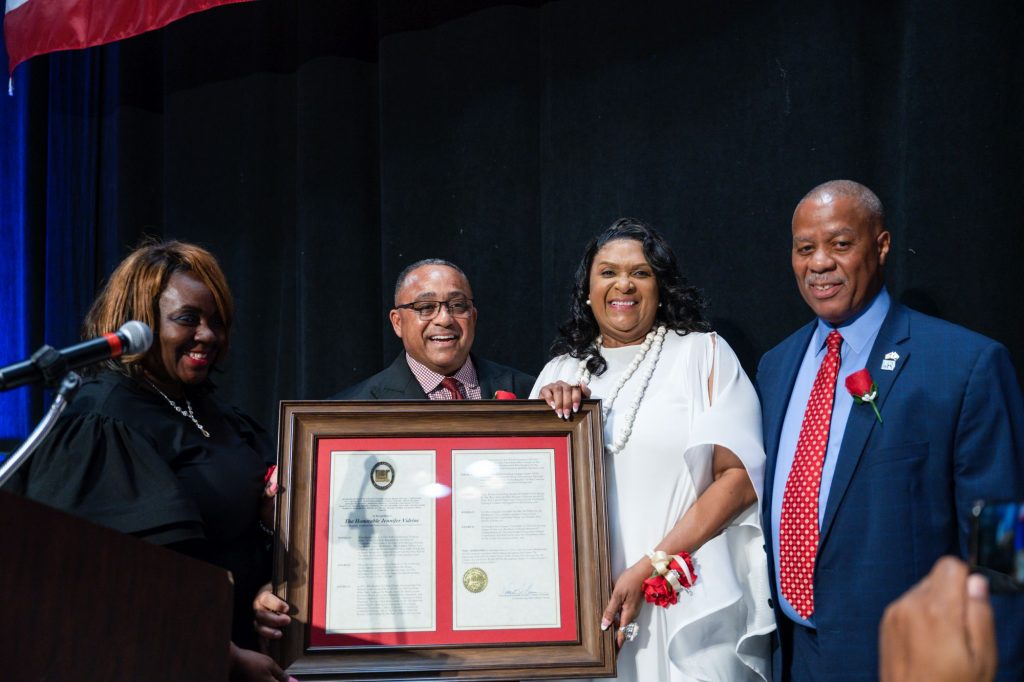
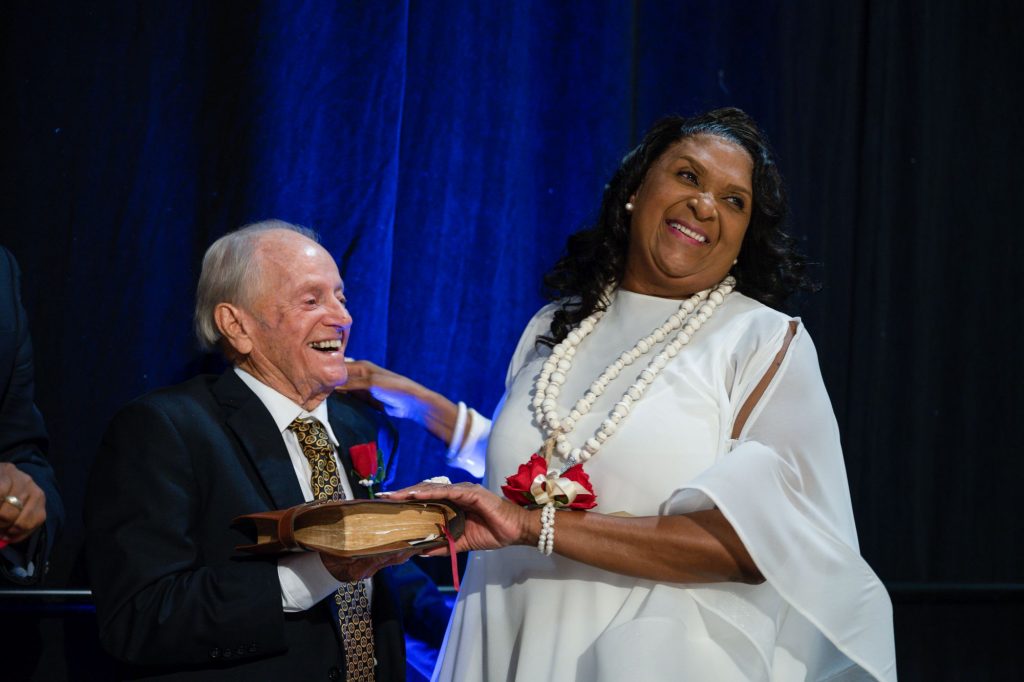
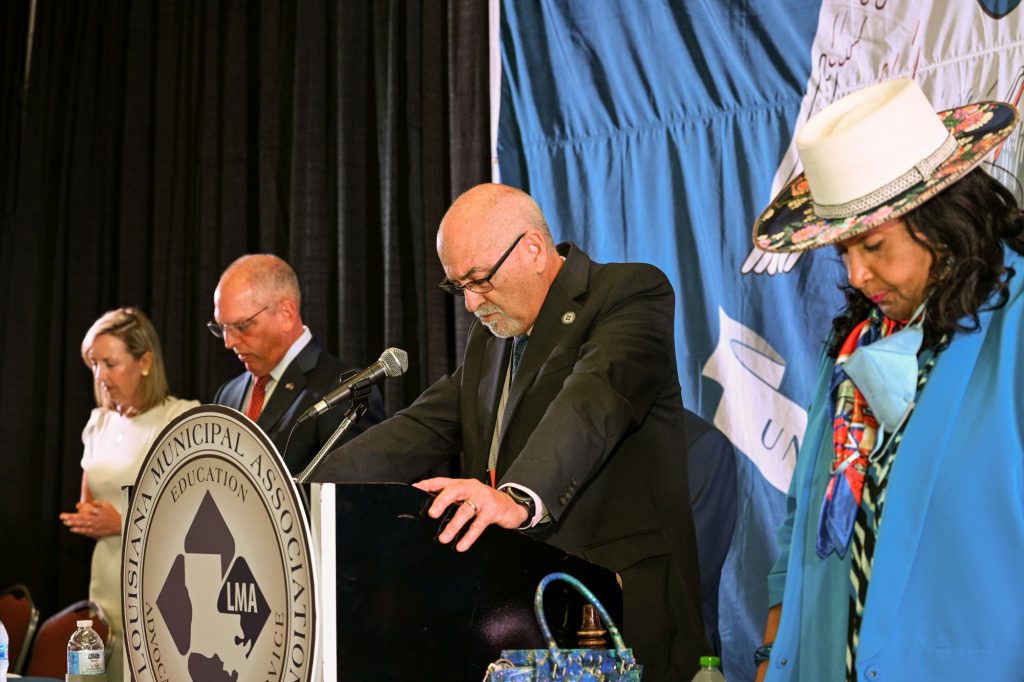
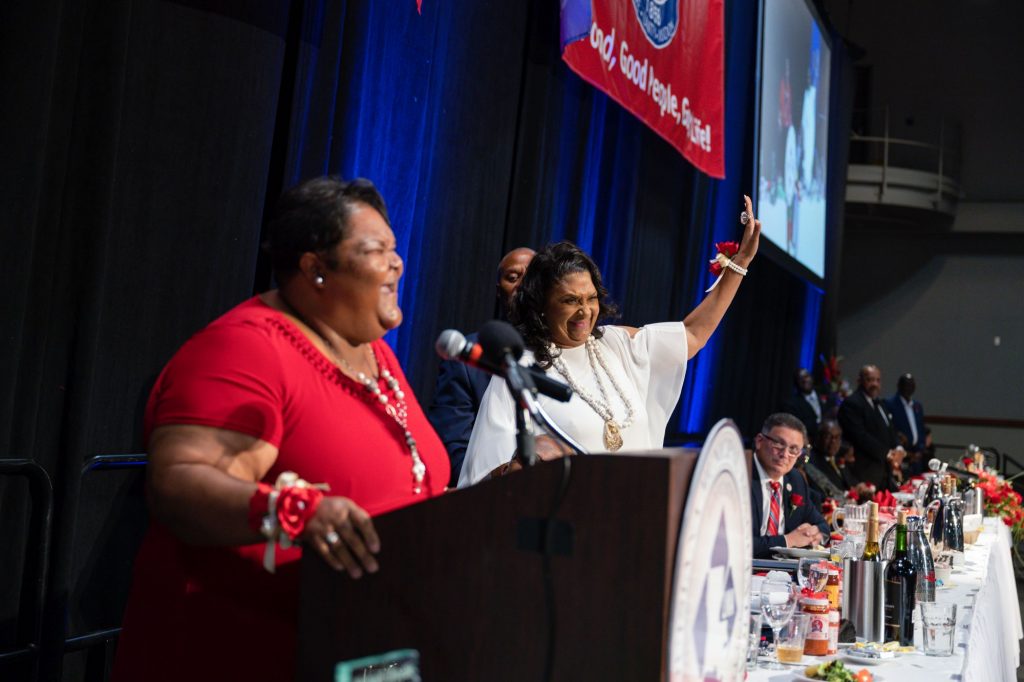
Mayor Vidrine is also the President of the Louisiana Municipal Association (LMA), having been elected in July 2022, and the first African-American woman to hold that office. Highly cognizant of the brutalities of the antebellum South, the nefarious legacy of slavery and Jim Crow, Mayor Vidrine sees herself as standing on the shoulders of giants in her new role. Referencing the egregious suffering and sacrifices of her black forbears, she declaims powerfully:
“Being President of LMA is humbling to me because freedom was not free for us, and it didn’t just happen. I stand here in this position as President of LMA on the backs and in the blood of enslaved people who were beaten and slaughtered and whipped and hung so I could stand here. I stand on the backs of Rosa Parks when she sat down, and Martin King stood up, so I can be President. I stand off the auction block where Black people were sold as property to the highest bidder for a price so I could stand here priceless. And I stand here in this position where Black people were killed, trying to vote. They were killed trying to learn how to read and write. Freedom was not free! The right to vote was not free!”
Her discourse is both so compelling and so elegiac because it is so true. She is painfully aware of the past and its impact on the present: “I know the sacrifices that our ancestors made, so I would have the freedom to be in this position, and that is what humbles me.”
Historically and emotionally literate, with a delivery full of Ciceronian rhetorical flourishes, her words are heartfelt, passionate and brimming with the righteous zeal of those who have been heinously wronged but who also wish to move forward to a better tomorrow.
Other positions and appointments
Given her expertise in developing innovative solutions to the housing crisis, Ms. Vidrine also served as Chairwoman Vice Chairwoman and current Board member for the Louisiana Housing Corporation Board of Directors. In addition, she has also worked with La Municipal Advisory and Technical Services Bureau (Immediate Past President), La Community Development Authority (Board Member), La Municipal Gas Authority (Board Member), La. Municipal Black Caucus (Past President), La Law Enforcement Body Camera Implementation Task Force, Louisiana Asset Management Pool (Board Member) and many other organisations devoted to improving life for the people of Louisiana.
The first of many
Mayor Vidrine was the first Black mayor of Ville Platte and the first woman mayor of Ville Platte. She is the first Black woman from Ville Platte to attend four National Democrat Conventions as a delegate and the first Black woman President of the LA. Municipal Advisory and Technical Services, and the first Black woman president of Ville Platte’s Rotary Club. She is the first Black member of the Ville Platte Rotary Club and the first woman to receive Ville Platte’s Rotarian of the Year award. She is the first Black woman from Ville Platte to be appointed Chair of the Louisiana Housing Corporation and the only mayor from Louisiana selected an E Pluribus Unum Inaugural Fellow. Mayor Vidrine is the first African American woman elected by her peers to serve as First and Second Vice-President and is now the President of the LMA.
What She Would Most Like to be Remembered for
Ultimately, Mayor Vidrine would like to be remembered for caring about the people of Ville Platte – and for caring enough to make their problems her problems.
Three Wishes
When asked what her three wishes would be, her answer is delivered with a mixture of powerfully abstract utopian thinking and an acute awareness of the things that really matter in life. “I would wish that all of the people in Ville Platte would be happy, peaceful, have a comfortable place to live, and have a beautiful city to live in, and all the elderly people would be cared for because we should take care of those who took care of us!”
She continues, re-articulating with passion her belief in the importance of expanding young people’s cultural horizons, “My second wish would be that we would be able to enhance the quality of life for the children (the “Sha Babies”) in small communities to be able to expose them to things that they otherwise would not be exposed to.”
Finally, her ardent belief in humanity and her devout Christian faith coalesce in her third wish – “That God would just keep me the way I am, caring and loving of people because they’re people.”
Her Message to the World
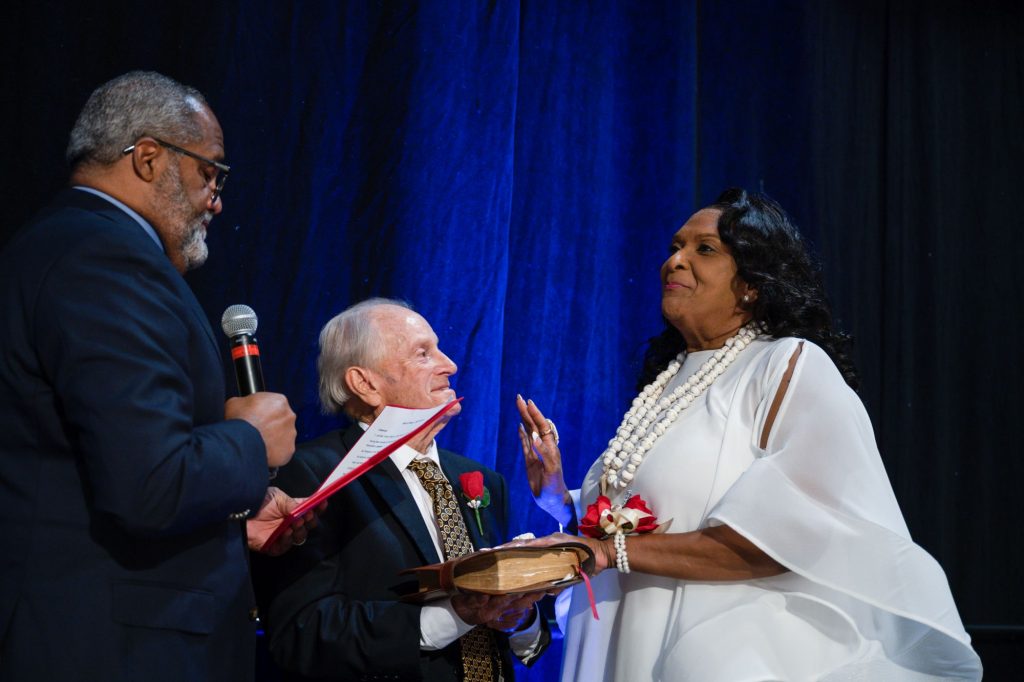
Her “message to the world”, delivered with unimpeachable integrity, is one of civic engagement and choosing to be actively involved in the life of the community. As she says with conviction and ardour, “Get involved. I think your social responsibility to your community would be to get involved, participate, volunteer and help because I believe everybody can do something.”
A strong advocate of greater civic participation and of instilling civic pride in one’s neighbourhood, such as starting with picking up litter in your own street, she exhorts getting involved and simply being part of the local community.
She is also a firm believer in the need for dialogue between citizens and elected officials. She positively encourages the town’s residents to engage with her, to approach her and tell her their ideas – be it at the supermarket, the football game, at church or elsewhere. As her beloved Pop used to warn her, in relation to people coming up and talking to her, “You need to be glad when they want to talk to you. When they don’t want to talk to you, you have a problem.”
Conclusion
Compassionate, empathetic, and keen to listen to others and embrace their common humanity, irrespective of their racial background, whilst asserting her own, Mayor Vidrine is a veritable force of nature, an inspirational tsunami of positivity and a guiding beacon for all Ville Platte’s residents. With her gentle smile, vivacity and quintessentially caring demeanour, she is a galvanising leader whose fervent belief in the efficacy of dialogue and honest communication has achieved so much. But as her beloved Pop used to tell her, in a phrase which has become another of her mantras,
”When you’re doing it out of love, it’s no trouble at all.”
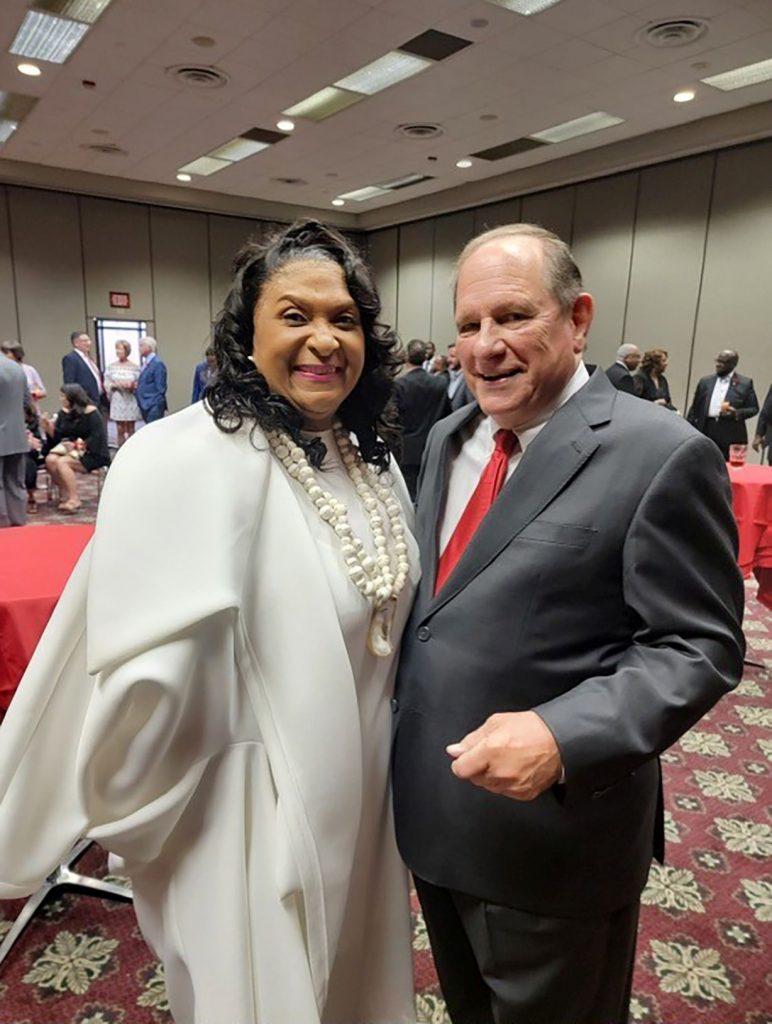
With a colourful sartorial style and a sense of refined yet understated elegance – one she inherited from her mother, Mayor Vidrine cuts a hugely impressive, commanding figure on both the Ville Plate and Louisiana stage, exuding gravitas but also sophistication, control and affability.
For now, Ville Platte remains in resoundingly safe hands – with a dynamic, erudite, strong black woman at the helm – one who is exceedingly solicitous about the welfare of all the inhabitants of her town and about their hopes, dreams, aspirations and the quotidian challenges they face. In short, she is a consummately devoted public servant – and one who sees it as her civic duty to affect positive change and strive to tangibly ameliorate the lives of the residents she represents.
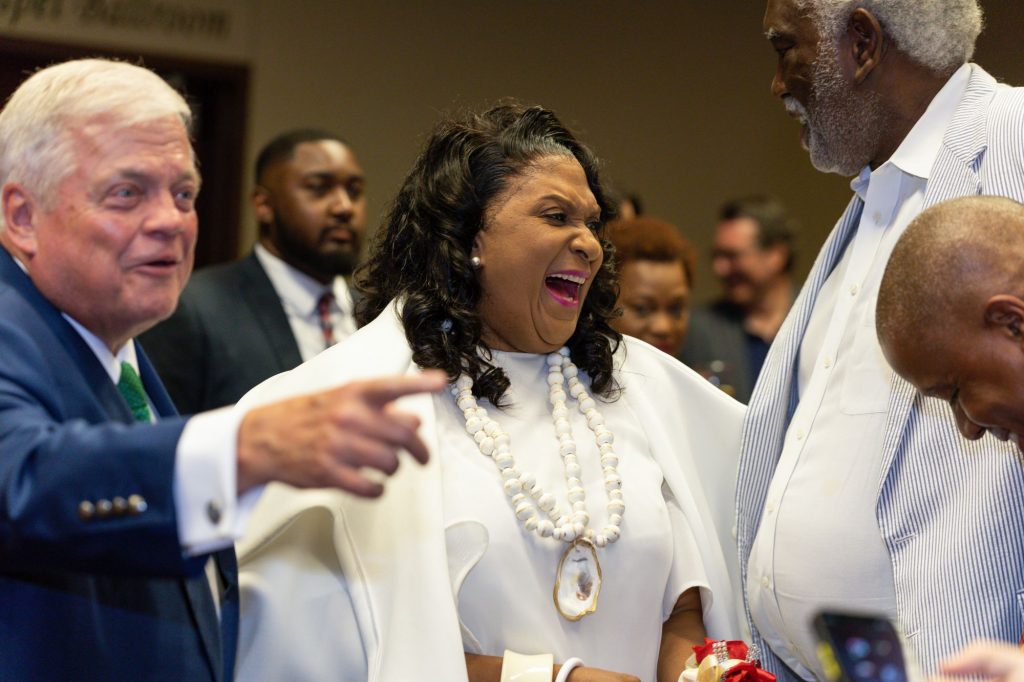
Having received rousing endorsements and accolades from regional and national luminaries such as State Senator Gerald Boudreaux, Baton Rouge Mayor Sharon Weston Broome, New Orleans Mayor LaToya Cantrell, former Mayor of New Orleans and President Joe Biden’s Senior Advisor on Infrastructure Mitch Landrieu, Secretary of State Kyle Ardoin, State Treasurer John Schroder, Lt. Governor Billy Nungesser, incumbent Governor of Louisiana John Bel Edwards, US Congressman Troy Carter, US Senator Bill Cassidy and former basketball player Magic Johnson, Mayor Vidrine evidently captures both the political and the public imagination, with an appeal which effortlessly transcends racial demographics, social boundaries and political affiliations.
As none other than Mahatma Gandhi once said,
“The best way to find yourself is to lose yourself in the service of others.”
His phrase eloquently and succinctly articulates exactly how Jennifer Vidrine found herself and her true calling in life. One is left hoping that the inhabitants of Ville Platte have the good sense to ensure that she is re-elected as Mayor for a fourth term so that her uplifting, edifying and meaningful work can continue unabated.