


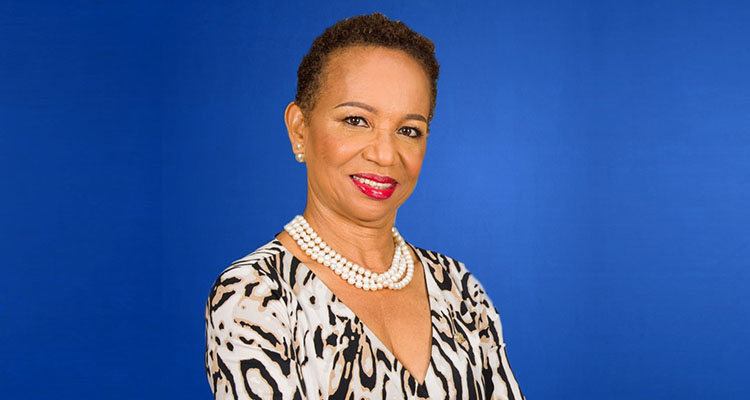
“We feminists have a global solidarity. Nationality does not matter. Our global charge is fostered by and based on mutual respect, friendship and discipline”
The opening response from the woman – a distinguished, feminist academic – who had presented the Devaki Jain lecture in the revered and respected Mary O’Gilvie Lecture Hall of Oxford University, United Kingdom, might surprise some, but would not raise the eyebrows of anyone who knew Violet Eudine Barriteau. Growing up in the Caribbean ‘Spice Island’ of Grenada, she recalls the sense of security, safety, family, community and connection which were the critical characteristics and experiences which influenced and shaped her life. Such beginnings have culminated in her leadership role as Pro-Vice Chancellor and first female Principal of the Cave Hill campus of the University of the West Indies (UWI) in Barbados.
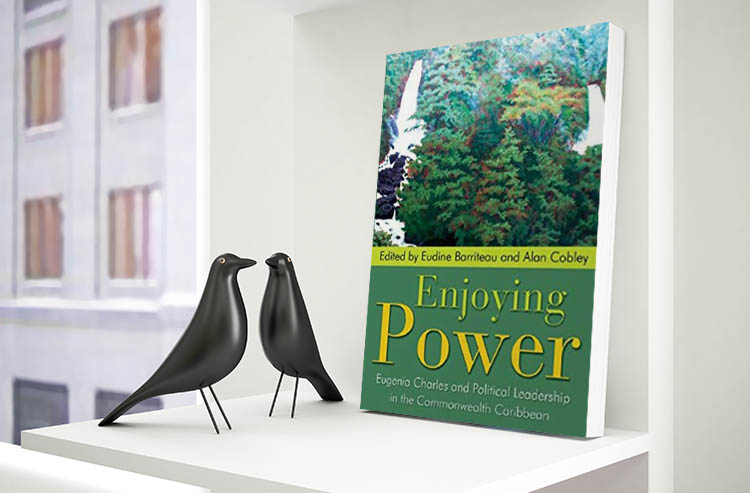
Best known for her seminal role in developing the Centre for Gender and Development Studies at the Cave Hill campus, her greatest satisfaction professionally is derived from starting the Centre in a one-room office with a typist and building this into an entity with post-graduate offerings at Masters and Doctoral level. Through the vehicle of a single project entitled “Caribbean Women: Catalysts for Change”, between 1994 and 2007 the work of the Centre contributed to the growing field of feminist literature and academic research, offering a lecture series, a certificate programme and commissioning studies throughout the Caribbean to explore and deepen understanding of issues of gender and development in Caribbean society. By the time of Barriteau’s promotion to Cave Hill campus principal, two books on outstanding Caribbean women, Dame Nita Barrow of Barbados and Dame Eugenia Charles of Dominica had also been published. She admits:
“Whereas it wasn’t the most lucrative financially nor the most prestigious position, in terms of giving me joy and satisfaction, that position was certainly the most satisfying.”


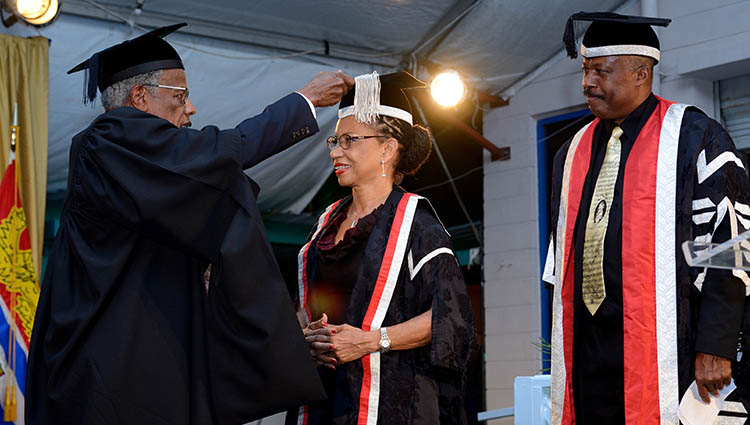
Ceremony to mark Professor Barriteau’s induction as Pro Vice-Chancellor and Principal – December 12, 2015
This dynamic feminist discovered her passion for the subject when pursuing doctoral research in race and class at Howard University in Washington D.C., United States. Taking a course in the philosophy of Social Science, she was to meet the Jewish feminist philosopher and political theorist, Jane Flax, and promptly became her disciple. Recognizing she had reached a major crossroads professionally and that her future academic path would be in the direction of feminist study and research, she concluded her doctoral studies and returned to Barbados, uncertain as to what her professional future would be. When her family asked what she was going to do, she replied:
“I can’t go back to what I did before. I am bored……….and I’ve fallen in love with this discipline.”
In 1992, the University of the West Indies (UWI) was in the early stages of developing its programme in Gender and Development on its main campuses in Jamaica, Trinidad and Tobago and Barbados, spearheaded by Dr Peggy Antrobus, Professor Joycelyn Massiah and Professor Elsa Leo-Rhynie. Barriteau was invited to teach part-time, and warmly welcomed the opportunity to lecture in the field she had come to love. Friends who had known her over many years reminded her of the indications ever since she was a teenager: she would end up working in spheres which supported, developed and empowered women. To one friend, she had even expressed a desire to open a school for women.


“Men at Risk”………. a fiction in the Caribbean?
The dominance of men in positions of power within the UWI and wider society, despite women often being more academically qualified, is indicative of some of the power dynamics still at play in Caribbean society. As the first woman principal of the Cave Hill campus in the 56 years of its establishment, Barriteau in acknowledging that there were many women before her who would have been eligible for the post, and notes:
“There is no guarantee that I will be succeeded by a woman and we’ve certainly never had a Caribbean woman as vice-chancellor, the most senior position in the university governance structure.”
When Professor the Honourable Errol Miller, Jamaican educator, authored and published “Men at Risk” in 1991, he provided persuasive arguments supported by international data, which reflected the extent to which male marginalization had taken place in the United States, the former Soviet Union and the Commonwealth Caribbean. Caribbean feminists responded forcefully to his thesis, pointing out that men were still dominating positions of power and influence at all levels of the society. Certainly there had been a sea change in the number of women seeking a university education and enrolling at the UWI, but this had not prevented men from so doing nor had those men with the same qualifications been prevented from advancing their careers, frequently attaining positions for which women were equally well qualified.
Barriteau warmed to this argument noting that at present male engagement in academic studies was increasingly being outweighed by that of women. However, throughout the 1940s and 1950s when there had not been as many places for women as men in secondary schools, fewer Caribbean women had access to university education. By the 1960s with many of the islands gaining independence and charting progressive education policies, female enrolment at university level expanded and by the 1980s, major change in the ratio of males to females was noted.

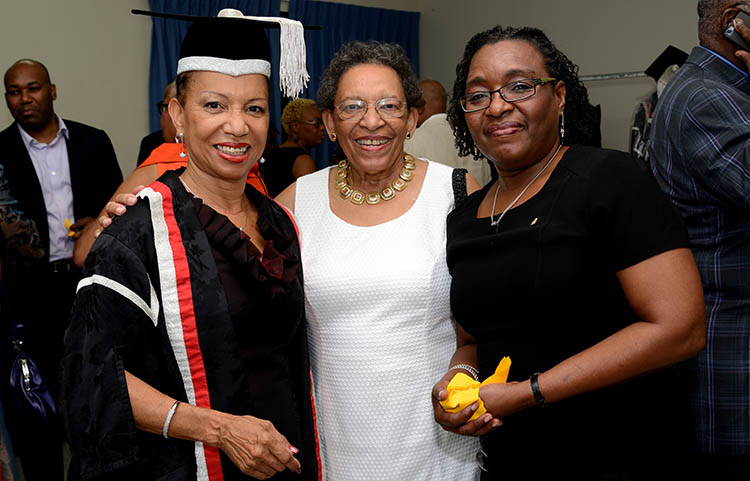
Prof Barriteau pictured with Dr Peggy Antrobus and Prof Rhoda Reddock at her Induction Ceremony, December 12, 2015
Caribbean Women and Power Dynamics
“Women hold up half the heavens” (Ancient Chinese proverb)
Power dynamics are at the heart of unequal relations of gender, economic and class relations. Wherever there is evidence that these inequalities have occurred, it is the distribution of power and who is denied access to power that makes the difference. The notion that women are taking over senior leadership is untrue in Professor Barriteau’s view. From her standpoint, they now have the opportunity to share their knowledge and expertise.
Compared to the women of other countries, Caribbean women are strong and many are forceful and dynamic, and they are not given to taking no for an answer. There are definite similarities between African women who, by and large, are willing to challenge situations in the work context and also go after an education whilst at the same time caring deeply for their families: Husbands, Partners, and Children. Emphasizing that Caribbean women are certainly not shy and retiring, and that the landscape is improving, Barriteau reflects:
“ I would like to see our society more appreciative of the contribution of our Caribbean women.”
An Inspiration and Role Model
Identifying outstanding role models as effective sources of inspiration and encouragement is a practice of many leaders and in this respect Eudine Barriteau is no exception. While for her many Caribbean women have been symbols of women’s advancement and empowerment, there is one who stands head and shoulders above the rest: namely, the late Dame Nita Barrow, former Governor General of Barbados, for whom she has the greatest esteem and unsurpassed admiration.
Through studying the achievements of Dame Nita, Barriteau understood the tenets of leadership: how to organize, how to get things done, achieve results and to do so without fear:
“She was an incredible treasure for the region”
Dame Nita held numerous posts including Barbados Ambassador to the UN, Convener of the Non-Governmental (NGO) Forum in Kenya for the United Nations Second World Conference on Women. She was the first black Matron of the University Hospital in Jamaica when the island was still a British colony and was engaged in citizen diplomacy long before it became a popular term. She was appointed head of the World Young Women’s Christian Association (YWCA) and went to Lebanon in the 1950s to try to bring Israeli and Arab women together, a courageous initiative. She was the first Barbadian governor-general to allow primary school children to visit Government House as previously this would have been an honour reserved for the chosen few. Following her death in 1995, a lecture series was established in her name by the UWI and the Cave Hill centre renamed the Centre for Gender and Development Studies: Nita Barrow Unit.
There are other outstanding Caribbean women whose contributions have influenced and impacted Eudine Barriteau’s career: Professor Joycelin Massiah, Professor Emerita Elsa Leo-Rhynie and Dr. Peggy Antrobus are some examples. Of the three, she singles out Elsa Leo-Rhynie who was the UWIs first professor for Gender and Development studies as a remarkable leader who practiced grace under fire, noting that she was always well prepared, well organised and brilliant. Peggy Antrobus she credits as outstanding and fearless as a feminist Caribbean activist.


Professor Barriteau Awarded the Gold Crown of Merit by the Government of Barbados on November 30, 2013
Global Feminism and the significance of the Devaki Jain lecture:
When probed about the significance of her lecture at Oxford University, Barriteau refers to the solidarity that is demonstrated by women who are feminists across the globe:
“We feminists have a global solidarity. Nationality does not matter. Our global charge is fostered by and based on mutual respect, friendship and discipline.”
The significance of the Oxford lecture is in demonstrating to the black British and to the Oxford population what kind of solidarity exists among women calling themselves feminists. Sensing this potential, by taking up the invitation and honour, she demonstrated the international reach of Caribbean feminist scholarship by presenting a lecture to honour an Asian feminist economist.

Her Swan Song or………….undertaking new challenges?
In speaking of her impending retirement in 2020, Eudine Barriteau makes it clear that this will simply be a time to re-energize and move on to new theatres of activism:
“I have a love for politics and am fascinated by power, so would like to be involved in electoral observation, both at the Commonwealth and OAS levels.”
Planning to undertake more research to focus on Caribbean feminism, she is keen to look deeply at another remarkable and accomplished Caribbean feminist, Dr. Lucille Mathurin-Mair, whose early doctoral thesis charted the beginning of a feminist theory of the Caribbean woman’s reality. Asked about her own greatest achievement, this vibrant feminist and academic leader admits that it is her only son that she considers her finest achievement. Wishing that she had more children, she admits that she could never have ‘had it all’ if she had a large family. Instead, she has made her students her family:
“I have tried to ensure that I open doors to young women and men that pass through the university, for the grace of God.”