


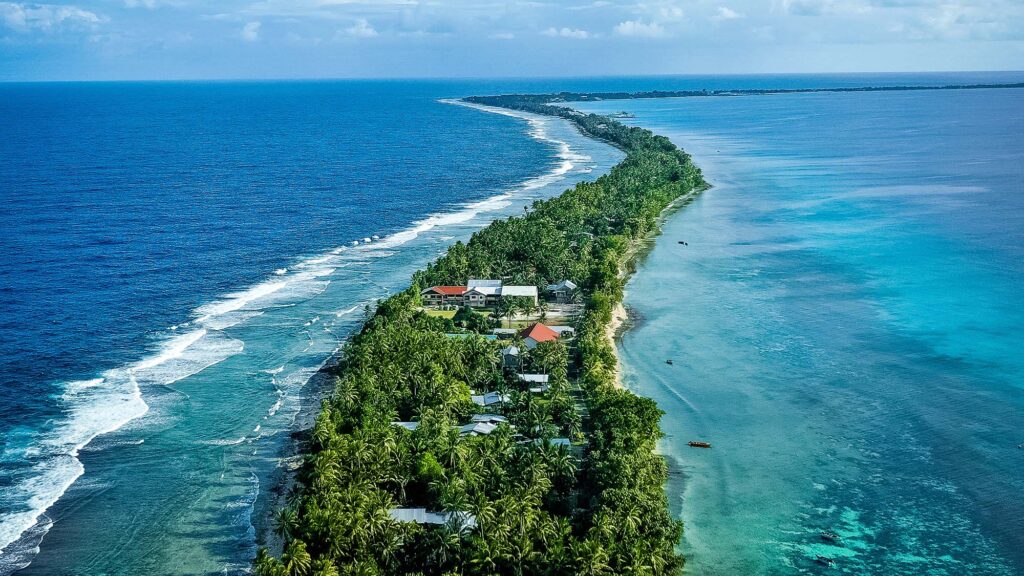
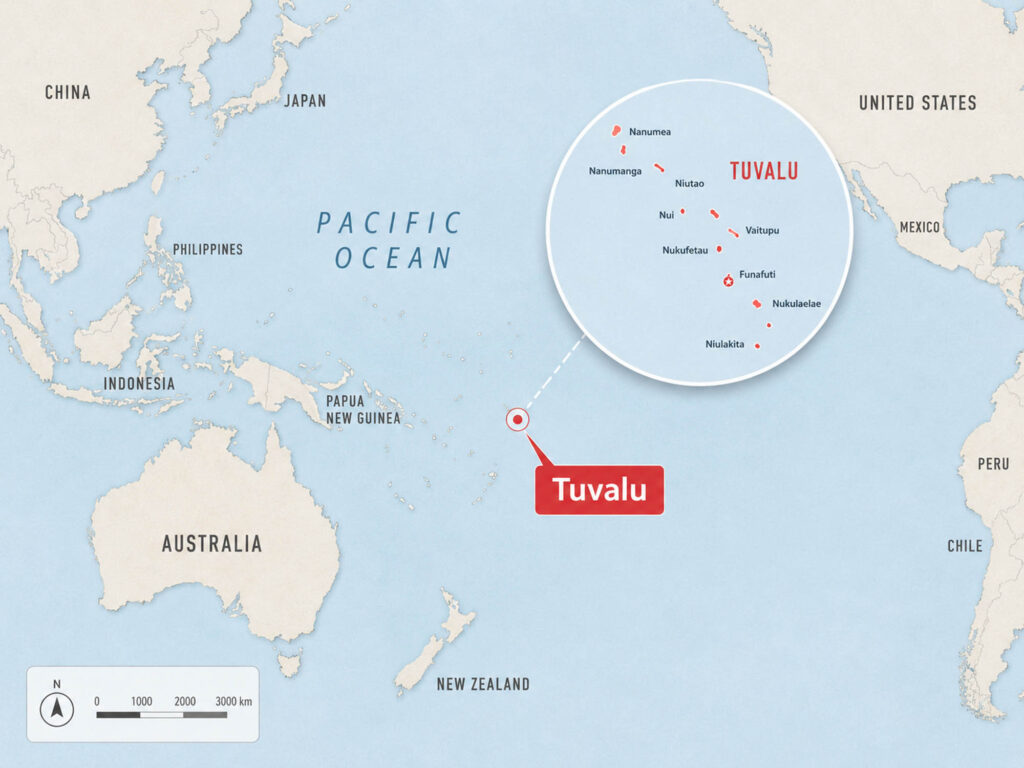
Somewhere between Hawaii and Australia, where the Pacific stretches so wide it seems to forget the rest of the world exists, nine slivers of coral rise barely above the waterline. This is Tuvalu, a nation so slender in places that a person standing at its centre can watch the ocean break on one side and the lagoon lie still as glass on the other, all within the same unhurried glance. There are no towering resorts here, no beach bars competing for attention, no queues forming for the next attraction. What Tuvalu offers instead is something increasingly rare in modern travel, an honest and unpolished window into Pacific island life, lived exactly as it has been for generations.
Somewhere between Hawaii and Australia, where the Pacific stretches so wide it seems to forget the rest of the world exists, nine slivers of coral rise barely above the waterline. This is Tuvalu, a nation so slender in places that a person standing at its centre can watch the ocean break on one side and the lagoon lie still as glass on the other, all within the same unhurried glance. There are no towering resorts here, no beach bars competing for attention, no queues forming for the next attraction. What Tuvalu offers instead is something increasingly rare in modern travel: an honest, unpolished window into Pacific island life, lived exactly as it has been for generations.
For travellers who have grown weary of destinations built entirely around tourism, Tuvalu presents a different kind of invitation. It is a country of roughly eleven thousand people, one runway, and a rhythm of life shaped by tide, weather and community rather than schedules or spectacle. Reaching it takes commitment. Staying there takes patience. But for those willing to make the journey, the reward is a rare kind of authenticity, the sense of having arrived somewhere the modern world has not yet reshaped.
A Nation Shaped by the Sea
Tuvalu is scattered across the Pacific like stepping stones flung across blue water, its nine islands and atolls linked more by history and language than by any road or bridge. Funafuti, the capital, doubles as the country’s main hub for travel and administration, while Fongafale, its narrow main islet, is so thin in places that ocean and lagoon appear to meet in a single frame, separated only by a strip of coral gravel and a line of coconut palms.
Nowhere in Tuvalu rises much above six metres above sea level. That flatness does something unexpected to the light, giving it a hard, reflective quality that makes the sky feel enormous and the sea feel impossibly close. Everything here happens near water. Fishing boats rest on the sand within sight of front doors. Children swim within earshot of church services. The maneapa, the open sided community hall found on every island, sits at the centre of it all, hosting weddings, council meetings and celebrations, and offering visitors one of the clearest windows into how a small, tightly bound society organises its formal and informal life alike.
Life moves to its own logic here, dictated less by clocks than by the tide, the weather and the needs of the community. It is a place where the boundary between the everyday and the ceremonial is thin, and where a visitor who slows down enough to notice will find as much meaning in an ordinary afternoon as in any planned excursion.


Getting There: The Journey Is Part of the Adventure
There is only one practical way into Tuvalu, and it is by air. Fiji Airways operates a handful of propeller flights each week from Suva, occasionally from Nadi, with an additional weekly service on Air Kiribati connecting through Tarawa. The flight from Fiji takes just under three hours, tracing a route across open ocean with barely a scrap of land in sight until Funafuti appears, a thin green thread on the horizon that seems to grow no wider as the plane descends.
Seats on these small aircraft are limited, and demand can spike sharply around public holidays, government business or international conferences, so early booking is not a suggestion but a necessity. Many travellers plan for a short buffer on either side of their trip, since schedules can shift with weather and logistics in ways that reward flexibility over rigid itineraries.
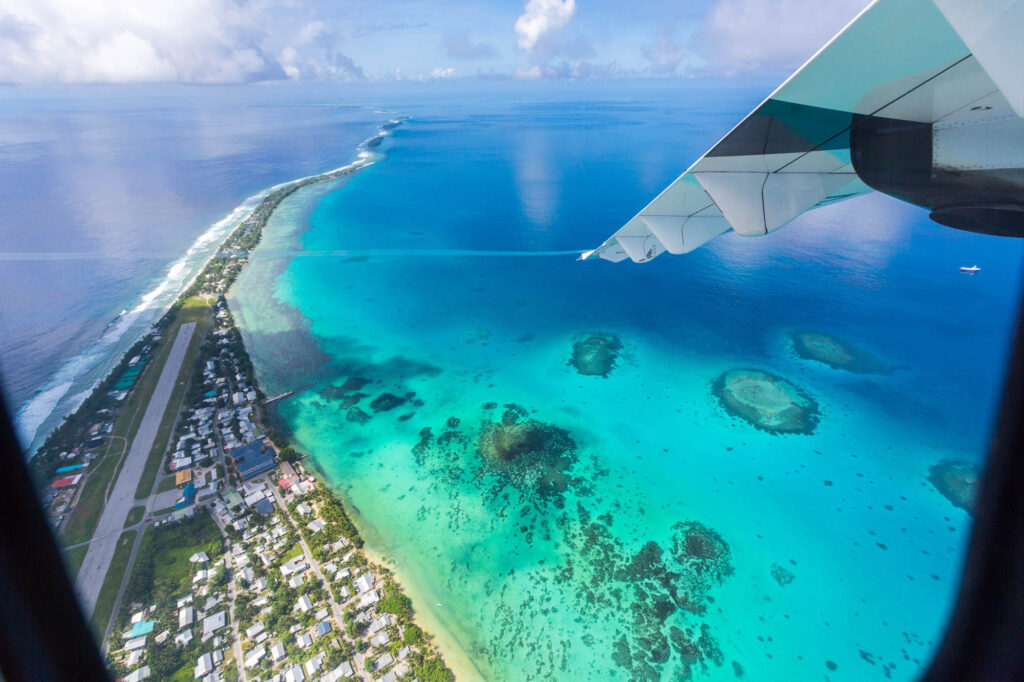
Once on the ground, the pace changes almost instantly. The airstrip itself becomes the island’s unlikely social centre. Twice a day it clears for scheduled arrivals and departures, and for the remaining hours it transforms into:
- A pitch for volleyball and football matches between neighbouring families
- A stretch of tarmac for evening walks, bicycle rides and unhurried motorbike cruising
- A gathering point at sunset, when much of Fongafale seems to spill out onto the runway to watch the sky change colour over the lagoon
Few sights capture the character of Tuvalu quite like this one, a working international airstrip that doubles, without irony, as the town square.
Where to Stay: Simple, Warm and Close to Everything
Tuvalu is not a country of resort chains or beachfront towers, and that absence is very much part of its charm. Accommodation is limited to a small handful of guesthouses and family run lodges on Funafuti, most of them clustered around Vaiaku, within easy walking distance of the airport, the government offices and the town’s few shops and amenities.
Rooms tend to be comfortable rather than luxurious, simply furnished and often just steps from the lagoon. What they lack in polish, hosts more than make up for in warmth and local knowledge, offering guidance on boat transfers to the outer islets, the best days to visit the market, or which stretch of reef is calmest for swimming that week. Because choices are so limited, and because many properties do not appear on conventional booking platforms, arranging accommodation well in advance, often through a direct email rather than an app, is essential rather than optional.

Culture on Display
Tuvaluan culture rarely performs for an audience. It reveals itself instead through everyday encounters, small gestures and unhurried conversation. Visitors who take the time to look will find:
- The maneapa, where formal community life, celebration and ceremony unfold much as they always have
- The Tuvalu Women’s Handicraft Centre, showcasing finely woven pandanus mats, shell ornaments and other traditional crafts made by hand
- The Philatelic Bureau, home to Tuvalu’s much loved postage stamps, collected by enthusiasts around the world and sold here alongside a quiet source of national pride
- Vaiaku Market, a modest but lively gathering of fresh fish, garden produce and handwoven goods, where fishermen and market women trade the day’s catch and news in equal measure
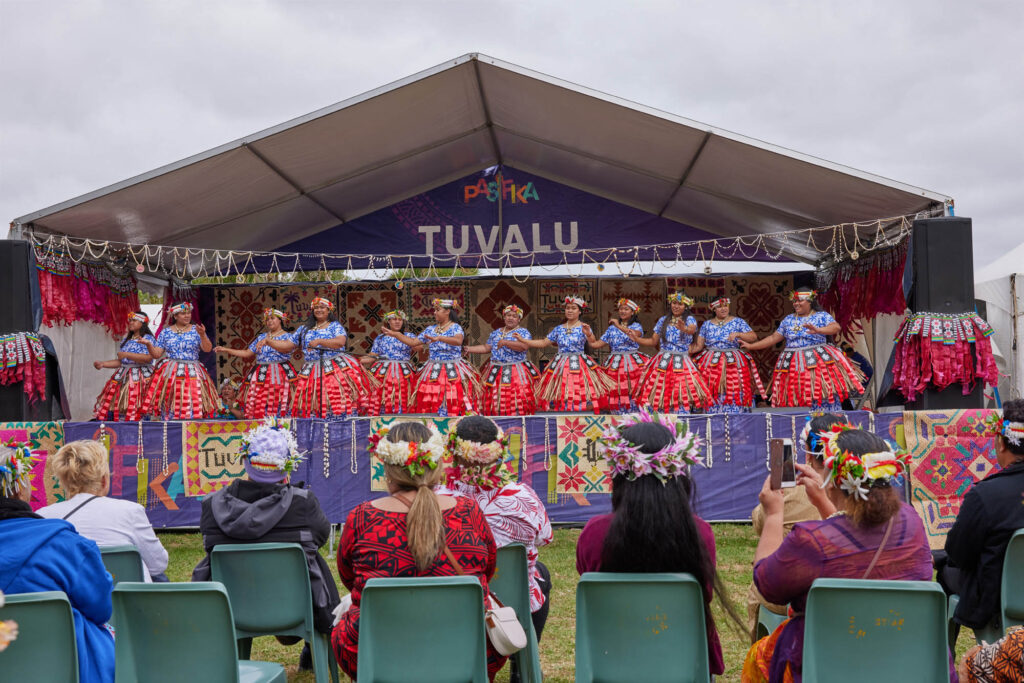
- Traditional dance and song, performed at the maneapa during festivals and community gatherings, carrying rhythms and stories passed down through generations
A simple greeting in Tuvaluan goes further here than almost anywhere else. Talofa for hello and faafetai for thank you are small offerings that tend to be met with genuine warmth, opening doors to conversation that a phrasebook alone never could.
Beneath the Surface
The waters surrounding Tuvalu are every bit as compelling as the islands themselves. The Funafuti Marine Conservation Area, tucked along the atoll’s western edge, protects some of the country’s richest reef systems, a mosaic of coral gardens largely undisturbed by mass tourism and rich with turtles, reef sharks and shoals of colour that dart through water so clear it barely seems to separate air from sea.
Snorkelling and diving here feel intimate rather than curated, offering a quieter alternative to the busier, more heavily trafficked reefs found elsewhere in the Pacific. History enthusiasts will find their own reward beneath the waves and along the shoreline, where wartime wrecks and bunkers from the Second World War lie scattered across Fongafale and several of the outer islands, weathered reminders of a distant chapter still visible in the coral and rusted steel.
A Country Worth Understanding
Travel to Tuvalu carries a dimension that few destinations share so openly. As one of the nations most exposed to rising sea levels, its relationship with the surrounding ocean is not an abstract talking point but a daily reality, woven into conversation, policy and the rhythm of island life itself. Visitors who approach these realities with curiosity and humility, listening more than commenting, tend to come away with a far richer understanding of the place and the resilience of its people.
It is this openness, rather than any single attraction, that leaves the deepest impression on those who make the journey.

Why Tuvalu Belongs on Your Travel List
Tuvalu will never compete with its Pacific neighbours on scale, infrastructure or polish, and it does not try to. What it offers instead is something increasingly difficult to find anywhere in the world: a nation still living at its own pace, generous with its welcome, unhurried in its rhythms and entirely unpolished in the best possible sense.
For travellers seeking a beach holiday with every comfort accounted for in advance, Tuvalu is not the answer, and it would not claim to be. But for those seeking something rarer, a genuine, low key encounter with Pacific island life, a place where the international airport runway doubles as the town square and the reef remains largely untouched, Tuvalu may be one of the most rewarding journeys left in the region, and one that stays with a traveller long after the return flight home.