
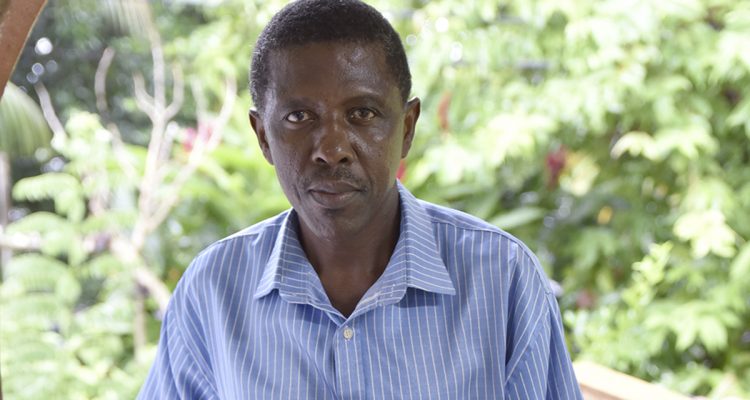
Donatien Fréminot found his way to art through his Chinese mentor and loves to represent Seychelles across the globe. However, the true heart of his work lies in the humble coco de mer.
Blending both inspiration and materials from your own natural environment can help one to produce truly meaningful pieces of art. No one does this better than Donatien Fréminot.
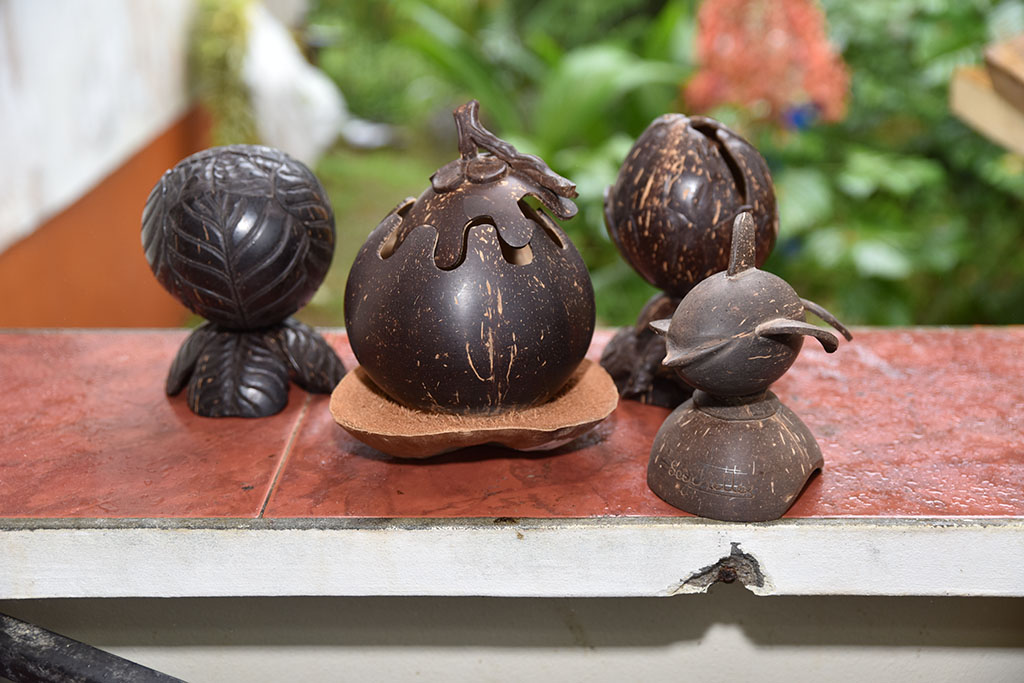
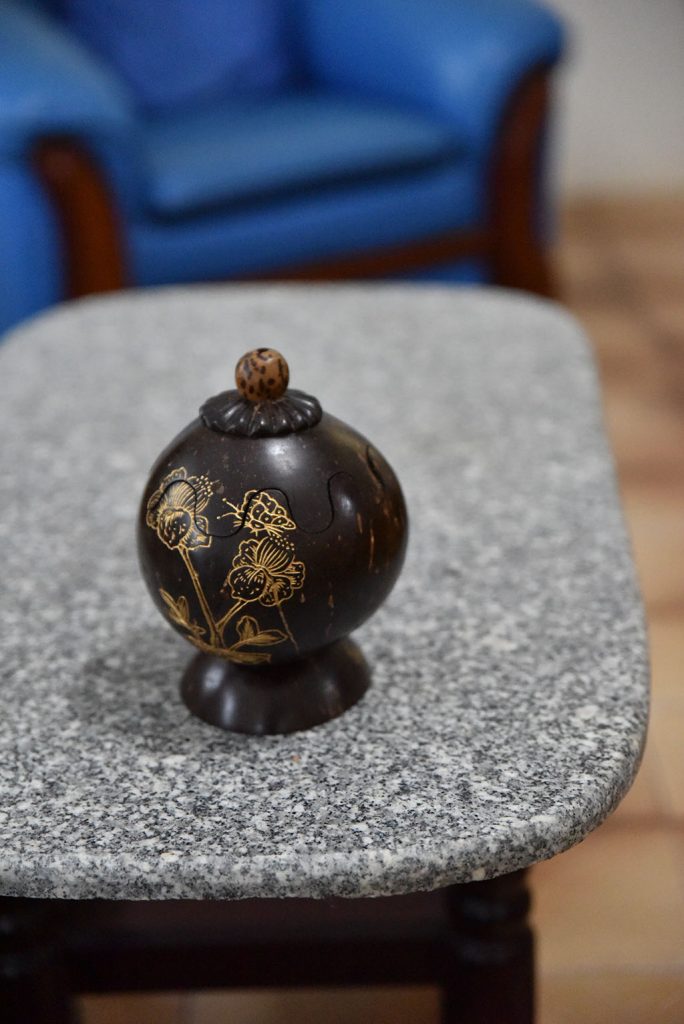
This native of the Seychelles crafts beautiful sculptures from various types of the source material but is best known for carving things of beauty from coconut shells.
In fact, he often uses the humble coco de mer, also known as a sea coconut, in his work, and which can be readily found on the islands of Praslin and Curieuse in Seychelles.
His creative skills and infinite patience for his chosen medium have led him to travel internationally to represent his home country. He was also one of three artists who featured in the ‘Eden’ coconut carving and craft exhibition at the Domaine de Val des Près, Au Cap.
So, where does such a talent originate, and how did 55-year-old Donatien Fréminot discover and perfect his specialism?

Discovering art in a coconut shell
Donatien Fréminot’s prestigious art career began when he was around 16 or 17 and attending secondary school. His family were connected to performing arts, but not to any of the visual arts. One of the study options offered to students at his school was ‘craft’. He explained: “For me, it was the first time I had heard that phrase. So, I chose craft just to explore.”
Experimentation with various materials eventually brought him to work with a coconut shell. Donatien explains: “With the coconut craft, I remember first it was an ashtray. An ashtray. Our teacher, Mr Lin, showed us how to manipulate a piece of coconut shell. A cup size. How to manipulate it to turn it into a useful item.”
An art form perfected by the Chinese
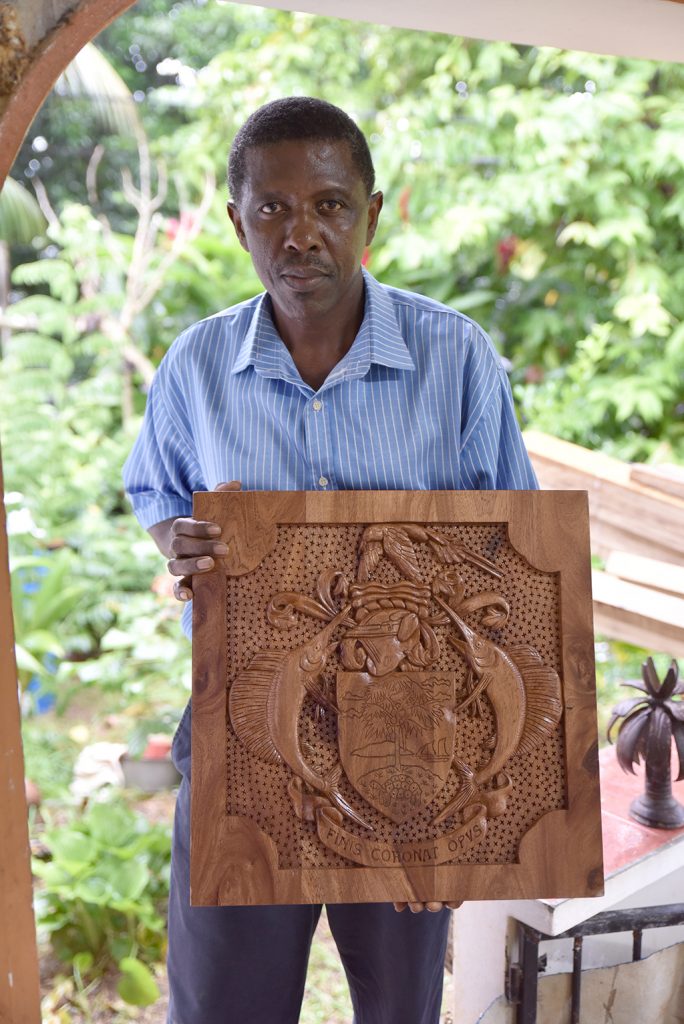
Mr Lin proved to be a pivotal figure in the evolution of this Seychellois artist. Donatien elucidated: “My teacher came from Hainan, China. He taught me how to manipulate this particular substance. Carving and sculpture. It has been almost 38 years ago. I was inspired by him. Due to his skills and knowledge; and also how he could manipulate the medium and the way he helped me to create. To create and to innovate ideas in our surroundings.”
This connection with China, first established under the tuition of Mr Lin, was inspired travel to that country in later life, to perfect his art. In fact, Donatien has visited China twice, including spending time in Hainan.
“I was in Hainan, Haikou, a southern province of China. I spent one month to extend my knowledge and skill in various methods. It was also to see how they use the particular material.” Fréminot adds: “It’s one of the main economic products for the island. It has vast and great industries of coconut carving and they do mass production of coconut artefacts.”
The artist was clearly impressed with the way the Chinese used every part of a coconut for some purpose or another – with no waste at all.
“It was very, very interesting and I obtained a great experience to see and to learn how versatile the coconut is.”

A labour of love
Though he carves stunning pieces of art in bamboo and wood, it is clear that the coconut is what truly challenges and inspires Donatien Fréminot.
So much so, that he has been known to labour for up to six months to perfect a piece.
“In the 38 years in my career, I have completed only two of these masterpieces. Because it drains you a lot. Throughout six months you have to think a lot. You are so much expressing your inner self.”
One such piece was a black parrot lovingly created from coco de mer in remembrance of Mr Lin, his secondary school teacher. The choice of motif was also a celebration of his homeland, as the black parrot is indigenous to Seychelles.
“There were various themes I could make, I consider a range of ideas, and then I choose one. I chose that black parrot. I could have chosen other birds, or even other animals or something completely different, but I chose the parrot, the black parrot, to make it unique.”
How does such a stunning and detailed art piece come from a coconut shell?
“I made a lot of research into how the feathers would be. When to do the carving in the convex and the concave. How to manipulate these feathers in the ups and downs, which are underneath the others. So, it’s a challenge. Personally, I always want to pursue the challenge. Fight through the barriers, try to break down barriers and to go further. This is why I have reached that level today.”

Passing on his skills and passion
Where has his talent taken Donatien Fréminot?
As mentioned, he has travelled abroad to represent his country at art-related events, including trips to Paris (for the Salon Mondiale du Tourisme), Algeria, Botswana, and India (for the Surajkund International Craft Melai in Haryana).
However, this gifted artist does not spend all of his days in his studio or exhibiting his work. His desire to pass on what he has learnt has led to a part-time teaching post, guiding a new generation of art students at the Seychelles Institute of Art & Design (SIAD).
The value of drawing ideas and materials from nature is clearly one of the things he most wants to hand on, particularly as it makes art a much cheaper option compared to buying expensive resources.
Donatien explains: “I’ve been teaching them how to express my experience, especially knowledge about the usefulness of the resources, which is in abundance, in our environment.”
It is also something he discussed in detail with a friend who visited him recently.
“Imagine you have coconut shell wood. Different varieties of palm seeds. These exist naturally in the environment. The only thing that we have to do, is just to innovate ideas, how to create something with it. And my friend told me, this is why China nowadays is one of the first nations, economically worldwide, because they always use what is around in their surroundings.”
Donation Fréminot concludes: “As an artist, you must be always thinking forward, have a vision. When you see you’ve got maybe a piece of wood or a bit of shell in the environment, try to imagine what purpose, or what such useful things or artefact, you can make.”