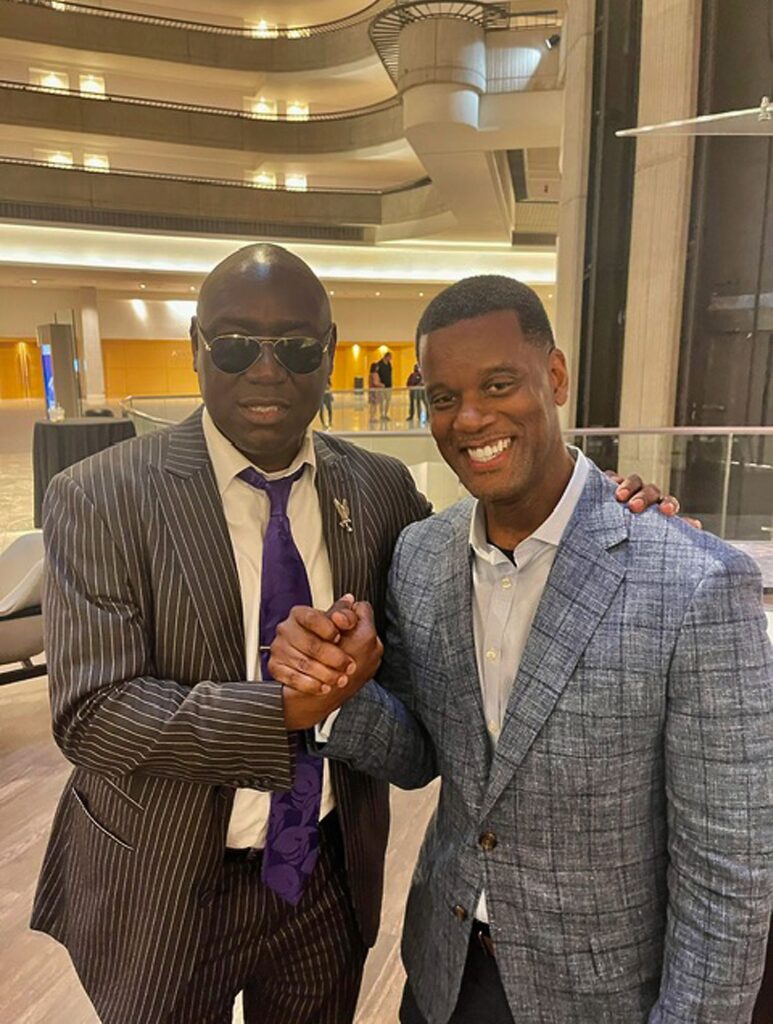
Ron Austin exemplifies the profound impact a dedicated attorney can have on their community. Known for his geniality, intelligence, and drive, Austin stands out in the Crescent City as a principled and courageous legal professional. Raised with strong values in Jefferson Parish, his career spans from groundbreaking legal victories to heartfelt community service, embodying the true spirit of justice and compassion.
Ron Austin is a testament to an attorney’s positive impact on their community. As a principled, dignified, and courageous New Orleans-based attorney, he exemplifies the very best of the legal profession.
His warmth, intellect, and determination make him a distinguished figure in the Crescent City. From the moment you meet him, it’s clear that he commands respect and admiration. Austin’s exceptional qualities highlight the invaluable role a dedicated lawyer can play in advocating for justice and making a difference in people’s lives.
Impeccably attired in a well-fitting, dark blue suit, this self-proclaimed Son of New Orleans is every inch the conscientious and crusading legal eagle – injury and mass torts lawyer of the highest calibre, standing and repute. He is also someone for whom serving his community daily, both professionally and personally, is of seminal importance. Austin steadfastly seeks to put people before profit, perennially mindful of the unpublicised, tangible impact of complex human emotions behind the high-profile cases he often represents.
Upbringing
Born and raised in Jefferson Parish, Louisiana, to a Creole mother and an African-American father, Austin benefited from an essentially principle-oriented, loving and stable childhood. Recounting his Creole lineage with pride and self-awareness, he explains, “My mother’s grandfather was a white man. He had a child with a black woman, and the black family essentially raised my grandfather. He married my grandmother, and they had 13 children.”
Detailing his father’s genealogy and slightly more quixotic journey to Louisiana – itself indicative of the egregious racism which black people routinely faced in the south, Austin is both forthright and unapologetic: “My father’s people came from Alabama. My father’s grandfather was running from a lynch mob after getting into trouble with the local whites, snuck out of Alabama and came to South Louisiana.”
By his admission, with his father a schoolteacher and his mother a nurse, Austin grew up “somewhat middle class.” Despite the lack of want, which can often (but did not in this case) breed complacency, his upbringing was shaped by solid parental discipline. With a knowing smile, he recalls childhood scoldings through an appreciative adult lens, “My parents were tough, no-nonsense parents. My mother would say, “I’m telling you now, don’t do wrong because I’m going to call the police for you after I whip you.” His mother, an introvert, was someone “who you’re going to toe the line with.” As a result, he confides with an enigmatic smile, “You did not screw up.”
Austin’s old school upbringing crucially gave him the stability he needed to thrive academically at school and the moral compass that still guides him.
His Mother, the Disciplinarian
Austin was blessed with a formidable, authoritarian mother – and someone who would take no prisoners or accept any foolishness from her children. His mother’s loving yet draconian discipline was perhaps best exemplified when she made his younger brother leave home at the age of 19 for not working.
As he relates it, “My mother told my brother, “Son, you must find a job. No man can stay in my house who’s not in school and not working.” My mother was a nurse, so the first day she woke him up, it was five am. “ Get out! I’m on my way to work. You’re not going to lay in a bed when I’m going to work.”
Yet Austin’s younger brother – now a successful river pilot – inordinately benefitted from his mother’s “tough love” parenting stance, and as Austin says, “To this day, he will tell you, “That’s the best thing that ever happened to me, mother putting me out.”
Austin recounts this incident to illustrate that “My mother toed the line. She didn’t play. “Here are my rules, and either you’re going to follow them or not.” So you knew the consequences of not following her rules. And that’s just the house we were raised in – we absolutely loved it.”
Austin is also enormously grateful to his parents for the lack of pressure they applied, letting him and his siblings move through adolescence at their own pace. Laughing, he says without regret, “They probably should have pushed us harder educationally, but they didn’t. My father would say, “Just do the best you can.” Judging by his exceptional career success, Austin heeded his father’s advice and directly gained from such a laissez-faire parenting philosophy.

Importance of His Father
The influence of Austin’s father during his upbringing was nothing short of gargantuan, and his son speaks of him in glowing almost hagiographic terms. As he explains fondly, “My father was full of life. He was a teacher and a community guy. My father will tell you that all he ever wanted to do in life was to be a dad.”
He continues with an effervescent pride, keen to explain what else he inherited from his paternal side. “My father, Tommy Austin, was the first black real estate man in Jefferson Parish. So my siblings and I grew up with a strong sense of entrepreneurship.”
Sense of Community
Austin’s upbringing also engendered in him a strong sense of community, something he is to this day both cognisant of and very grateful for, as it has evidently moulded his outlook on life and indelibly shaped, if not defined, his worldview. As he says with gratitude for the values his parents inculcated in him, “We grew up with a feeling of responsibility towards our community.”
Then, detailing how hard his dad’s generation had it and some of the daily struggles he had to endure, he continues, “My father fought for everything he ever received in life. When he was a kid, like most black people at that time, he had to walk to school and fought his way through.”
Austin then comments on his own journey to school in a tone devoid of rancour or bitterness, phlegmatic and stoic. “When we went to school, we had to walk to school and had to encounter some of the same things he did. We had to fight the white people to get to school. We had to fight the whites to come home from school. Coming up in the early 1970s, it was just part of the layover from the 1960s.”
Austin’s paternal reverence is deeply touching, and his candour about how his father’s community-spirited actions have rubbed off on him is both instructive, illuminating, and humbling. “My father was a man of the community. My BFF (best friend forever) has always been my father. He’s my role model. I followed him, so I learned from him. And so he always gave back to the community, which put the onus on us.”
He continues, assessing his family’s comparative affluence and his father’s laudable and intrinsically noble desire to not move out of the neighbourhood but remain a positive role model, “We probably had the means to move out of the community in which I was raised, which was a predominantly black community, into a middle-class neighbourhood. But my father refused because he said that we were responsible for providing role models for the rest of the community.”
He then gives a poignant, funny example. “So my mother would say, “Where’s that new coat I just bought?” And then my father would go quiet and go run to the office. My mother would be looking around. He had given our stuff away because others just didn’t have enough.”
As Austin talks, recalling the halcyon days of his childhood, it is evident that his family home was a place of unbridled joy, manifold kindness and sharing with those who were less fortunate – an avowedly humanistic ethos which to this day thoroughly imbues Austin’s professional work.
Another anecdote Austin lovingly tells to illustrate his father’s generosity and selflessness is of him going to the market in the French Quarter. “Back when we grew up, it was a true market. So when we went, most people, let’s say, if they were going to buy a watermelon, they would buy one or two watermelons for their home. My father would buy 15 or 20 watermelons. When asked, ”Are you selling watermelons?” he’d reply, “No, that’s for my family and all of their friends.”
Austin’s family home was always welcoming and, with such an open-door policy, both a magnet and a haven for friends. As he recalls fondly, the warmth evident in his voice at the memory, “We just had one of those homes where our friends just knew, whether it was the 4th of July or a New Year’s Eve celebration, there would always be something to eat, and somewhere to hang out, so they just came to our house.”
Thus, from an early age, Austin explains, “we were taught the value and the responsibility of community, which sticks with me to this day.” And it was in such an environment that Austin flourished.

Work Ethic and Business Acumen
Austin’s prodigious work ethic, business acumen, and ability to make a financial profit have been evidenced since childhood. Reminiscing about his precocious teenage entrepreneurial zeal, he says with a good-natured chuckle, “Growing up, I had a paper route when I was 10, 11 or 12. I understood the importance of math early on, so I figured out how to make money. I hired my friends to work for me. I had to pay my older brother to drive the truck because I wasn’t old enough to drive so I could disperse my papers. Believe it or not, I was probably making as much as a paper boy at 12 or 13 as my father was as a school teacher. But it just was the beginning of a business model.”
Acknowledging his innate ability and talent with business, he blithely states, “I’ve always had an eye for turning a dime. I can quickly look at most situations and understand where the opportunity money is.”
Education
As one of only three black students at his high school out of a class of about 100, Austin understood what it meant to be in – and crucially, how to successfully navigate – a practically all-white space from an early age. As he explains, fortunately, his strong self of self, coupled with an abundance of self-esteem, gave him a firm grounding: “Luckily for me, I understood who and what I was.”
At high school, just like his brothers, Austen’s athletic prowess was evident, and he excelled on the sports field and academically, playing both American football and track. But then breaking his ankle halfway through the season led to a period of intense reflection and interrogation, where he asked himself “that question which most people ask themselves; “Why me, God? Why?” But then he adds, with the benefit of hindsight, “Little did I know that God had a different plan for me at that time.”
With somewhat of a sense of biblical mission, the teenage Austin felt as if he could be a divinely ordained catalyst for change and a theologically motivated instrument in the fight for social equality and racial justice. “Back then, I believed God was talking to me, and I thought that my charge in life was to change the world. And not only change it but change it in a great way – I was thinking of Gandhi, Thurgood Marshall and Martin Luther King. I just thought God had me on it, and that’s where He wanted me.”
Clarifying his logic and how it led him to pursue a legal career, he continues, “I thought at the time that the only way to do that was through becoming a lawyer, so I could become a politician to effect change that way. A few decades later, I realised that maybe that’s not it. But I do believe we’re on a change mechanism.”
Austin is frank about how he ended up attending Southeast Louisiana University. He explains with refreshing candour, “When my high school football career ended, I no longer had scholarships, so I had to figure out how to pay for school. I had probably stopped taking money from my parents at the age of 12 and thought not to ask them to pay for what I saw as my obligation: my education. So I wound up at a little university, Southeast Louisiana University in Hammond, because the truth is that it was all I could afford.”
University
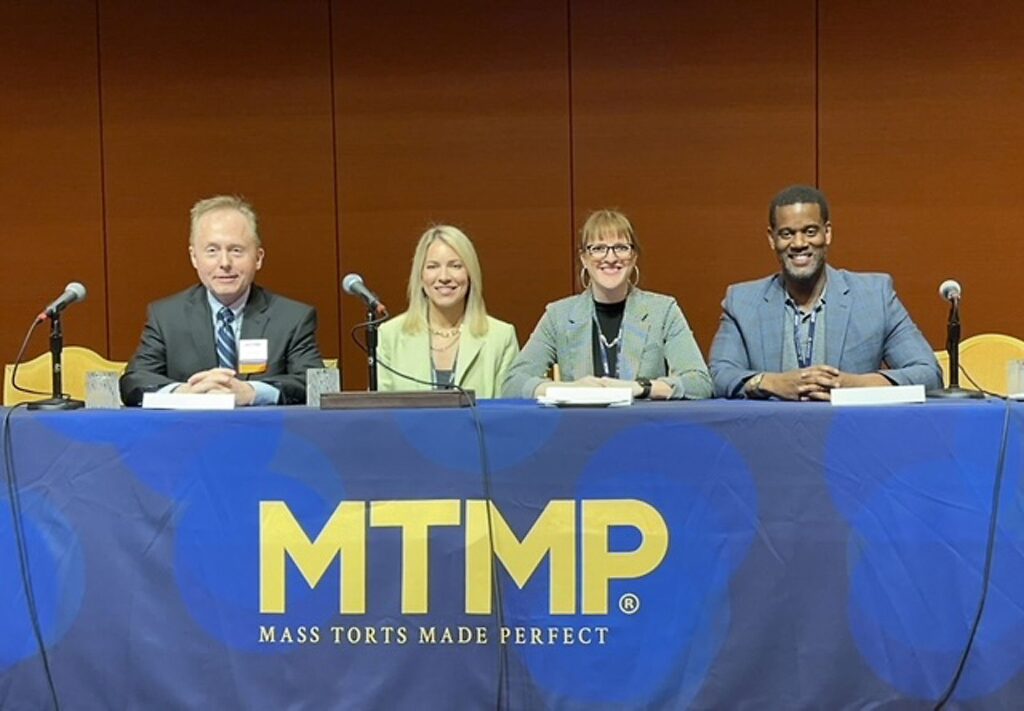
Despite some initial challenges settling in at university, including an encounter with some inhospitable townsfolk, Austin proceeded to throw himself with palpable relish and gusto into various undergraduate extra-curricular activities, pledging to a fraternity and getting very involved in campus life. He recalls, “I started doing what I do best – organising people and starting to make changes.” Those changes included bringing the Black Greek Associations, fraternities, and sororities together and bridging a gap between black and white Greeks. As he explains, “For me, coming up in our community, I’d felt the other end of a couple of police batons before, so I understood the power of authority.”
Throughout this period, Austin’s outlook – whether about campus politics or social interaction with others who were different to him – was always fair and respectful but uncompromising when necessary. “As I grew up, I wasn’t taking wooden nickels from anyone. I will take you as a man or a woman for who and what you are. You respect me, and I’ll respect you. You disrespect me, then I’m going to give in kind what you give.”
Sadly, but perhaps not unexpectedly, he encountered some virulent racism at university. Recalling one specific incident and how he dealt with it, Austin explains self-deprecatingly, “We had some challenges there, some that we had to go back to old school ways of thinking.” Elaborating on the incident with remarkable sangfroid, chronic under-statement and a lack of hyperbole, he adds, “I remember one day we were jogging, and it was extremely dark. We got on the backside of campus, and some guys thought it was funny to let their dog – a pit bull – loose on us. So, imagine you’re at the other end of a three-mile run, and there’s a dog after you.”
He then quips somewhat laconically, a chivalrous twinkle in his eye, “I didn’t take too kindly to that exercise, so we had to fix that in an old-school way because I didn’t think that speaking to them calmly would work. But that got handled, and rest assured, they never let that dog out on anyone else.”
Law School
Initially, Austin had planned to go to Law School at Loyola-Tulane, but then, after an intervention by the President of South Eastern, who, as he relates it, told Southern that “there’s a young man here you really should come and get,” he was effectively headed hunted by the Southern University Law School in Baton Rouge.
On his decision to attend Law School at Southern, Austin is unequivocal and unrepentant. “A great, great, great, great choice! Probably one of the best decisions I’ve ever made.” As he explains, detailing the racial composition of the school and how that affected him, “Southern is an HBCU, but the law school was probably 50/50 white and black. So it offered intellectual stimulation and an opportunity to mix up ideas with people from different races and different backgrounds.”
From early on, it was apparent to Austin that he intended to choose law as a career path. Elucidating his motivation, he alludes to popular TV crime shows of the era, “I’ve always wanted to be a lawyer from a young age. From 10, 11 or 12, I was a Perry Mason and Murder She Wrote type of guy.” Then, addressing the deeper motivation for his career choice, he adds, “I think it was always about helping people. Where can I have the greatest impact to help people? I thought the law was my answer, so I followed my calling.”
He continues, recalling the university recruitment procedure whilst at high school and his commitment to using football as a means to an end: “When I was a high school athlete being recruited, most guys were worried about what the school was ranked, whereas I was like, “Can I go to law school on the same scholarship?” For me, the football programs. I was looking at what was tied to universities and law schools. I never wanted to play professional football – I just wanted free schooling to get into law school.”

Passing the Bar & Starting to Practice
Austin is rightly proud of his academic achievements and passing the Louisiana Bar. As he explains in an understated tone, wholly devoid of hubris, “The year I took the bar, I was the only black male to pass the bar for the first time in Louisiana.” Then, to contextualise this exceptional intellectual feat further, he adds in a deadpan voice, “Louisiana has an extremely tough bar.”
With consummate humility, Austin then provides the background to his achievement, the somewhat daunting reality he faced then, and how he effectively got his “lucky break” in the legal world. He says with evident gratitude and appreciation, “I didn’t really have a job. I was volunteering on a gubernatorial campaign. So, I passed the bar and got our results on October 2nd. And on October 5th or 6th, the Gaylord chemical plant over in Bogalusa, Louisiana, exploded. So I was ready for prime time.” He then readily concedes, with good grace, honesty and charm, “I didn’t know anything about the law, but I had a licence, I knew people, and I had much confidence in who and what I was, so I was able to get in.”
Early Career
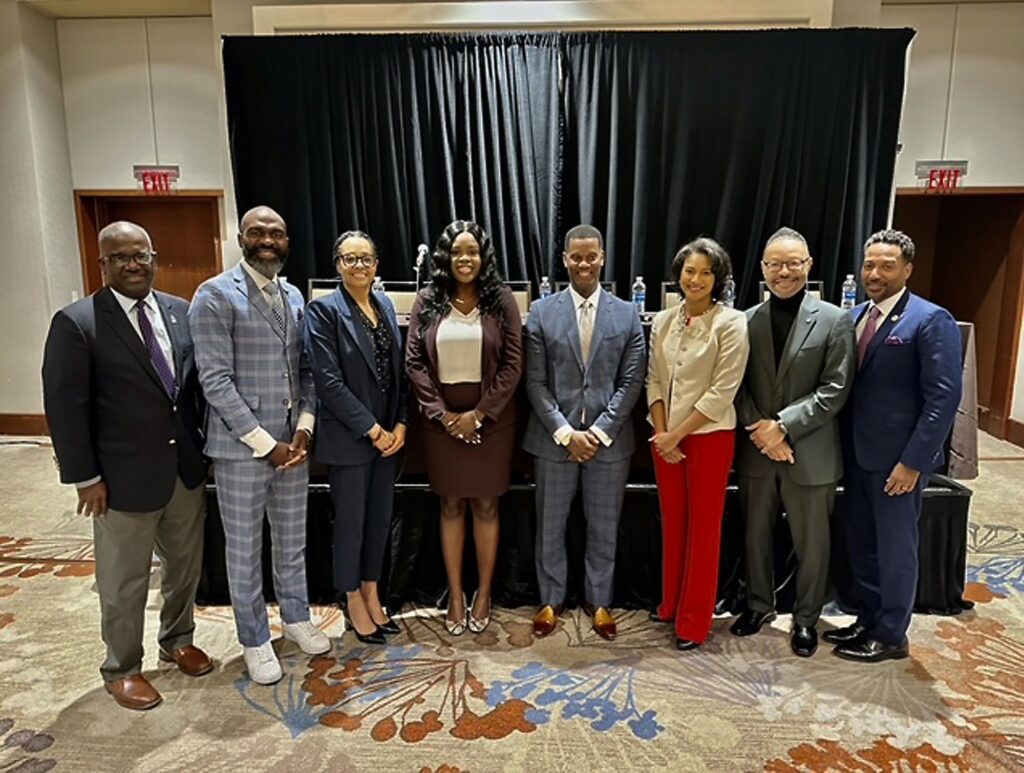
Be it serendipity, good luck or wholly merited cosmic karma, from early on in his career, Austin was fortunate to work on a major case with some very experienced and, in some cases, very high-profile attorneys. Relating one particular instrumental encounter on his legal journey, which juxtaposed success, wealth and his own poverty all in one memorable vignette, he duly explains: “One of the attorneys who came down was a guy named Johnnie Cochran. Johnnie was just off of the OJ Simpson case, and everybody wanted a piece of him. I was a 25-year-old lawyer having lunch with Johnnie Cochran, but riding around in a car that I could actually see the pavement through as I drove. Because I was so poor at that point, taking care of a family, my car was that ragged.”
But Austin was not discombobulated by his good fortune at meeting Cochrane. Instead, with a Machiavellian (in the true sense) eye for the main chance, he asked the famous Louisiana lawyer for some career advice.
“I remember sitting at the table with Johnnie Cochran and some other guys, me, a young lawyer just on the verge of this huge case. And they were projecting the hundreds of millions it was worth. And I was speaking to Johnnie – Johnnie was a charismatic guy. I said, “Man, what’s the key to your success?” He said, “Ron,” – he talked to you like an old friend like he’s been knowing you forever. He said, “Preparation. And when I get tired of that, I prepare. When I get tired of that, I go back to Preparation.”
Visibly buoyed by that encounter and from Cochrane’s intelligent advice, Austin admits, “That made a massive impression on me. Again, I am all of 26 years old. I had a licence at that point for a month, and I was sitting across the table with arguably the most famous attorney in America at that time, getting legal advice. But it helped propel me because soon I understood what it took.”
Recalling another invaluable piece of professional advice from one colleague, he says fondly, “I can remember Stewart Smith telling me, “Well, Ron, if you want to be a shark, expect to get bitten.” It taught me very early on that if you’re going to play the game of being a major lawyer and you want to swim with the great whites. It’s real out there.”
But, thanks to “all of the values that my father and my mother had instilled in me, the integrity of not losing who and what you are,” Austin was duly able to successfully navigate this new, meretricious world, even if, by his own admission, he was still a callow, impressionable young man. “Going into that world where guys are showing up in these $200,000 automobiles and with their own planes, and I was 26 years old, driving around in a car that you could actually see the cement on – I was impressionable.” Then Austin adds gnomically, “Sometimes you choose life, and sometimes life chooses you.”
After practising that type of law for several years, he decided to return home to Louisiana to become an Assistant District Attorney in Jefferson Parish, principally because of his young family. “I had gotten married, had a young child, and my wife was tired of me being on the road. I was the fourth black assistant district attorney here in Jefferson Parish.”
Austin’s attainment was all the more extraordinary, given that Jefferson Parish had long been a hotbed of KKK activity and support. To hear him relate it and thus contextualise the enormity of what he accomplished is both mordantly amusing, given his comedic delivery, but also infinitely tragic and infuriating, due to the way nefarious racism, bigotry, and prejudice can so easily stymie human potential.
“Now, to give you an idea of the place I call home, where I grew up and actually where I stood this business up, a little bit about Jefferson Parish. There’s a guy named David Duke. David Duke was the head of the Klansmen. Every time he’s run for governor, he’s won Jefferson Parish. By a lot.”
Thankfully, Austin was not stymied and, equipped to deal with the racist brickbats, initially relished his new role as a prosecutor, given that he now had an opportunity to see the justice system working effectively and see – and stop – the injustices. “Certainly, there were many inequities in the way people were arrested. I saw many inequities in the way people were prosecuted. But it’s a necessary scenario. Meaning the criminal justice system, not the inequities. Not the inequities, but the process.” He adds, somewhat rhetorically but with genuine insight, empathy and tenderness, “Some very mean people out there need to be locked up. But there are also a lot of people who are really just misunderstood, need some guidance, need some help, need some counselling and need some alternatives.”
Austin is again both unequivocal and unrepentant on the types of criminals he struggled with representing, and his fully calibrated, gentlemanly moral compass is evident when he talks. “For me, I had a hard time with extremely violent people, paedophiles and people who prayed on women. I have an issue with people that prey on women.”
Austin then articulates his measured, pragmatic and profoundly compassionate approach to sentencing, saying, “As a prosecutor, I was never the guy who was trying to give someone’s life for selling drugs. For a couple of rocks of cocaine, I’m not trying to give somebody 20 years to life. That’s just not an equitable scenario. You’re stealing from the local grocery store? I’m not trying to prosecute you for that. You get violent, and you kill someone? Then I have some real issues.”
However, after three years of being a prosecutor, Austin found that he could no longer endure the work, so he decided to leave and start a new legal venture – his own private practice.
He duly resigned but then, unsurprisingly, given the measure of the man, duly returned to try one final case because he wanted to prosecute one more person since he had made a promise to the victim’s family. Austin explains, in a laconic, almost irreverent manner, “After I handed in my badge, I don’t think I took a pay cheque. I went back to my boss and said, “Hey, do you mind if I stay for two more weeks? I need to prosecute this guy for actually killing the guy on the next street over.”

Exxon Mobile Case
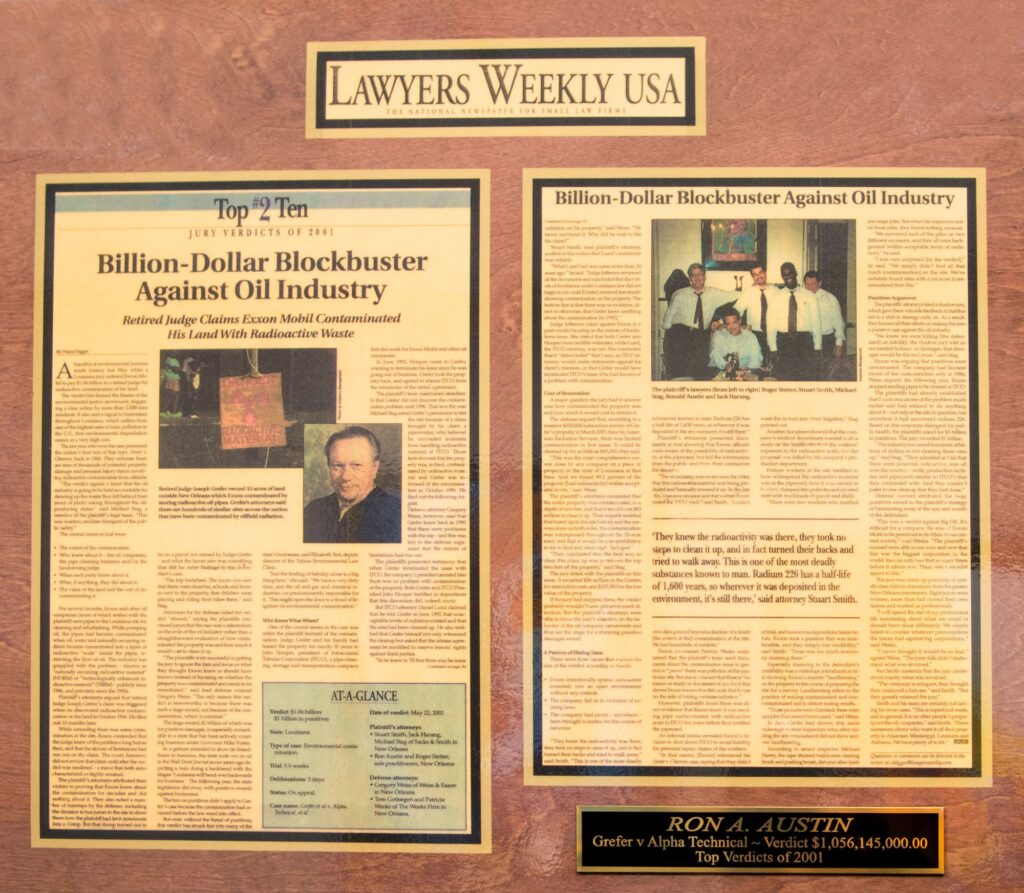
Austin then recounts arguably the most significant case of his legal career to date, a Rubicon in Louisiana’s legal history and the one for which he is thus far most celebrated – that of Exxon Mobile. The chutzpah and braggadocio of a young, clever, ambitious lawyer working what would become a landmark case in Louisiana for environmental contamination, and one which would spur much reform legislation, is not lost on him now.
“I think at the time, I was the youngest lawyer in the room. So Exxon came in with their slate of high-end attorneys, and we came in. There were four of us – four firms, four lawyers. When settlement negotiations broke down in front of the judge, I turned to the Exxon lawyer and said, “You need to go call Dallas. I’m going to take a billion dollars from you on Monday.” And I stared at him with this cold, cold stare, and he just looked at me. I said, “No more talking. See you guys on Monday. Please make the call.”
Austin continues with a broad smile, recalling his trenchant quip to the Exxon lawyer. “Five and a half weeks later, the jury returned a verdict of a $1,56,000,000 compensatory billion dollar punitive damages. So I turned to the defence lawyer and said, “Next time I tell you something, believe me.” He concludes, “That case – and that decision – was a turning point in Louisiana.”
Private Practice
Austin’s current private practice engages in environmental, class action and personal injury work but is guided by one simple, over-arching principle. He readily explains, “I tend to take on cases where you’re going to make a difference in someone’s life fundamentally.”
He is conscious of his positioning in the legal world as something of a David taking on Goliaths. Austin is acutely aware of what he feels he should be using his myriad gifts for. As he explains with genuine and moving conviction, thinking of how his various legal talents can positively impact others, “Fundamentally, what do we use our gifts for? And if we’re not using it to change lives, if we’re not using it to become better humans, if we’re not using it to make this place a better place, then what in the hell are we doing?”
His firm is now in the enviable position of not having to seek out work. He states, “We do our fair share of basic advertising, like most people. But usually, people will find us.” He then adds, again with a disarming humility, “Luckily for us, I’ve had an opportunity to travel the country and a little bit of Europe, a little bit of Africa, a little bit of the West Indies, some of Asia. And so we will get calls from everywhere. Everywhere from some of the African governments will call us, to folk down in the West Indies who have pesticide eating up their fruit, through to where you all are. It’s just a matter of who you can service and who you can service adequately.”
As Austin readily admits, “I’m a human interest guy. It’s not necessarily the big things. It’s the small cases. And the truth of the matter is this: it’s never the successes that live with you. It’s the failures. It’s the ones that you could not help.”
Regrets
Austin’s reply is almost painfully wise when asked if there is anything he would have done differently on his career journey: “I’m hard-pressed to say I would do anything differently because, for every eraser, there’s another line that’s drawn.” With a touching sincerity, he adds, “Fundamentally, I’ve tried to stay true to who and what I am, how I was raised and my core values. And always remembering, it’s about something other than self.”
The Nature of True Success
Austin then proceeds to articulate a philosophically profound and profoundly humbling assessment of what constitutes true success – one which, no pun intended, is bang on the money. “Many people look at success, and they measure it with money. I’m a guy who believes money is a by-product of success. Success is how rich you feel in life. Success is how rich of a human being you become. Your mark measures success in other people’s lives. Money, at least here in the US, is the easiest thing to get. So, I don’t measure success by money. I truly measure success by what sort of human being I am. That’s what is fundamentally important to me.”
Message to the World
As for his “message to the world,” Austin learnt a plethora of painful but ultimately valuable and consolatory lessons from the tragic passing of his wife eight years ago, and thus frequently gives his two daughters and his son the following sagacious advice about life’s intrinsic ephemerality, accepting the past and boldly going forwards into the future: “The sun is going to set in the west and rise in the east. You really can’t do anything about yesterday. Tomorrow allows you to reinvent yourself.”
Three Wishes
When it comes to the proverbial three wishes he would like were he granted them, Austin ruefully admits, much to his chagrin, that “We are living in interesting times right now, and our society is changing? While I’m a glass half full, our society currently leaves a lot to be desired.” He then adds thoughtfully, “I’m a middle-of-the-road guy. I’m a guy who loves to hunt and fish. I’m in a hunting club, and several of the guys are massive Republicans, and I’m a Democrat. I don’t really care because I believe you can meet intellectually. Most of us have common goals in raising our families and what we want in our lives.”
“But I think we’re at a turning point in our society. One of my hopes is that common sense prevails. The answer, I believe, is always in the middle. Whether that’s centre right or centre left, I don’t know. But I hope that common sense prevails because we’re currently not on a good course if we allow the fringes to consume us.”
He continues with passion, warming to his theme, “So I hope that ordinary, good people, good human beings, see the wisdom in running away from the fringes and not identifying with their gangs. And I say gangs because whether it’s the street guys, the politicians or the political parties, people are afraid to run away from their gangs. To see the wisdom in running away from the fringes and coming to the middle and start hearing people, versus seeing people.”
Austin’s second wish acknowledges his interest in young people and his awareness of his mortality: “I would like our young people to take hold of the responsibility that lies ahead of them and handle it with care. When you get to my age and are on this side of life, the downside is that you become a lot more introspective. When you’re a younger person, you think you have time. Once you flip over 50, you start looking at things very differently. So I hope that young people understand the responsibility that lies ahead.”
His third wish is replete with goodwill, affability and public-spiritedness, focusing on the tangible personal and collective benefits of altruism and selflessness. As he explains, “Lastly, I hope that everyone incorporates an act of selflessness into their being once a week. So, once a week, you schedule, at a minimum, one act of selflessness – whatever that means to you. If we can get our society, whatever part of the world you are from, to think more selflessly, we could change things quickly.”
Current Projects: Championing Justice Across Multiple Fronts
Ron Austin is at the forefront of several significant legal battles, tirelessly advocating for justice and the well-being of individuals affected by corporate negligence and misconduct. His current projects span various critical issues, showcasing his commitment to fighting for human rights and holding powerful entities accountable.
Social Media’s Effect on Children
In recent years, Austin has taken on some of the world’s largest social media companies in Multi-District Litigation (MDL) lawsuits. These cases address the profound and adverse effects of social media on children, including issues such as depression, anxiety, cyberbullying, and sleep disruption. Austin is determined to hold these companies accountable for prioritising profits over the well-being of young users, advocating for stricter regulations and better safety measures to protect children in the digital age.
AFFF and PFAS Water Contamination
Austin is also deeply involved in litigation concerning Aqueous Film-Forming Foam (AFFF) and per- and polyfluoroalkyl substances (PFAS) water contamination. These chemicals, used in firefighting foams and various industrial applications, have been linked to serious health issues, including cancer and liver damage. Austin’s efforts in this arena focus on seeking justice for communities affected by contaminated water supplies, pushing for accountability from manufacturers, and ensuring that affected individuals receive proper compensation and clean water.
Insulin Overpricing Litigation
The skyrocketing cost of insulin has placed an enormous burden on diabetes patients, many of whom struggle to afford this life-saving medication. Austin is actively pursuing litigation against pharmaceutical companies responsible for the unjustifiable pricing of insulin. He aims to expose and rectify the unethical practices that have led to exorbitant costs, ensuring that diabetes patients have access to affordable medication and highlighting the broader issue of drug pricing in America.
Hair Relaxer Litigation
Austin is also tackling the hair relaxer industry, which has been scrutinised for the harmful chemicals in many products. These chemicals have been linked to severe health issues, including cancer and reproductive problems. By representing affected individuals in litigation against manufacturers, Austin aims to hold these companies accountable for their negligence and failure to warn consumers about the risks, ultimately advocating for safer beauty products.
Other Key Initiatives
Beyond these major cases, Ron Austin’s firm is engaged in various other important legal battles, reflecting his broad commitment to justice and human rights. From environmental lawsuits to consumer protection cases, Austin’s work consistently demonstrates his dedication to using his legal expertise to impact society positively.
Conclusion
Ron Austin’s dazzling and deeply inspirational professional trajectory showcases a journey marked by resilience, dedication, and an unwavering commitment to justice. From his beginnings as a budding high school football player to becoming a father while still in law school, Austin’s path has been nothing short of extraordinary. Transitioning from a struggling young lawyer who received career advice from the legendary Johnnie Cochran to serving as a robust prosecutor in a Klan heartland, Austin has continually demonstrated his fortitude and moral integrity.
His landmark victory in the Exxon Mobile case and his current leadership of a thriving private practice underscore a career built on advocating for the underrepresented and challenging powerful corporations. Ron Austin’s story is a remarkable testament to the quintessential (African) American dream, embodying the spirit of perseverance and the pursuit of justice. His journey, filled with significant achievements and ongoing impactful projects, promises a future that continues to inspire and effect meaningful change.