
They called it lost. But Benin was never gone.
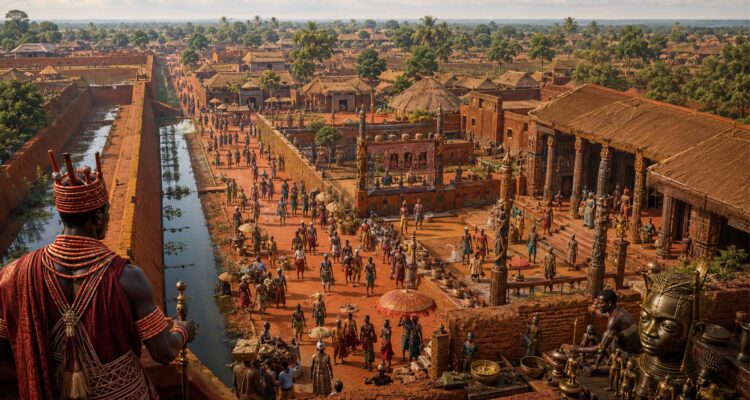
For centuries before the first European ship anchored off its coast, the Kingdom of Benin was one of the most powerful and sophisticated civilisations on earth. Its capital was a city of wide straight roads, royal bronze, sacred ivory, and walls that stretched further than the eye could follow. Its Oba was divine. Its artisans were the finest in the region. Its merchants traded with the world.
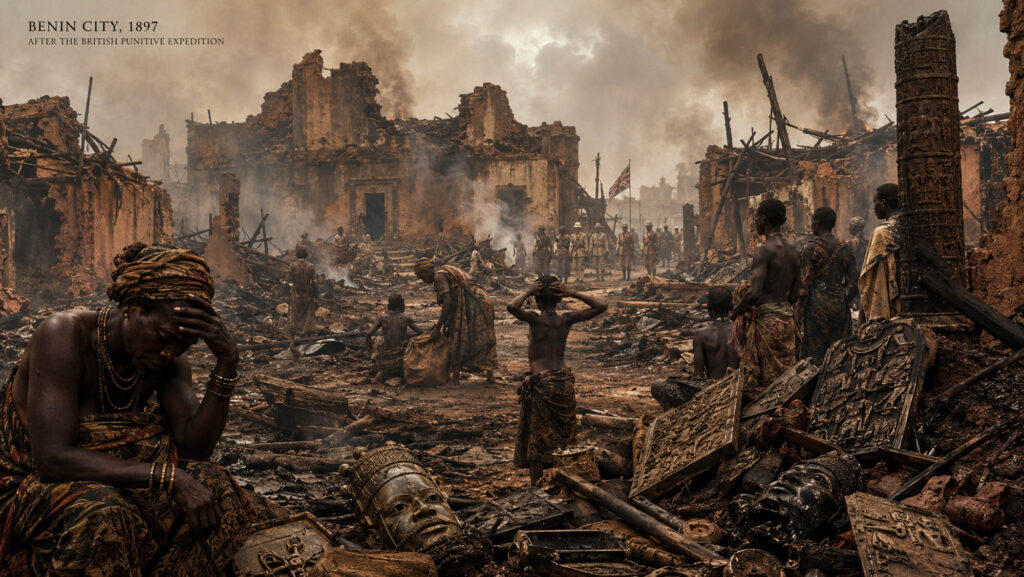
Then came 1897. A British naval expedition invaded, burned the royal palace, exiled the king, and carried off thousands of artworks that would spend the next century in foreign museums. In the aftermath, colonial writers reached for a convenient word. They called Benin lost.
It was never lost. It was taken. And now, slowly, it is coming back.
Long before European powers carved up Africa, the Kingdom of Benin was one of the most sophisticated civilisations on earth. Its capital was a city of broad avenues and bronze masterworks. Its kings were divine. Its walls stretched further than imagination. So how did such a place come to be called lost?
A City at the Height Of The World
Imagine a morning in the royal capital of Benin, sometime in the sixteenth century. The sun rises over walls of packed red earth, their surfaces so vast and so high that early European visitors would later struggle to find the words to describe them. Inside, wide straight roads lead to the palace of the Oba, the divine king who stands at the centre of everything. Along these roads, market traders set out their wares. Smiths heat their furnaces. Ivory carvers bend over their work with tools that have been handed down through generations. The sound of drums carries across the rooftops.
This is not a scene from myth. It is not a fragment of oral tradition left to interpretation. It is a city documented by the Portuguese in the fifteenth century, described in meticulous detail by Dutch merchants in the seventeenth, and confirmed by British officers in the nineteenth. The Kingdom of Benin was real, prosperous, and remarkable. Its existence was no secret to those who encountered it.
And yet, in the decades after 1897, a city that had been known to the world for over four centuries came to be described, in colonial records and popular accounts, as a place of darkness, mystery, and decay. The language of discovery and rediscovery was applied to a civilisation that had never been hidden. The word lost became attached to a kingdom that had been destroyed, not disappeared.
The question of how that happened is not merely historical. It speaks to the mechanics of colonial memory, to the way power writes its own justifications, and to the particular resilience required of communities whose histories have been stolen alongside their artefacts.
The Kingdom the World Underestimated
The Kingdom of Benin was established by the Edo people in the dense rainforest region of what is today southern Nigeria. Its origins are traced to around the ninth or tenth century, though oral traditions reach back further, to a founding dynasty known as the Ogiso, the rulers of the sky. The kingdom as it came to be known emerged fully with the Eweka dynasty, established around the thirteenth century, when the Oba became the political, spiritual, and ceremonial centre of Edo society.
To understand Benin is to understand the role of the Oba. He was not merely a king in the European sense. He was a sacred figure, the intermediary between the living and the ancestral world, the guarantor of the kingdom’s prosperity and its protection. His palace occupied the centre of the capital, and the organisation of the city radiated outward from that point in a manner that was both practical and symbolic.
Benin City was a planned urban space. Its streets were wide enough for several people to walk abreast. Its wards were organised by occupational guild and lineage. The system of governance that administered this complexity included a sophisticated court of chiefs, hereditary officials, and appointed administrators who managed trade, diplomacy, taxation, and law.
And then there were the walls. The earthworks surrounding Benin City and its wider territory have been described by archaeologists as one of the most extensive systems of earthen construction in human history. Patrick Darling, the scholar who carried out the most thorough survey of these structures in the twentieth century, estimated their total length at around 16,000 kilometres. They enclosed not just the city but dozens of satellite settlements and agricultural districts, all integrated into a coherent territorial system.
By the time Portuguese traders arrived on the coast of West Africa in the 1480s, Benin was already a major regional power with well-established trade networks, a standing army, and diplomatic relationships that stretched across a wide area. The Portuguese were not discovering Benin. They were being received by it.
Bronze, Ivory, and the Preservation of Memory
No account of the Kingdom of Benin can be told without pausing on the art. Specifically, on the bronzes.
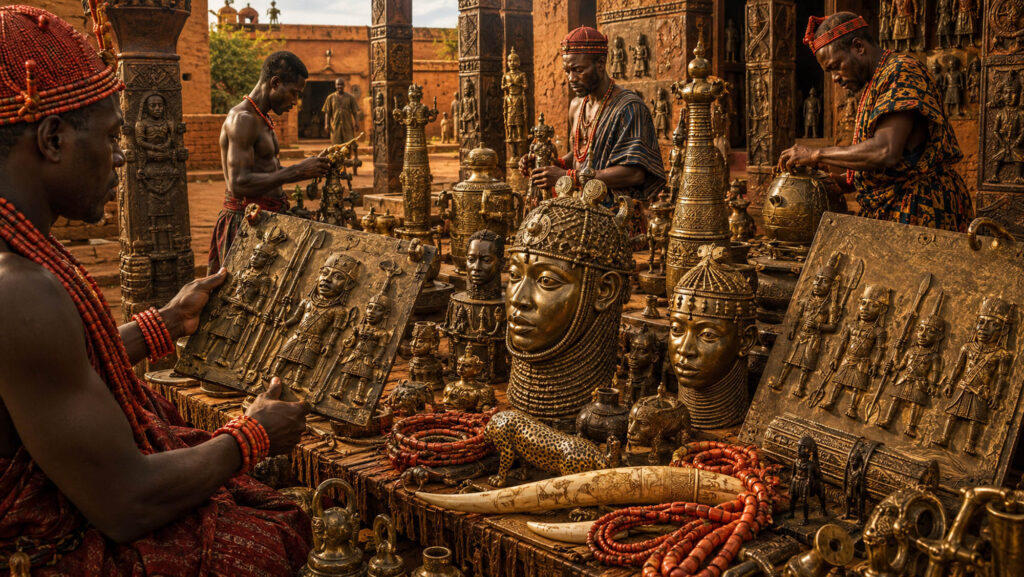
The Benin Bronzes, as they have come to be collectively known, are a body of work comprising brass plaques, portrait heads, figurines, decorative objects, and ceremonial regalia. Produced by the royal guild of brass casters, the Igun Eronmwon, they were not decorative objects in any casual sense. They were acts of memory, commissioned and maintained to record the lives of Obas and chiefs, to document military victories and diplomatic encounters, to preserve the faces of the ancestors for the veneration of future generations.
The brass casting technique used in Benin was the lost wax method, known in French as cire perdue. A model was formed in wax, then encased in clay. When the clay was fired, the wax melted away and molten brass was poured into the space left behind. What emerged when the clay was broken open was an object of extraordinary precision. The portrait heads produced in this way captured individual physiognomies with a naturalism that, when the objects first appeared in European museums after 1897, caused immediate controversy. Scholars raised questions about whether African craftspeople could really have made them. They could, and had been doing so for centuries.
Ivory was worked with equal mastery. The royal guild of ivory carvers, the Igbesanmwan, produced objects ranging from intricately carved tusks to delicate pendants worn by the Oba during ceremony. Each carving encoded layers of meaning. The motifs, figures, and patterns were a language understood within the court, a visual system through which power, ancestry, and cosmology were simultaneously expressed.
When the bronzes reached European collections in 1897, scholars argued they could not be African in origin. The art itself disproved those arguments before the arguments could be finished.
The artworks were sacred. They resided in shrines. They were tended by priests. They were not objects to be admired from a distance but presences to be maintained in relationship. Their removal in 1897 was therefore not merely a cultural loss in any abstract sense. It was an act of desecration as well as theft.
1897: The year that Changed Everything
The events of January and February 1897 can be told briefly, though their consequences cannot.
A British trading mission led by Acting Consul General James Phillips set out for Benin City without the permission of the Oba, during a period when the court had declared a sacred festival during which outsiders were not permitted entry. Whether the mission was intended as a provocation is debated. What is not debated is what happened next. The party was ambushed. Phillips and several of his companions were killed.
The British response was immediate and overwhelming. A naval expedition of over one thousand officers and men, armed with modern weaponry, advanced on Benin City. The Edo fighters resisted, but the outcome was decided by the disproportion of force. Within days, Benin City was taken. The royal palace was burned. The Oba, Ovonramwen, was captured, tried, and exiled to Calabar, where he died in 1914 without returning to his throne.
Accompanying the soldiers and sailors were officers tasked with the systematic removal of every object of value they could find. What they took, in those days of smoke and wreckage, amounted to thousands of artworks, ceremonial objects, bronze plaques that had lined the pillars of the palace, ancestral heads from shrine altars, ivory carvings from storage rooms and sacred spaces. These objects were shipped to Britain and rapidly distributed among private collectors, auction houses, and museum collections across Europe and North America.
A city that had stood for centuries was reduced in days. The artefacts that survived its burning were carried off as trophies and curiosities, to be reinvented in foreign institutions as evidence of a culture that had supposedly ceased to exist.
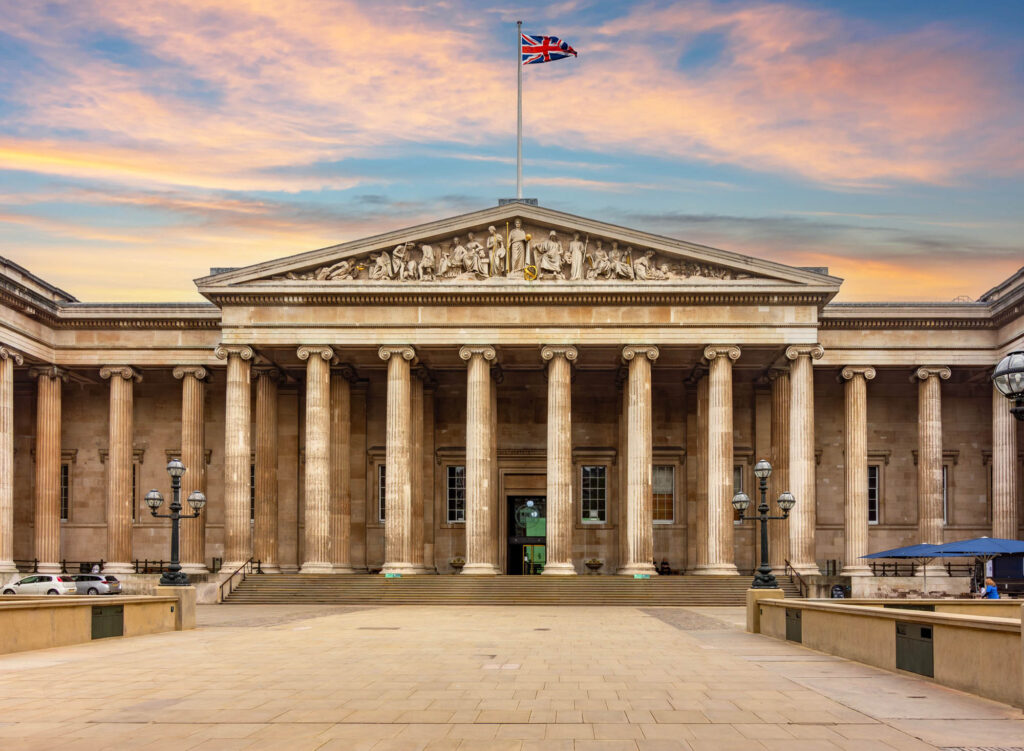
The Pitt Rivers Museum in Oxford received a significant share of the objects. So did the British Museum. So did institutions in Germany, the United States, Austria, and beyond. By the end of 1897, the artistic heritage of a living royal court had been transformed into the contents of European display cases.
The language that accompanied this dispersal is instructive. The expedition was called punitive, a word that framed a military invasion as a matter of discipline. The Oba was described as despotic. The city, once so admired by European visitors, was now characterised as primitive, barbarous, and ripe for the civilising intervention that had just destroyed it. The bronzes, when they appeared in London, were greeted with astonishment precisely because they contradicted the narrative of African primitivism that was being simultaneously constructed to justify the invasion that had brought them there.
The Myth of the Lost City
The phrase lost city carries with it a particular romance. It conjures images of jungle undergrowth slowly reclaiming stone foundations, of a civilisation that somehow vanished, leaving only ruins and riddles for future explorers to decode. Applied to Benin, it is not merely inaccurate. It is a deliberate misdirection.
Benin City was not lost. It was attacked, burned, looted, and its ruler was removed. The Edo people did not disappear. They continued to live in and around their city, to observe their ceremonies, to maintain their traditions, and to mourn the objects that had been taken from them. The kingdom continued to exist in attenuated form. The Oba dynasty survived. The royal institution was eventually restored.
The language of the lost city served a specific purpose. It allowed colonial writers and administrators to discuss the consequences of the 1897 expedition without confronting the nature of what had occurred. If Benin had simply declined or vanished of its own accord, the removal of its artefacts became archaeology rather than theft, their storage in European museums preservation rather than retention, and the whole episode a matter of historical inevitability rather than political choice.
This is the particular violence of colonial narrative. It does not merely destroy. It rearranges the story of the destruction so that the destroyers become the inheritors and the destroyed become the absent, the primitive, the lost. The Kingdom of Benin was subjected to exactly this process, and the artworks that were removed became the primary vehicle through which the rearrangement was sustained.
There is an important distinction between a civilisation being destroyed and a culture disappearing. Benin demonstrates that distinction with unusual clarity. Everything that could be carried away was carried away. The physical evidence of the kingdom’s sophistication was redistributed across the world. But the people remained. The knowledge remained. The ceremonies remained. The Oba remained, even in exile.
Benin Today: A Living Kingdom
Benin City today is a sprawling urban centre of several million people, the capital of Edo State in southern Nigeria. Its modern streets follow no obvious plan, the legacy of colonial restructuring and rapid postcolonial growth. But within the city, and within the communities that surround it, the ancient kingdom persists in ways that are neither museum pieces nor performances for visitors.
The Oba of Benin remains an active and significant figure. Oba Ewuare II, who ascended to the throne in 2016, is a trained diplomat and lawyer who has presided over the kingdom with a vigour that has surprised commentators accustomed to characterising traditional rulership as symbolic. He has been one of the most prominent voices in the international campaign for the return of the Benin Bronzes, and he has done so not merely as a cultural advocate but as the direct institutional descendant of the court from which those objects were taken.
The Igue Festival, held annually in December, brings together the Oba and his court, chiefs, and thousands of participants in a ceremony that combines ancestral veneration, thanksgiving, and communal renewal. It is one of the most visually spectacular and spiritually significant events in the Edo calendar, and it has continued without major interruption for generations, including through the years of colonial rule.
Archaeological work in and around Benin City has continued to yield important discoveries. The earthworks surveyed by Patrick Darling and his successors have helped scholars understand the full scale of the ancient settlement. More recent excavations and aerial surveys have added detail to what is now understood as one of the most complex pre-industrial urban systems anywhere in the world.
Heritage preservation efforts have been supported by a combination of state and federal government interest, international academic partnerships, and community organisations. The Great Moat of Benin, a portion of the ancient earthworks, has been proposed for UNESCO World Heritage status. The physical evidence of the kingdom’s greatness is being documented and protected, even as the cultural evidence never required any protection to survive.
The Long Road Home: Restitution and Return
In the years following the Second World War, and accelerating sharply after Nigerian independence in 1960, the campaign for the return of the Benin Bronzes became a consistent thread in international cultural politics. For decades, the major holding institutions responded with a combination of legal arguments, appeals to universal heritage, and institutional inertia. The objects, it was argued, were better preserved in European museums. Their removal was historical and could not be undone. The legal frameworks of their transfer, however morally compromised, were technically valid under the laws of their time.
These arguments have, in the twenty-first century, begun to lose their purchase.
The shift has been driven by a combination of changing political will, scholarly pressure, community advocacy, and the intervention of the Nigerian government and the Benin Royal Court. The 2018 report commissioned by the French government, authored by scholars Felwine Sarr and Benedicte Savoy, made a moral and legal case for wide restitution that reverberated through museum boardrooms across Europe.
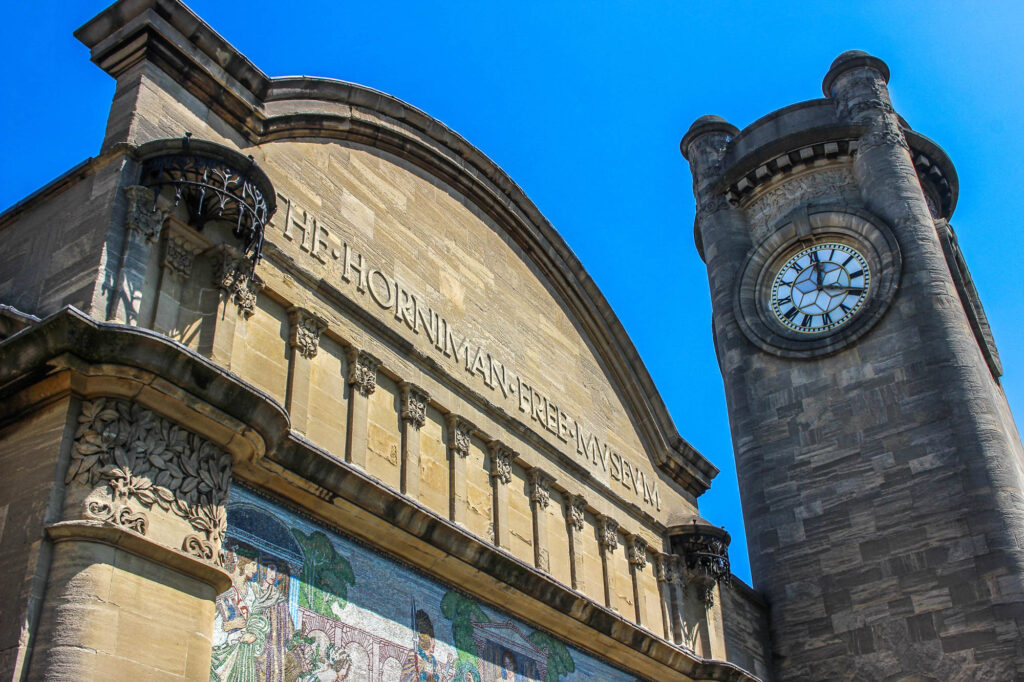
Germany, which held the largest number of Benin Bronzes outside Nigeria through its many state museums, moved first among the major holding nations. In 2022, the German government transferred legal ownership of over a thousand objects to Nigeria. The Smithsonian Institution in Washington followed. The University of Aberdeen returned a single bronze head to the Oba of Benin in 2021, in what became a symbolically significant early act of repatriation. The Horniman Museum in London committed to returning its entire Benin collection in 2022.
The British Museum has moved more slowly. Its Benin collection of over nine hundred objects remains the largest single holding in the world, and the institution continues to face the constraint of the 1963 British Museum Act, which prohibits the deaccession of objects from its collection. As of the mid-2020s, negotiations between the museum, the UK government, and the Nigerian authorities remain ongoing, with various proposals for long-term loan arrangements and co-stewardship under discussion.
At the receiving end, the Edo State Government and the Benin Royal Court have been developing the Edo Museum of West African Art as a permanent home for returned objects. Designed with input from the Royal Court and intended to contextualise the bronzes within the living culture from which they came, the museum represents a vision of repatriation as cultural restoration rather than mere institutional transfer.
Five Things You May Not Know About Benin
- Benin’s walls were among the largest earthworks in history. The system of walls and moats surrounding Benin City and its surrounding territory extended for an estimated 16,000 kilometres. Archaeological surveys have suggested the total length of these earthworks may have exceeded the Great Wall of China in overall extent.
- The Benin Bronzes are not all bronze. Despite their collective name, the artworks removed from Benin in 1897 include brass plaques, ivory carvings, wooden sculptures, and iron figures. The term ‘bronzes’ has become a shorthand for the entire corpus of looted royal regalia and court art.
- The Portuguese were trading with Benin before Columbus reached the Americas. Portuguese merchants established contact with the Kingdom of Benin around 1485. The two powers exchanged ambassadors, conducted regular trade in cloth, pepper, and ivory, and Benin warriors even used Portuguese firearms in military campaigns.
- A British officer was the first to recognise the quality of the bronzes. Reginald Bacon, a naval officer who participated in the 1897 expedition, wrote that the bronzes were of extraordinary quality and expressed puzzlement that objects of such sophistication had emerged from Africa. His astonishment reflected the racial assumptions of his era rather than any deficiency in Benin’s artistic tradition.
- Benin City was reportedly described as comparable to Amsterdam. Dutch trader Olfert Dapper, writing in the seventeenth century, described the capital as a city of great broad streets and beautiful houses. Some accounts from the period placed it among the most impressive cities a European traveller might encounter anywhere in the world.
Why Benin Matters to the Creole World
For readers of International Kreol Magazine, the story of Benin is not simply a West African story. It is a story that resonates across every community shaped by colonialism, by the forced movement of people and the forced removal of culture, by the particular effort required to remember who you are when the powerful would prefer you to forget.
The Creole world, in its various expressions across Louisiana, the Caribbean, the Indian Ocean, and the diaspora communities of Europe and North America, knows the mechanics of cultural erasure intimately. It knows what it means for a language to be suppressed, for a religion to be driven underground, for a cuisine or a musical tradition to survive precisely because it was not grand enough to attract the attention of those who were confiscating the obvious things. It knows that survival is not the same as approval. It knows that memory, passed through families and communities and ceremonies, is its own form of resistance.
The Kingdom of Benin offers a concentrated and documented version of this experience. Its bronzes were taken specifically because they were extraordinary, because they were the most visible evidence of a sophistication that complicated the colonial narrative of African primitivism. The Edo people survived not despite this loss but alongside it, maintaining the traditions and relationships and ceremonies that no punitive expedition could carry away in a ship’s hold.
There is also a more direct connection. The transatlantic slave trade, which the Kingdom of Benin was drawn into in various complex ways from the sixteenth century onward, is part of the origin story of Creole communities across the Americas. The ancestors of many people in Louisiana, Haiti, Trinidad, Martinique, and elsewhere came from the broader region of West Africa that includes Benin. When Benin reclaims its story, it is reclaiming something that belongs not only to the Edo people but to the diaspora that extends from them.
Cultural survival, in the Creole world as in the Edo kingdom, is never passive. It requires active maintenance, deliberate transmission, and, in many cases, the willingness to fight for recognition against institutions that have a vested interest in the simplified version of history. The return of the Benin Bronzes is, in this light, part of a much larger global conversation about who gets to tell history, and who gets to hold it.
A Story that was Never Truly Ended
The title of this article poses a provocation, and it is worth dwelling on it for a moment. Benin was never lost. The phrase only makes sense if you accept the premise that a city can disappear simply because the people who burned it declared it gone. The Edo people did not accept that premise. They have been insisting on the reality of their history for over a century, through ceremony and scholarship and diplomacy and art.
What is now happening, in the slow and still incomplete return of the bronzes to Nigeria, is the formal acknowledgement by some of the world’s most powerful cultural institutions that they built their collections on a foundation of violence. That acknowledgement is important. It does not erase what happened, but it changes the conditions under which history is told.
The Kingdom of Benin never needed to be rediscovered. It needed to be listened to. The Oba who sits on the throne today is the inheritor of a dynasty that stretches back seven centuries. The festivals observed in Benin City each year connect the present to the same ancestral world that the bronzes were made to honour. The art that was taken was extraordinary, but the culture from which it came is more extraordinary still, because culture, unlike bronze, cannot be melted down and poured into a new form.
Reclaiming Benin’s story is an act of historical justice, but it is also something more intimate than that. It is the acknowledgement that a people’s account of themselves is worth more than someone else’s account of them. It is the insistence that the standard of civilisation was never Europe’s to set. It is the understanding that the past is not a collection of settled facts but a living argument, one that communities around the world are still making, with every festival celebrated, every language spoken, every tradition maintained against the pressure to forget.
Benin was never lost. It was always here, waiting for the world to catch up.
Key Dates in the History of Benin
| DATES | EVENT |
|---|---|
| c. 900 | CE The Kingdom of Benin established by the Edo people in the rainforest region of present-day southern Nigeria. |
| c. 1300 | The Eweka dynasty founded. The role of the Oba formalised as divine king and ruler. |
| c. 1440–1473 | Reign of Oba Ewuare the Great. Construction of Benin City’s inner walls and moat begins. The kingdom reaches its height of power. |
| c. 1485 | Portuguese traders arrive at Benin. The first sustained contact between the kingdom and European merchants. |
| c. 1600s | Benin Bronzes being produced in large numbers. Dutch and English accounts describe the city as rivalling Amsterdam. |
| 1897 | British Punitive Expedition invades and destroys Benin City. Oba Ovonramwen exiled to Calabar. Thousands of artworks looted. |
| 1914 | Death of the exiled Oba Ovonramwen. His son Eweka II is eventually allowed to return and restore the dynasty. |
| 2021–2022 | Major international restitution begins. Germany, the United States, and the United Kingdom announce the return of Benin Bronzes to Nigeria. |
| 2023 | The Edo Museum of West African Art (EMOWAA) project advances as a permanent home for returned artworks in Benin City. |