
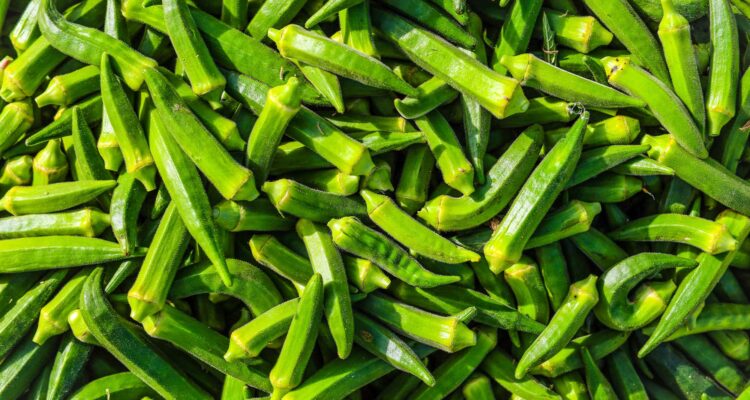
In Louisiana, the smell of okra dropping into a hot cast iron pot means Sunday has arrived. This is the story of a small green pod that crossed an ocean, survived history, and became the living heart of Creole cuisine. From Opelousas family kitchens to the seafood markets of New Orleans, okra is not simply an ingredient. It is a memory, a people, and a meal.
There is a particular kind of Sunday morning in Louisiana that does not happen anywhere else in the world. The screen door is open just enough to let in the smell of honeysuckle and warm earth. A cast iron pot sits on the stove, already holding the memory of every meal that was ever made in it. Someone is rinsing okra under the tap, slicing it without measuring, dropping the rounds into the oil with a sound that is more feeling than noise. Somewhere nearby, a grandmother is humming. A cousin is setting the table. Children are running circuits through the house and into the yard and back again, drawn by the smell that tells them something is coming.
This is Louisiana Creole cooking at its truest. It is not a restaurant experience, though the restaurants of New Orleans come close. It is not a festival, though the festivals of Acadiana have carried it across generations with joy. It is a domestic ritual, rooted in family and faith, in hard work and celebration, in the particular genius of a culture that took everything history threw at it and built something extraordinary from the wreckage and the abundance alike.
And at the centre of that ritual, more often than not, sits okra.
A Pod That Carried a World
Okra arrived in Louisiana the way so many of its greatest treasures did, by necessity, by passage, by the stubborn human will to preserve what matters. Carried across the Atlantic during the slave trade, okra came with West African men and women who brought not only their labour but their knowledge, their tastes, their agricultural understanding, and their culinary traditions. The plant they knew from Senegal, Ghana, and the Niger Delta found fertile ground in the Louisiana heat and humidity, and it thrived.
But Louisiana was never a simple place. By the time okra became part of the regional kitchen, French colonists had already shaped the city of New Orleans. Spanish rule had left its own deep imprint. The Choctaw and other Native American nations had long shared their knowledge of local ingredients, including file powder made from dried sassafras leaves, which would become another cornerstone of gumbo. Free people of colour, some of whom had come via Saint-Domingue in the Caribbean, added their own threads to the weave. Cajun settlers from Acadie brought the peasant pragmatism of making a full meal from whatever the swamp and the sea provided.
Okra wove itself into all of it. The Wolof word for okra, ki ngombo, gave Louisiana its most famous dish its name. Gumbo is, at its etymological root, an African word. The dish that the world now identifies with Louisiana was born from the encounter between African cooks who knew how to use this thickening, silken vegetable and a culture that was learning how to cook from many directions at once.
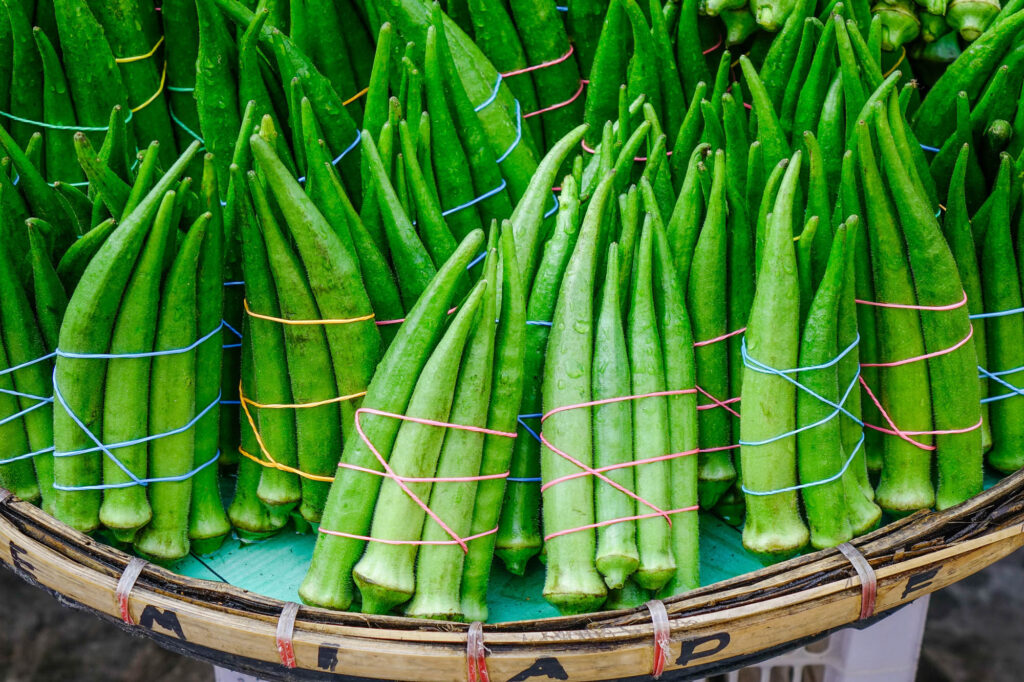
What makes okra remarkable in the pot is the quality that intimidates the uninitiated: its mucilaginous, silky interior, which releases into the broth as it cooks and creates a body, a depth, a texture that no other ingredient quite replicates. In Creole cooking, this is not a flaw to be managed. It is a gift to be welcomed. The thickening quality of okra is what gives Louisiana gumbo its signature consistency, dark and rich and clinging to the rice in a way that feels almost intentional, almost designed.
Okra Gumbo: The Dish That Holds Everything
If you want to understand Louisiana Creole culture, order a bowl of okra gumbo. Do not rush it. Sit with it. Notice how the steam rises. Notice how the colour shifts from the edge of the bowl to the centre, darker where the roux has done its work, lighter where the rice has begun to absorb the broth. Notice that every household makes it differently, and that every household believes its version is the right one, and that both of these things are entirely true.
Okra gumbo is a dish that refuses to be standardised, and this refusal is part of its power. In one kitchen in Lafayette you will find chicken and andouille sausage. In a home kitchen in New Orleans, blue crab and shrimp. In the bayou parishes, catfish. Along the Gulf Coast, oysters. The okra is the constant, the anchor around which everything else arranges itself. It is what gives the dish its character before the spices are even added.
The foundation of any serious Louisiana gumbo is the roux: equal parts flour and fat, cooked slowly over medium heat and stirred without mercy until it reaches the precise shade of dark chocolate. A pale roux produces a thin, European sauce. A burned roux produces a bitter pot and a deeply frustrated cook. The perfect dark roux requires patience and attention, two qualities that Louisiana cooking teaches with affection and demands without apology.
Once the roux is ready, the trinity of celery, onion, and green pepper goes in. Then garlic. Then the stock, which in a seafood gumbo is built from prawn shells and crab bodies and whatever the sea gave up that week. The okra follows, sliced into rounds and added early enough to melt into the broth and do its thickening work. Then the seafood, never overcooked, added in stages so that each element reaches the bowl at its peak.
The result is not a soup. It is not a stew in the European sense. It is something that Louisiana invented for itself, a celebration in a bowl, a history lesson you can eat.
Serving Suggestions and Variations
Serve gumbo always with white rice, cooked separately and placed in the bowl first. Crusty French bread on the side is traditional in New Orleans. A cold beer or a glass of sweet tea completes the picture.
For a chicken and andouille variation, replace the seafood with 500g of bone-in chicken thighs (brown them first in the roux pot before building the gumbo) and 300g of sliced andouille or smoked sausage. Add the sausage with the okra and the chicken once the stock is in.
For a vegetarian version, use a rich vegetable stock and increase the okra to 600g. Add two tins of drained butter beans and a tin of chopped tomatoes along with the stock. The result is simpler but still honest.
What the Pot Remembers
There is a reason people cry at gumbo. Not often, and not publicly, but the moment happens: the first spoonful at a family reunion after years away, the bowl that appears at a funeral because someone remembered the recipe, the pot your grandmother made that you have been trying to recreate ever since and never quite managing, though you keep trying because the trying is the point.
Louisiana Creole cooking, and okra gumbo above all, carries memory the way soil carries seed. The African women who planted okra in the Louisiana earth and stirred the first versions of this dish into being could not have known what they were building. They were surviving, as people do, by holding on to what they knew and making it work in a new world. What they left behind is a living tradition, still cooking on stoves across Louisiana, still making its way into new kitchens and new countries, still tasting of everything that made it.
Food does not lie. It cannot be revised or rewritten. When you sit down to a bowl of okra gumbo, you are sitting with West African farmers, with French Creole cooks, with Choctaw herbalists, with Caribbean arrivals, with Gulf fishermen, with grandmothers who never wrote anything down because they never needed to. The recipe was in their hands. It is now, slowly and with love, making its way into yours.
The Story of Okra
- Okra (Abelmoschus esculentus) is a flowering plant in the mallow family, closely related to hibiscus and cotton.
- It originated in northeast Africa and was cultivated in ancient Egypt as early as the twelfth century BC.
- Enslaved Africans brought okra seeds hidden in their hair and clothing during the Middle Passage, preserving it as a cultural lifeline.
- The name ‘gumbo’ derives from ki ngombo, the Bantu word for okra, spoken across West and Central Africa.
- Today okra is grown across the American South, the Caribbean, West Africa, South Asia, and the Middle East.
- In Louisiana, peak season runs from May through October, when pods are at their most tender.
There is a particular kind of Sunday morning in Louisiana that does not happen anywhere else in the world. The screen door is open just enough to let in the smell of honeysuckle and warm earth. A cast iron pot sits on the stove, already holding the memory of every meal that was ever made in it. Someone is rinsing okra under the tap, slicing it without measuring, dropping the rounds into the oil with a sound that is more feeling than noise. Somewhere nearby, a grandmother is humming. A cousin is setting the table. Children are running circuits through the house and into the yard and back again, drawn by the smell that tells them something is coming.
This is Louisiana Creole cooking at its truest. It is not a restaurant experience, though the restaurants of New Orleans come close. It is not a festival, though the festivals of Acadiana have carried it across generations with joy. It is a domestic ritual, rooted in family and faith, in hard work and celebration, in the particular genius of a culture that took everything history threw at it and built something extraordinary from the wreckage and the abundance alike.
And at the centre of that ritual, more often than not, sits okra.
A Pod That Carried a World
Okra arrived in Louisiana the way so many of its greatest treasures did, by necessity, by passage, by the stubborn human will to preserve what matters. Carried across the Atlantic during the slave trade, okra came with West African men and women who brought not only their labour but their knowledge, their tastes, their agricultural understanding, and their culinary traditions. The plant they knew from Senegal, Ghana, and the Niger Delta found fertile ground in the Louisiana heat and humidity, and it thrived.
But Louisiana was never a simple place. By the time okra became part of the regional kitchen, French colonists had already shaped the city of New Orleans. Spanish rule had left its own deep imprint. The Choctaw and other Native American nations had long shared their knowledge of local ingredients, including file powder made from dried sassafras leaves, which would become another cornerstone of gumbo. Free people of colour, some of whom had come via Saint-Domingue in the Caribbean, added their own threads to the weave. Cajun settlers from Acadie brought the peasant pragmatism of making a full meal from whatever the swamp and the sea provided.
Okra wove itself into all of it. The Wolof word for okra, ki ngombo, gave Louisiana its most famous dish its name. Gumbo is, at its etymological root, an African word. The dish that the world now identifies with Louisiana was born from the encounter between African cooks who knew how to use this thickening, silken vegetable and a culture that was learning how to cook from many directions at once.
What makes okra remarkable in the pot is the quality that intimidates the uninitiated: its mucilaginous, silky interior, which releases into the broth as it cooks and creates a body, a depth, a texture that no other ingredient quite replicates. In Creole cooking, this is not a flaw to be managed. It is a gift to be welcomed. The thickening quality of okra is what gives Louisiana gumbo its signature consistency, dark and rich and clinging to the rice in a way that feels almost intentional, almost designed.
Okra Gumbo: The Dish That Holds Everything
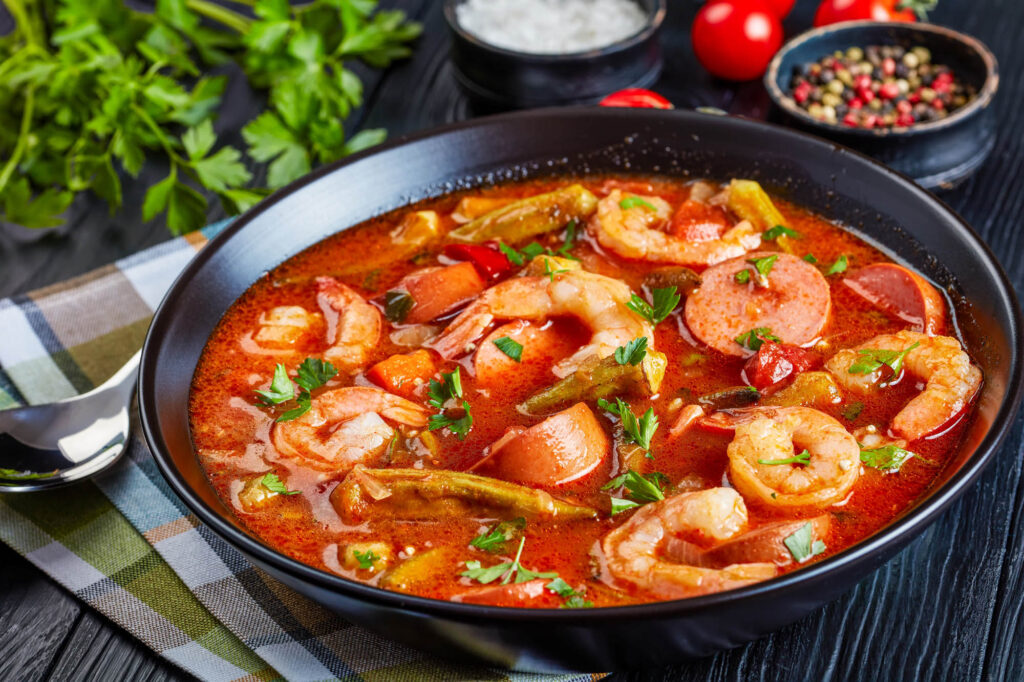
If you want to understand Louisiana Creole culture, order a bowl of okra gumbo. Do not rush it. Sit with it. Notice how the steam rises. Notice how the colour shifts from the edge of the bowl to the centre, darker where the roux has done its work, lighter where the rice has begun to absorb the broth. Notice that every household makes it differently, and that every household believes its version is the right one, and that both of these things are entirely true.
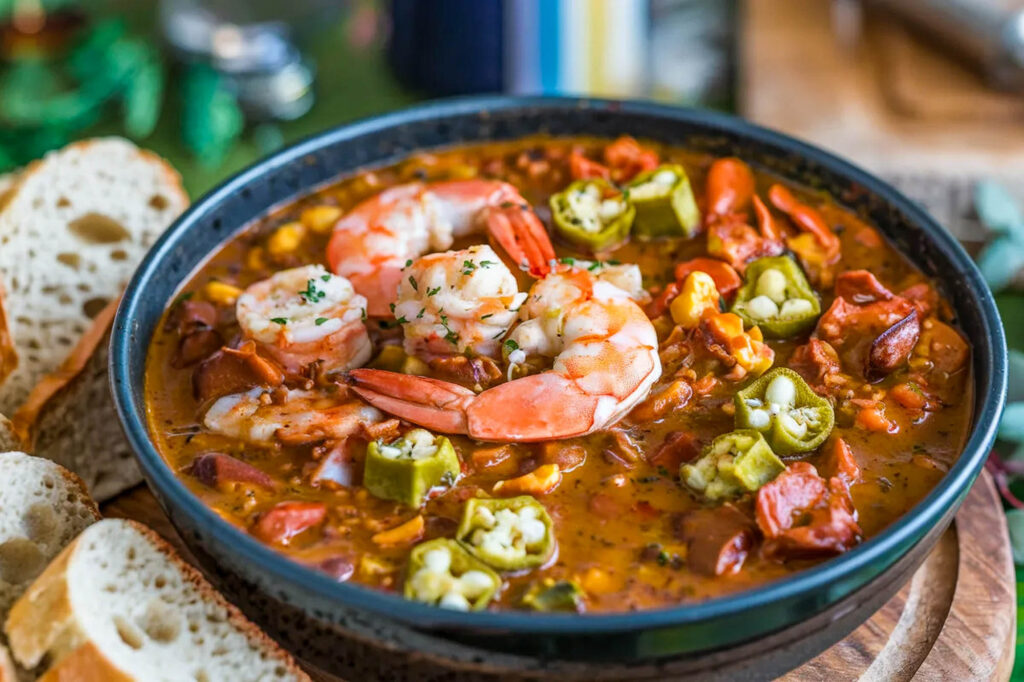
Okra gumbo is a dish that refuses to be standardised, and this refusal is part of its power. In one kitchen in Lafayette you will find chicken and andouille sausage. In a home kitchen in New Orleans, blue crab and shrimp. In the bayou parishes, catfish. Along the Gulf Coast, oysters. The okra is the constant, the anchor around which everything else arranges itself. It is what gives the dish its character before the spices are even added.
The foundation of any serious Louisiana gumbo is the roux: equal parts flour and fat, cooked slowly over medium heat and stirred without mercy until it reaches the precise shade of dark chocolate. A pale roux produces a thin, European sauce. A burned roux produces a bitter pot and a deeply frustrated cook. The perfect dark roux requires patience and attention, two qualities that Louisiana cooking teaches with affection and demands without apology.
Once the roux is ready, the trinity of celery, onion, and green pepper goes in. Then garlic. Then the stock, which in a seafood gumbo is built from prawn shells and crab bodies and whatever the sea gave up that week. The okra follows, sliced into rounds and added early enough to melt into the broth and do its thickening work. Then the seafood, never overcooked, added in stages so that each element reaches the bowl at its peak.
The result is not a soup. It is not a stew in the European sense. It is something that Louisiana invented for itself, a celebration in a bowl, a history lesson you can eat.
Creole Kitchen Tips
- Fresh okra: choose pods that are firm, bright green, and under 10cm long. Larger pods can become tough and fibrous.
- Frozen okra works well in gumbo. Thaw completely and pat dry before adding to the pot to prevent excess liquid.
- To reduce sliminess when sauteing okra as a side dish, cook it in a dry pan over a high heat before adding oil. For gumbo, the sliminess is exactly what you want.
- File powder (ground sassafras leaf) is a traditional Creole thickener. Add it only after the pot leaves the heat.
- The dark roux is non-negotiable. A light roux will not give you the deep, complex flavour that defines Louisiana gumbo.
- Gumbo improves overnight. Make it the day before, refrigerate, and reheat gently. The flavours deepen beautifully.
- Never reheat gumbo at a boil. Gentle heat preserves the seafood and keeps the broth clear.
Serving Suggestions and Variations
Serve gumbo always with white rice, cooked separately and placed in the bowl first. Crusty French bread on the side is traditional in New Orleans. A cold beer or a glass of sweet tea completes the picture.
For a chicken and andouille variation, replace the seafood with 500g of bone-in chicken thighs (brown them first in the roux pot before building the gumbo) and 300g of sliced andouille or smoked sausage. Add the sausage with the okra and the chicken once the stock is in.
For a vegetarian version, use a rich vegetable stock and increase the okra to 600g. Add two tins of drained butter beans and a tin of chopped tomatoes along with the stock. The result is simpler but still honest.
What the Pot Remembers
There is a reason people cry at gumbo. Not often, and not publicly, but the moment happens: the first spoonful at a family reunion after years away, the bowl that appears at a funeral because someone remembered the recipe, the pot your grandmother made that you have been trying to recreate ever since and never quite managing, though you keep trying because the trying is the point.
Louisiana Creole cooking, and okra gumbo above all, carries memory the way soil carries seed. The African women who planted okra in the Louisiana earth and stirred the first versions of this dish into being could not have known what they were building. They were surviving, as people do, by holding on to what they knew and making it work in a new world. What they left behind is a living tradition, still cooking on stoves across Louisiana, still making its way into new kitchens and new countries, still tasting of everything that made it.
Food does not lie. It cannot be revised or rewritten. When you sit down to a bowl of okra gumbo, you are sitting with West African farmers, with French Creole cooks, with Choctaw herbalists, with Caribbean arrivals, with Gulf fishermen, with grandmothers who never wrote anything down because they never needed to. The recipe was in their hands. It is now, slowly and with love, making its way into yours.
What to Serve with Okra Gumbo
- Long grain white rice: always, without exception.
- French bread: to soak up every last drop of the broth.
- Potato salad: a Louisiana tradition, served alongside or even inside the bowl.
- Sweet tea or lemonade for a non-alcoholic pairing.
- A cold American lager or a crisp Sauvignon Blanc if you prefer something with bubbles.
- Pecan pralines or bread pudding with whiskey sauce for dessert.