

There are festivals that fill a calendar, and there are festivals that fill a city. Festival International de Louisiane belongs to the second kind. For five days every April, Downtown Lafayette stops behaving like a Louisiana town of modest size and starts behaving like a crossroads of the world, with a Malian guitar line drifting past a crawfish stand and a Belgian stilt walker weaving through a crowd that speaks a dozen languages before lunch.
This year the festival turned forty, and Kreol Magazine travelled to Acadiana to see what four decades of that idea looks like in practice. What we found was not simply a music festival with good food attached. We found a working demonstration of something this magazine has spent its life arguing for, that Creole culture, Cajun culture, and the wider Francophone world are not separate rooms to be visited one at a time, but a single table everyone is welcome to sit at together.
A festival with no ticket booth and no closed doors, built entirely on the belief that joy shared is joy multiplied.
What follows is our account of those five days on Jefferson Street. The music that carried across continents in a single afternoon. The food that turned a city block into a communal table. The strangers who, by the second evening, were no longer strangers at all. And the quiet, considerable achievement of a small Louisiana city that has spent forty years proving the world is always better when it shows up together.
The trumpet reaches Jefferson Street before the band does. It moves through the crowd the way heat moves through a room in summer, felt before it is seen. A woman selling boudin balls from a folding table looks up and smiles without missing a beat of her ladle. A child on his father’s shoulders claps off time and does not care. Somewhere behind the stage, a Malian guitarist tunes a string that will, in a few minutes, sit comfortably beside a zydeco frottoir and a Cajun fiddle as though the three instruments had always known one another. This is Lafayette in April. This is Festival International de Louisiane.
Kreol Magazine travelled to downtown Lafayette this spring to witness the fortieth anniversary of a festival that has spent four decades proving a simple and stubborn idea. A small city in the American South, with its own particular French inheritance and its own Creole and Cajun soul, can open its arms wide enough to hold the entire Francophone world and still feel like home.
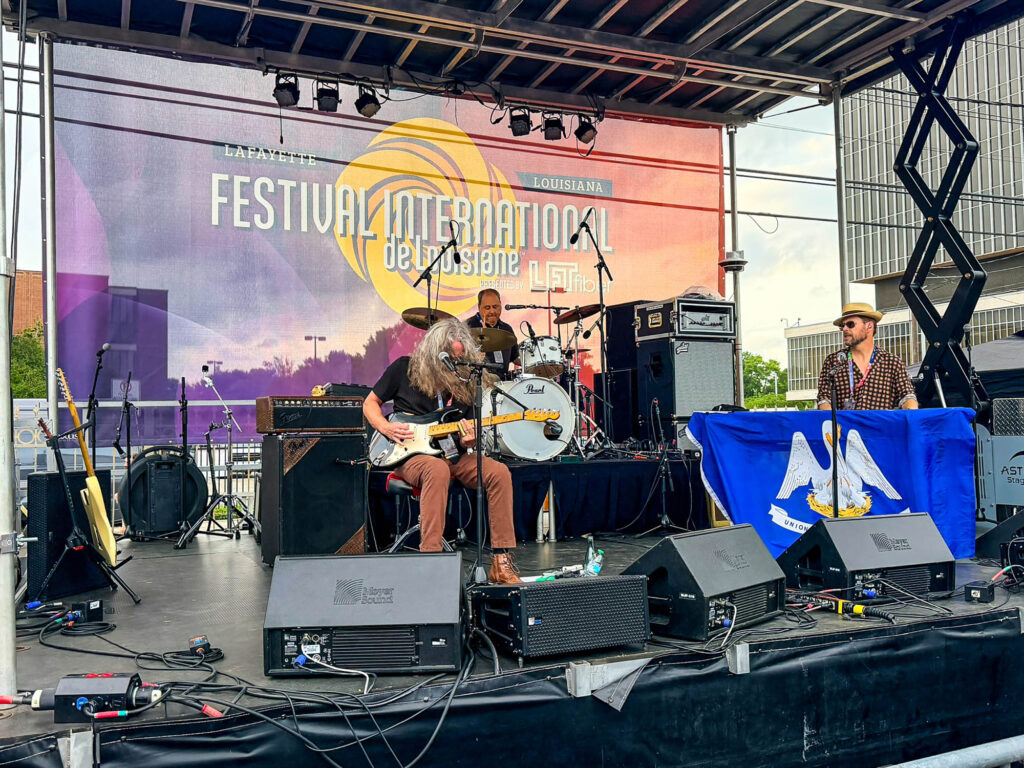
Forty Years in the Making
Festival International de Louisiane began in 1987 as an unlikely dream held by a handful of Lafayette residents who believed their city’s French roots deserved a stage as large as the ones in Europe and West Africa. Executive Director Scott Feehan, marking the fortieth edition this year, called it a milestone worth celebrating, describing a festival that started small and grew into something the whole world now recognises. What started as an unlikely dream has flourished into the largest free Francophone festival in the United States, and this year it welcomed hundreds of performers and visual artists from more than fifteen countries across seven stages over five days.
There is no ticket booth at Festival International. There never has been. The organisers describe it as a festival built on trust, funded through merchandise and on site beverage sales rather than admission, so that a family without a spare hundred dollars can still bring their children to hear a Cuban horn section or a Scottish folk trio for free. That decision, made decades ago and defended every year since, is part of why the festival has grown to draw visitors from up to forty eight states and twenty six countries in a typical year, and why more than three hundred thousand people were expected to move through Downtown Lafayette across the five days of the fortieth anniversary celebration.
The Music that Crossed Oceans
From the twenty second to the twenty sixth of April, the stages of Parc International and Parc Sans Souci carried a lineup built to honour the anniversary. Grammy winner Stephen Marley shared billing with folk icon Rhiannon Giddens. Louisiana’s own Zachary Richard and Sonny Landreth stood alongside Cimafunk from Havana, Vieux Farka Touré from Mali, Delgres from France and Guadeloupe, and Natu Camara from Guinea. A bluegrass band from South Korea called Country Gongbang delighted families who came expecting fiddles and found something entirely unexpected instead.
What makes Festival International different from a conventional music festival is its geography. The stages sit close enough together that a visitor can catch the end of a set from West Africa, walk two blocks, and find a Cuban brass section mid song, all without losing a beat of the afternoon. Belgian stilt walkers moved through the crowd in full costume. Zydeco accordions carried across the same air as Senegalese drums. It is, by design, a festival where no single culture is asked to perform alone.
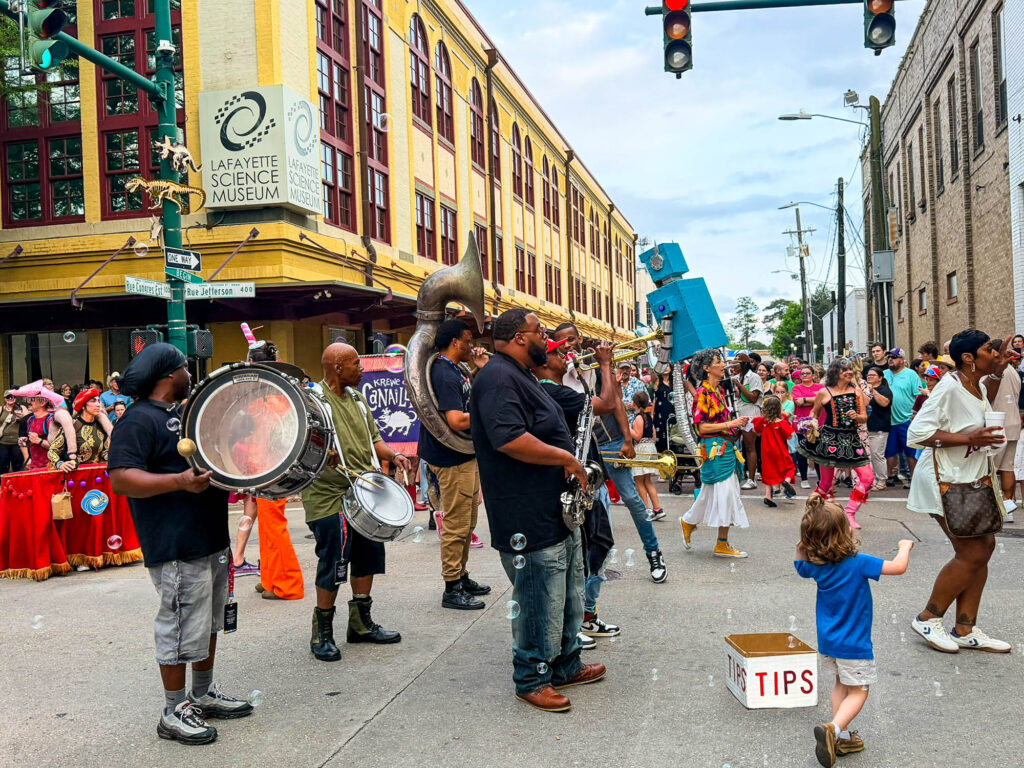
The Food, the Drink, the Table
If the music is the heartbeat of Festival International, the food is its memory. Twenty five food booths lined the footprint this year, and the smell of them announced the festival long before any stage did. Crawfish étouffée steamed in cast iron pots beside trays of boudin and cracklins. Cajun and Creole cooking, the true backbone of the region, sat comfortably next to Greek gyros, Vietnamese noodles, and Caribbean plates, each one tended by a vendor who had queued before dawn to claim their corner of the block.
This is Louisiana eating the way it was always meant to be eaten, standing up, in the open air, with a beer in one hand and a paper tray balanced in the other, while a brass band plays close enough to feel through the ground. Festival introduced a cashless RFID wristband system this year, sponsored by First Horizon Bank, so that a visitor could load funds once and move from a crawfish stand to a beer tent to a coffee cart without ever breaking stride to find their wallet. It is a small piece of modern convenience wrapped around a very old tradition, the tradition of a Louisiana table that welcomes anyone who is hungry.
The drink told its own story. Local breweries poured alongside Caribbean rum punches and French wine tastings, a reminder that Acadiana’s palate has always looked outward even as it stays rooted in its own soil. There was no pretension in any of it. A plate of red beans and rice cost the same respect as a plate of jollof, and both were eaten with the same appetite, in the same shade, by strangers who had, an hour earlier, never met.
A City made of Strangers who Became Family
What Festival International sells, if it can be said to sell anything at all, is proximity. It puts a grandmother from Opelousas on the same patch of grass as a student from Dakar and a retired couple who flew in from Belgium for the fortieth anniversary alone. Nobody is asked to prove they belong. The festival simply assumes that everyone does.
Kreol Magazine spoke with vendors, volunteers and visitors across the five days, and the same phrase returned again and again in different accents and different languages. People said the festival felt like family. A volunteer at the Wristband Registration tent, on her twelfth year helping run the event, said she no longer thought of the visitors as strangers, because so many of them return every April and greet her by name. A first time visitor from London, standing near the Scène Fais Do Do as Vieux Farka Touré’s guitar rang out over the crowd, said she had never been anywhere that felt so effortlessly international and so completely Southern at the same time.
That is the quiet success of Festival International de Louisiane. It is not only an economic engine for a mid sized American city, though it is certainly that too, drawing visitors whose spending ripples through hotels, restaurants and small businesses across Acadiana for weeks afterward. It is a five day argument, made in music and food rather than words, that difference is not a threat to community but the very material community is built from. For a magazine dedicated to Creole identity and heritage across a global diaspora, that argument is one worth travelling a great distance to hear made so joyfully and so well.

Kreol Magazine on Jefferson Street
Bringing International Kreol Magazine to Lafayette for the fortieth anniversary was never simply a matter of covering an event. It was an opportunity to place the Creole story of Louisiana, its food, its language, its music and its people, inside the larger conversation the magazine has been having with its readers across the Seychelles, Mauritius, the Caribbean and beyond. Wherever Kreol Magazine travels, the aim is the same. Seek out the threads that connect Creole communities to one another across oceans, and bring those threads home to readers who may never set foot in Louisiana but who recognise its rhythms all the same.
Across the five days of Festival, the Kreol team walked the footprint of Downtown Lafayette gathering the material for this feature, sitting with cooks between their lunch and dinner rushes, listening to musicians backstage as they prepared for sets that would carry Malian guitar and Louisiana fiddle onto the same programme, and watching a city give itself over completely to the pleasure of hosting the world. It was, without exaggeration, one of the great privileges of this publishing year to help bring such an enormous gathering of people together in these pages, from Lafayette locals who have never missed a single festival to visitors who crossed oceans to be there for the fortieth time this idea proved itself true.
Louisiana’s Creole heritage sat at the centre of that experience, not as a footnote to Cajun culture but as an equal and essential thread in the fabric of Acadiana, from the zydeco stages to the étouffée simmering in the food court. Kreol Magazine will continue to return to this region, because Festival International de Louisiane offers something rare among the world’s festivals. It offers proof, five days a year, every April, that joy shared freely across cultures is not a naive idea. It is simply good practice, tested for forty years running, in a small city in the American South that decided long ago to open its doors to everyone.
Looking Ahead
As the fortieth anniversary closed on the final Sunday evening, with the last notes drifting off Parc Sans Souci and vendors beginning the long work of packing down twenty five food booths, the mood in Downtown Lafayette was less like an ending and more like a promise. Organisers were already looking toward next April, and a coffee table book documenting four decades of the festival’s history was still finding its way into the hands of longtime attendees who wanted a permanent record of what they had just lived through.
Kreol Magazine left Lafayette with full notebooks, fuller stomachs, and a renewed sense of why this kind of gathering matters. Festival International de Louisiane does not ask its visitors to choose between Cajun and Creole, between local and international, between the familiar and the new. It simply lays the table and lets everyone sit down together. Forty years on, that invitation still works exactly as it was meant to.