

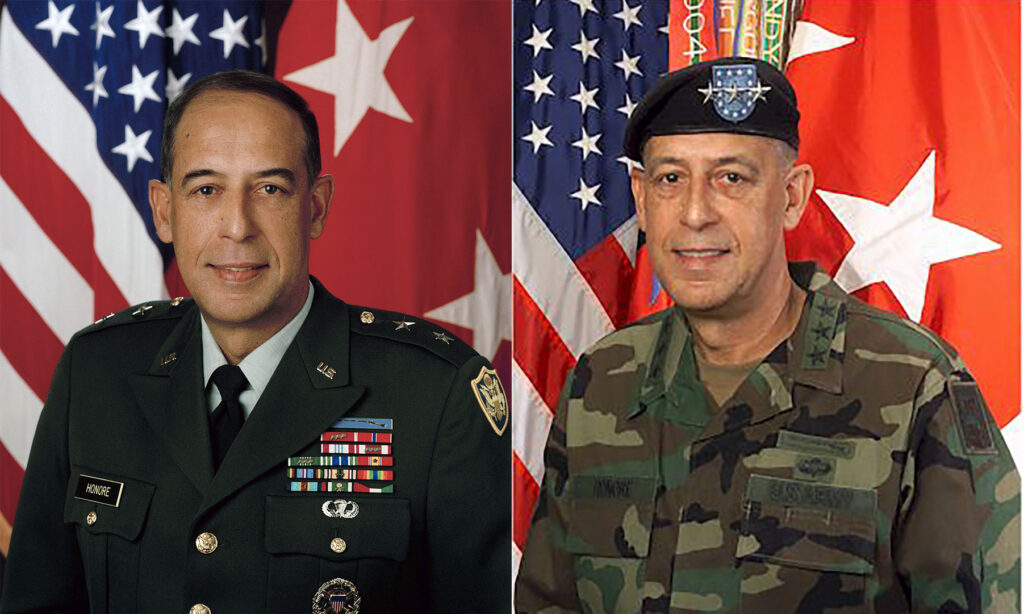
Lt. General Russel L. Honoré, a retired three-star general in the U.S. Army, rose to national prominence for his leadership during Hurricane Katrina. Born into a large Creole family in rural Louisiana, he served nearly four decades in global command roles. Since retiring, he has authored leadership books, founded the GreenARMY to fight pollution, and launched initiatives to support young African-American men. A lifelong advocate for justice and resilience, Honoré remains a powerful voice for environmental and social change.
Lt. General Russel Honoré, the retired US Army three-star general best known for serving as commander of the Joint Task Force, which coordinated military relief efforts during Hurricane Katrina in 2005, is, for good reason, a bona fide Louisiana hero, and an all-American one, too.
A professional soldier and adjunct professor for most of his adult life, Honoré radiates control and charisma, and, as one would expect from a distinguished military man, an air of unwavering command.
On his website, Honoré refers to himself as an “expert, leader, and fighter.” All three nouns are exceedingly apposite descriptions of this remarkable and profoundly inspirational individual who galvanizes any room he enters with his authoritative, calming presence.
Discipline, service, and courage, not to mention loyalty and integrity, are cornerstones of his outlook and character traits, which are deeply ingrained in his very being and sense of self.
Renowned for his booming, stentorian voice, his stern (yet when needed, compassionate) “thousand-yard stare,” and his direct, no-nonsense manner, General Honoré embodies the commanding presence of a battle-tested leader. These qualities reflect a lifetime forged through discipline, service, and a deep-rooted connection to his Louisiana heritage, a legacy of strength, resilience, and principled action.

Lt. General Russel L. Honoré -Upbringing
Honoré was born in 1947 in an old wood cabin on a subsistence farm in Lakeland, Pointe Coupée Parish, Louisiana. The youngest in a string of eight boys and one of twelve siblings, Honoré was born during a hurricane, an early sign, perhaps, of the storms he would one day navigate as a soldier and leader. Raised in a rural, agrarian community, Honoré’s early years were shaped by hard work, family, and the rhythms of the land. He recalls fondly, “All the time I was growing up, we rented land to raise cotton, corn, sugarcane, pigs, and cows. You had a big garden, you had a few cows, you had a few pigs – that’s subsistence. The cash crops were sugar cane, cotton, and corn.”
Like for many Creoles at that time, it was an often arduous upbringing, earning a living from the land. As he has previously stated, “I grew up poor, but we had a good family.”
He states with a matter-of-fact delivery devoid of pathos, “When you grow up poor, you’re going hand to mouth all the time.”
Despite his straitened circumstances, Honoré was taught the value of hard work by his father and mother and realized the importance of being prepared from an early age. “We had one light hanging from the ceiling with a drawstring, and the electricity would often go out. So people had coal oil lamps – they had a level of preparedness.”
Honoré’s childhood also taught him about the inherent mutability of nature. As he recalls, “The other thing I learned as I grew up, when the hurricanes come, sometimes you would end up with more chickens after the storm than you had before because they would migrate, or you’d have a couple of fewer pigs, because the pigs got out or they got into the bayou or somebody else got them. And if you were lucky, your garden was still there.”
In such an environment, Honoré learnt another vital life lesson: the need to adapt. This is something he would go on to harness later in life, and which would become central to his outlook.
On His Creole Heritage and Identity
Honoré describes himself as an “African-American Creole” of mixed black and Creole heritage, combining French, African, and Native American ancestry. Like most Louisiana Creoles, he was raised Catholic.
Education
Honoré’s journey out of Lakeland began through involvement in the New Farmers of America (NFA) and the 4-H Club during high school. A pivotal moment came with a school trip to Atlanta that expanded his cultural and geographic awareness. “I attended the New Farmers of America National Conference in Atlanta as a sophomore. That was my first time going to a big city. We stayed at Morehouse College in some dormitory rooms during their summer break,” he recalls. The experience left a lasting impression: “It was a real education because it was a large middle-class African-American community there. They had stores. I mean, these people walked around in suits. It was something to behold on that university campus. I said, ‘Wow, this is how you could live if you’ve got an economy, an education, and people working together.’” Not long after, the NFA, historically for African American students, was integrated into the Future Farmers of America (FFA), a predominantly white organization, through a federal push for funding equity and consolidation. This shift marked a broader movement toward integration in agricultural education across the South.
University
Initially keen to become a veterinarian, Honoré soon realized his limited options. He explains, “When I graduated from high school, it became apparent that I didn’t have the science skills to compete in the veterinary program because the only veterinary school was the flagship one at LSU.” He continues, “So I did what most people do – I went to an HBCU. I went to Southern University in Baton Rouge. I couldn’t be a vet, so I studied agriculture and thought of being an agriculture teacher. And then I wanted to be a farmer. That was my childhood dream.”
While at Southern University, Honoré joined the Reserve Officer Training Corps (ROTC) during the height of the Vietnam War. He explains, “Because Southern was a land-grant HBCU, the first two years of ROTC were mandatory. If you didn’t participate, you could be drafted.” However, for Honoré, staying in ROTC wasn’t just about avoiding the draft; it was a deliberate decision. “I chose to stay in ROTC for all four years because I wanted to be commissioned as a Second Lieutenant,” he recalls. That decision began a military path that would define much of his life. He graduated in 1971 with a B.S. in Vocational Agriculture from Southern University.
U.S. Army Career
What began as a purposeful decision to pursue an officer’s commission through ROTC at Southern University evolved into nearly four decades of distinguished military service. General Russel Honoré rose steadily, taking on increasingly complex leadership roles marked by strategic command, crisis response, and a steadfast commitment to national service.
He held numerous critical roles, including:
- Instructor at the United States Army Armor School
- Commander of C Company, 4th Battalion, 54th Infantry
- Assistant G-1 (Personnel) for the 1st Infantry Division (Forward), United States Army Europe and Seventh Army
- Commander of the 4th Battalion, 16th Infantry, 1st Infantry Division (Forward) in support of Operations Desert Shield and Desert Storm
In 1999, Honoré served as the Vice Director for Operations for the Joint Chiefs of Staff, supporting the Department of Defense’s planning and response to Hurricane Floyd and the U.S. military’s response to the flooding in Venezuela and Mozambique.
In 2004, Honoré became the 33rd Commanding General of the U.S. First Army at Fort Gillem, Georgia, where he coordinated military preparedness and response for hurricanes Charley, Frances, Ivan, and Jeanne. His leadership during Hurricane Katrina in 2005, where he commanded Joint Task Force Katrina, solidified his reputation for effective crisis management and earned him the nickname “Category 5 General”.
Honoré’s notable positions also included:
- Commanding General of the Standing Joint Force Headquarters-Homeland Security, U.S. Northern Command
- Deputy Commanding General/Assistant Commandant at the United States Army Infantry Center and School, Fort Benning, Georgia
- Assistant Division Commander, Maneuver/Support, 1st Cavalry Division, Fort Hood, Texas
- Brigade Commander, 1st Brigade, 3rd Infantry Division, Fort Stewart, Georgia
Throughout his career, General Honoré exemplified leadership, resilience, and a commitment to service, earning numerous military decorations, including the Defense Distinguished Service Medal, the Distinguished Service Medal, the Legion of Merit, and the Bronze Star Medal.
Training and California
After a year of infantry school training at Fort Benning, Georgia, where he arrived in February 1971 – by which time, luckily for him, the Army had stopped sending large groups of infantry to Vietnam- Honoré’s first assignment was in California.
“In 1972, I got assigned to a command focused on developing new equipment post-Vietnam, such as creating night vision capability, creating anti-tank missiles, and creating advanced helicopters. It was a build-up for the Cold War to keep the Soviet Union down.” He adds, “We needed better equipment than we had in Vietnam. Whereas Vietnam was a jungle fight, the future fight would be on the planes in Germany against the Soviet Union. So our training changed from jungle warfare to tanks, armored vehicles, artillery, and helicopters with many weapons.”
After spending two years in California, he was duly assigned to Korea. By then, he was married and had one child, Stephanie. His wife and daughter moved back to Baton Rouge while Honoré took up his position abroad.
South Korea
During his military career, Honoré had two postings in South Korea, the second of which was as the 2nd Infantry Division’s commander. It was a country that he found to be a real culture shock. He explains, “They did many things differently but very effectively.” He continues, “It was an emerging democracy with an authoritative leader. At that time, if a Korean army general or colonel was going through the town, they turned the sirens on so people would get out of the street. That’s how much respect the Korean people had for the military.”
Korea was in the process of changing, both economically and culturally. “At that time, it was a country in transition. You could drive through Seoul and see a cart pulled by an ox, then a Mercedes or a Cadillac right next to it. You would drive through the countryside and see people plowing fields with small tractors with a cart on the back.”
He also found the midnight curfew discombobulating. “Everybody was off the street at midnight because of the threat from North Korea, and everything shut down, including all the clubs and restaurants. It stayed that way for the American GI for years. But when I first got there, it also included the Korean public. They closed the country down so they could watch for North Korean infiltrators.”
Honoré quickly acknowledges that his postings in Korea provided him with invaluable lessons. When asked if he enjoyed his time there, his reply is diplomatic, revealing: “Enjoy is not a word I would use, but it was a life-learning experience.”
After Korea, General Honoré continued to rise through the ranks, holding multiple high-level command and operational roles that sharpened his leadership skills and prepared him for one of the most significant challenges of his career: leading the military response to Hurricane Katrina.
Leadership During Hurricane Katrina
When Hurricane Katrina ravaged the Gulf Coast in 2005, Honoré was designated commander of Joint Task Force Katrina and thus played a seminal role in coordinating the disaster relief.
This appalling meteorological and humanitarian tragedy catapulted the General overnight into the public consciousness and afforded him national media exposure, recognition, and even celebrity. So successful was he after what was widely believed to be a poor performance by the Federal Emergency Management Agency (FEMA) that he became known as the “Category 5 General,” and the then Mayor of New Orleans Ray Nagin dubbed him “one John Wayne dude” – a flattering nod to his gruff, straight-talking management style and peerless ability to get things done.
At the time of Katrina, Honoré commanded the First Army, which included the part of the country east of the Mississippi River. “My job was to train and mobilize National Guard Reserve troops and then be prepared in case there was a natural disaster to go to provide comfort and assistance.”
As the scale of the Katrina tragedy unfolded, even getting Honoré to New Orleans proved to be a logistical and bureaucratic challenge, given that the city was not in his command area. “As the storm was approaching, I was at my headquarters in Atlanta, and we were focused on Mississippi and Alabama as the two most likely places the storm would go. Then, by Saturday, the forecast had changed, and it was coming toward New Orleans, which was not in my area of operations. I requested helicopters, ships, and troops to cover my area of Mississippi. Still, they said we are not approving this because we don’t send troops unless FEMA (Federal Emergency Management Agency) asks for it. FEMA will not ask for it until the Governor asks for it.”
Honoré then wanted to fly to New Orleans, but his staff advised against doing so due to the adverse weather conditions. After persisting, he drove from Atlanta to Birmingham and Camp Shelby. On arrival, he called his boss. As he vividly relates, “I called my boss, a Navy Admiral at Northern Command, and said, ‘Boss, I’m at Camp Shelby.” And he said, “Damn Russel, what are you doing at Camp Shelby? We have no orders yet. “I said, first of all, I got troops here. Second, I don’t need an order to do my mission to save American lives. That’s what we are doing. Our mission is to save lives.”
The decision to create a task force was duly made, and Honoré begged to be given charge of it. The reply from his superiors was colloquial but effective. “They said, “Tell that general to get his ass to New Orleans! It looked like a grand plan to send a Louisiana boy back.”
However, immensely frustrated by the delay in responding, Honoré had to begrudgingly resign himself to adhering to the established protocols. “The higher headquarters in the Pentagon and the bureaucracy in Washington were looking sequential. You wait until the storm happens, then for the governor to ask for help. Then, the federal government responded. That’s nonsense. But that’s the way the laws were written.”
Still chomping at the bit to reach New Orleans so that he could assist, Honoré managed to secure a helicopter from a combat ship under the command of a Navy Captain he knew from his time at the Pentagon and finally made it into the devastated city. “I flew into New Orleans on that Navy helicopter around 9.45 am Wednesday. The pilots flew over the Superdome and landed right next to it. When the helicopter came in, it hit the limbs of the trees to get me on the ground.”
As former Mayor Ray Nagin has famously said of Honoré, “He came off the doggone chopper, and he started cussing, and people started moving.”
Seeing the human anguish at the Superdome has inevitably stuck with the General. As he recalls with tangible emotion in his voice, “I remember probably 14,000 people out there standing in the Superdome, watching that helicopter landing and looking in the eyes of the people. Walking off the helicopter, I saw a woman pushing a shopping cart through floodwaters, trying to reach dry ground. Inside was her baby, nearly submerged up to its neck. I thought, Okay, we have some work to do.”
Honoré immediately met with the Mayor of New Orleans, FEMA, and the Head of the Louisiana National Guard. As he relates it in his own inimitably direct style, “I said, ‘What do we need? What are your priorities, Mayor? He said to evacuate the city. I said, OK.”
Thanks to the General’s swift and decisive action, some 200 helicopters with troops had already arrived by Friday. However, one logistical problem he needed to address was where to put the troops being flown in to assist with the relief effort.
“I said, “Wait a minute, we have got to sort this out because if I’m going to bring all these troops in, we haven’t gotten the people out of the city yet. The Mayor prioritized evacuating the city because there were no lights, water, or food.”
He elucidates his problem with faultless logic: “You had to do it in stages. You had to get the people out and focus on that because if you leave people, you can bring in more troops to help them; that’s stupid. We had to get to the search and rescue because there were people still trapped in their houses. So I said, let’s get those people at the Superdome and the Convention Center out on buses first, then we can land with troops to start doing the search and rescue, and that’s what we did.”
In the six weeks he was on the ground in New Orleans, Honoré flew by helicopter from trouble spot to trouble spot. He inspired relief workers and storm victims with his relentless energy and tenacious determination to get the job done at all costs.
Hearing Honoré recount his Katrina journey is both humbling and inspiring in equal measure – humbling that one man’s dogged perseverance, mental fortitude, and decisiveness in the face of so many logistical and bureaucratic obstacles could save countless lives and directly alleviate the abject suffering of so many in arguably the city’s darkest hour, and inspiring when both the best and the worst of humanity was on display for the world to see.

Books, Broadcasting, and Speaking
Since retiring from the army in January 2008, Honoré has dedicated himself to writing and broadcasting about – and thus sharing – the knowledge he gained from his extraordinary military career.
He is the author of three best-selling books drawing on his leadership achievements – Survival (2009), Leadership In The New Normal (2012) and Don’t Get Stuck On Stupid (2017) (the title being one of his famous slogans), Honoré has successfully distilled the precepts from his remarkable life as a warrior leader – one forged in the most intense and demanding of crucibles – into easily digestible (and intensely readable) self-help guides.
These focus on his experiences managing natural and artificial conflicts to overcome adversity and build resilience. Whether developing a preparedness mindset, implementing critical strategies to respond to crises, or articulating the essential qualities that 21st-century leaders need, Honoré has the distinct advantage of being a man who knows what he speaks, having lived it and done it himself at the highest level.
Referring to himself as “a voice America trusts,” Honoré is an acknowledged authority on disaster management, national security, the climate crisis, and government and military leadership. As a result, he has been a regular contributor to CNN and NPR and continues to be in demand on the after-dinner speaking circuit, where he communicates his vast wisdom with patriotism, panache, and often colorful humor.

GreenARMY
Perhaps somewhat surprisingly, the General’s latest challenge is not a military one but an ecological one. Honoré does not look like your typical eco-warrior, yet he is now engaging the enemy in a very different field of combat.
Honoré was moved to found the GreenARMY – an alliance of civic, community, and environmental groups – in 2012 after a devastating 30-acre sinkhole from a collapsed salt dump forced hundreds of Bayou Corne, Louisiana, residents from their homes. When the government and local corporations failed to respond, residents called the General for help, and he magnanimously took up their cause.
As he recalls, explaining how he first came to be involved, “There were over a hundred homes in this little community in and around where the salt dump collapsed. The people who lived there knew of me from Katrina, and they knew I had moved to Baton Rouge, so they called me and said, “The governor’s not listening to us. The federal government’s not listening to us. We need your voice.”
He continues, “So I went to meet with them. They were 99% Cajun, and they were all diehard Republicans. They said, “They’re just not paying attention to us. We need your Katrina voice to lead. To hell with the government!”
Honoré duly got the families’ media attention and gave a speech to environmental groups at Xavier University in New Orleans. He recalls, “The speech resonated with a lot of people. As I went by this one desk, one of the people yelled out, “You know what, General? You ought to create your army. You ought to create a green army.”
Having had something of a Damascene conversion, Honoré began to realize the broader ramifications. “I started to see that this is bigger than just Bayou Corn. We’ve got to save Mother Earth.”
Speaking at another conference, he issued a rousing and inspirational challenge full of military rhetoric to the student audience, which articulated his new aim: “Your great-great-grandparents fought in World War One. Your grandparents fought in World War II. Your parents fought in Vietnam. Your war is to save the earth.”
Despite some students’ reluctance to get involved, who were worried by the size of their student debt, Honoré was brutally concise and direct in his response, primarily since he had worked his way through university: “Suck it up! We still need you to be involved in saving the climate.”
After further contemplation, the GreenARMY’s mission was born. As Honoré says sagely and with admirable conviction, “Our mission is to find solutions for pollution. It’s not just fossil fuel; it’s also the sewage water. Where does it go? Does it end up in the river, or is it being treated? Where is our garbage going? Is it being recycled and turned into energy, or is it just being put in a dump? We have to find solutions for pollution because when we find solutions, it will reduce our impact on Mother Earth.”
Honoré passionately believes that preventing climate change is essential to protecting communities from hurricanes and other natural disasters, hence his newfound and unwavering commitment to this righteous cause. He states with enthusiasm and realism, “It’s not just about climate change. It’s about finding a solution to pollution because the pollution is what’s causing climate change. Business makes the world go around, so it has to have a business proposition.”
Combating air pollution and ensuring clean water for Louisiana is also central to the General’s vision for GreenARMY. Seeing the devastating impact of air and water pollution on families in his home state made him want to take on a new mission: fighting the global climate crisis.
“The two most egregious things here in Louisiana are air and water pollution. We’ve got 150 chemical plants between Baton Rouge and New Orleans.”
Honoré does not mince his words and delivers them in his traditionally forthright style. “We call it Cancer Alley, but the government in Louisiana despises you if you use that word. They said, “There’s no such thing.” But it’s proven. There is a high concentration of cancer and a high concentration of prenatal deaths here, and we think it’s attributed to the pollution.”
He continues, ire in his tone and genuine humanitarian concern etched on his face, “The establishment says it’s their lifestyle – that these women smoke and they eat the wrong stuff. Bullshit! It’s the chemicals in the river water. By the time the Mississippi arrived, thirty states had dumped their sewage, industrial run-off, and agricultural run-off in that river. Most people between here and south of New Orleans have to drink that water. That’s having an impact on people. The life expectancy here is ten years less than in the rest of America.”
Assessing U.S. Capitol Security
Despite being retired for over a decade, Honoré remains at the forefront of public service to his nation. In January 2021, at the request of the Speaker of the House, the General selflessly heeded the call to lead a Task Force to review and improve security following the failures and breaches during the attacks on the Capitol on January 6th, 2021. Nancy Pelosi said the General was a “respected leader with experience dealing with crises,” his appointment was met with praise and commendation from all sides.
A Commanding Voice for Haiti’s Diaspora
Lt. General Russel Honoré is channeling the determination that saved New Orleans after Hurricane Katrina into advocating for Haitians at home and abroad, as gangs tighten their grip on Haiti, causing violence, mass displacement, and hunger.
He played a key role in moderating the 2021 Haiti Unity Summit, leading to the Louisiana Accord, and emphasizes that addressing urgent humanitarian needs is just the beginning; lasting security and nation-building are essential. By rallying Haitian Americans to leverage their resources and influence, Honoré is a vocal advocate for Diaspora unity, international participation and a collective effort to disarm gangs, restore governance, and rebuild livelihoods in a country plagued by natural disasters.
The Honoré Center
Cognizant of the power of education to create life-changing opportunities for young people from all walks of life, General Honoré founded the Honoré Center for Undergraduate Student Achievement (CUSA) at his alma mater, Southern University in New Orleans—an initiative of which he is rightfully very proud.
The program aims to provide resources to African-American men enrolled in college and increase the number of certified male teachers in urban classrooms.
Seniors from New Orleans-area high schools with leadership potential who want to give something tangible back to their community are recruited to the program and supported to complete their college education at Southern. Upon completion of the program, participants are required to serve at least two years as local classroom teachers, thus proving their commitment to supporting the uplift of their communities.
Beyond this program, Honoré has also been involved in academia and public engagement. He joined The Gallup Organization as a Senior Scientist and served on the faculties of Emory University’s Rollins School of Public Health and Nell Hodgson School of Nursing. These roles have enabled him to widely share his expertise in disaster management and leadership.
Giving back – to one’s alma mater, to one’s community, and society at large in such a noble and generous way – is typical of the character of a man like Honoré.
Honors and Awards
In addition to a plethora of military medals, badges, and decorations accumulated during his long and illustrious career, including a Bronze Star and an Army Distinguished Service medal, Honoré has also received numerous civilian awards for his leadership contributions, including an NAACP Humanitarian Award, a National Newspaper Publishers Association Newsmaker of the Year Award and six Honorary Doctorates from prestigious academic institutions.
During halftime of the Independence Bowl in Shreveport on December 30, 2005, Honoré was honored with the Omar N. Bradley “Spirit of Independence Award” for his outstanding leadership post-Katrina, which greatly assisted Crescent City’s recovery. He was also awarded the Key to the City Award by New Orleans for his exemplary military service.
Family
Honoré currently resides in Baton Rouge with Beverly, his wife of many years, and their four children: Stephanie, Kimberly, Michael, and Stephen.
Acutely aware of the toll his peripatetic military lifestyle has taken on his children, being constantly uprooted and made to move school to follow their father’s national or international postings, the General’s top priority is now his children. With pride and a discernible tinge of regret, he says, “We have four kids, all born during my various assignments in different places, be it in Georgia, Holland, or Germany, so I now do everything for my kids that I can.” He continues, conscious of his family’s sacrifices for his job, “My youngest son attended six different schools by the time he got to high school.”
A Lifelong Bond with Horses
Lt. General Russel Honoré is well-known for his love for horses, a passion deeply rooted in his childhood on a farm in Lakeland, Louisiana. Growing up, he rode horses to help with farm work, a necessity in his rural upbringing. This early connection to horses laid the foundation for a lifelong affection for these animals.
One of his beloved horses is Big Red, a registered Quarter Horse with a racing lineage. Big Red, originally named Crimson Pie, spent eight years as a cow horse before becoming part of General Honoré’s life as a retirement gift in 2011. Big Red’s calm demeanor and excellent training make him a treasured companion for Honoré.
General Honoré ensures that Big Red receives top-notch care at the LSU School of Veterinary Medicine. The horse has garnered a following on social media, with fans regularly inquiring about his health. In 2021, Big Red faced health challenges, including kidney disease and a hoof abscess, but received comprehensive care from a team of veterinarians at LSU. Honoré’s dedication to Big Red’s well-being is evident in his frequent visits and attentive care routines.
This love for horses and commitment to their care reflect General Honoré’s deep connection to his rural roots and his enduring appreciation for the animals that played a significant role in his early life.

Lt. General Russel L. Honoré – Three Wishes
Regarding the proverbial three wishes he would like if granted, Honoré is unequivocal and doesn’t need much time to think. He replies with clarity and customary indubitable force, articulating his ecological concerns, profound commitment to racial and social justice, and desire for greater equality.
“Firstly, a commitment from the government is needed not just to talk about it but to stop pollution so that we can save Mother Earth.”
He continues with evident passion, “Secondly, equality among people, regardless of your race, gender, or creed. For all people to have equal opportunities for education, justice, and housing. Those would be the three things.”
Conclusion
Lt. General Russel Honoré is not only an American military colossus – embodying the finest virtues of bravery, loyalty, and integrity after a lifetime of service to his country and his people, but also a zealous eco-warrior, ardently committed to raising our communal level of awareness about climate change, pollution and the state of the planet, be it in Louisiana itself or more globally.
A working-class Creole boy made good through talent, hard work, and drive – and one who took full advantage of the career opportunities available to him in the Army at the time to provide an escape route out of rural poverty, Honoré is the classic “from the log cabin” narrative.
Whether General Honoré harbors any political ambitions remains to be seen. Many would view him as a compelling and unifying figure if he ever chose to enter the national political arena. In a time when public confidence in leadership is increasingly strained, a leader of Honoré’s caliber, defined by service, discipline, and a steadfast commitment to the common good, could help restore faith in the nation’s highest office. With patriotism and duty woven into the fabric of his life, his reputation for action in the face of adversity would make him a formidable and respected presence in any arena he chooses to enter.
As the saying goes, “Once a warrior, always a warrior!” Rest assured, this determined Creole son of Louisiana has plenty of fight left in him. He is more determined than ever to win yet more essential battles, even if they are ecological, social, and political, as opposed to military ones.
It is reassuring to know that old soldiers like Honoré are determined to valiantly keep fighting for both the good of the American people and that of the planet until their last breath. Diehards like the General never give up and will either triumph or be carried out on their shield, trying. The city and the people of New Orleans were indeed hugely fortunate to have had him in charge in their hour of need. With his tenacity, resolve, and indomitable spirit, my money is on Honoré, still leading, serving, and fighting for what matters most.