Ted Ellis is a man of genuine polymathic talents. What’s more, he is the living embodiment of the unification of that dichotomy famously described by English novelist and scientist C.P. Snow in his 1959 book The Two Cultures – a rare breed, able to combine a love of – and stellar achievement in – both the Arts and Humanities and the Sciences.
An astonishingly successful son of Louisiana, born and bred in New Orleans, a chemist by academic training, a former soldier, now a famous, critically and commercially acclaimed portrait artist by profession and more recently, a museum director, as well as a Federal Commissioner, his entire life has been dedicated to pursuing, in one way or another, his true vocation as an artist and using art as a conduit to help and heal others. In so doing, he has striven to uplift Louisiana’s African-American community by telling their stories with compassion, dignity and an abundance of humanity.
Upbringing
Raised in the Lower Ninth ward of New Orleans (the predominantly African-American neighbourhood severely damaged by Hurricane Katrina in late August 2005), his parents were a huge source of artistic inspiration to him. With his mum a beautician (“an artist of sorts”) and his father a musician (a percussionist who had his own band), his parents bequeathed him an artistic temperament as well as entrepreneurial zeal.
Although his parents had no tertiary education, Ellis nevertheless appreciated their improvisational abilities and realised that he, too shared the same kind of artistic talent, albeit one he expressed differently. “So everything that we had and did was utilitarian. We used it creatively, be it cooking, my dad’s improvisation, how he played off of just listening, or what my mom did with hair. I knew I had the same kind of artistic talent from my parents. I just expressed it differently – in drawing art.”
As Ellis explains, fondly recalling how his first tentative steps towards a life of art were inspired by reading comics as a child, “I gravitated toward art, toward drawing, sketching and doodling at a very early age. I was a very inquisitive child. I read early and what always caught my fancy were comic books. I would doodle and sketch at the kitchen table.”
It was in the seventh grade that he knew he wanted to become an artist, having had an inspirational art teacher at Junior High school, Anna Torregano. As Ellis recalls her impact on him, immense gratitude audible in his voice, even all these years later,
“She was like a surrogate mother for me, in the sense that she provided everything and nurtured everything that I wanted to learn about art.”
Jackson Square
As a child, around the age of 11 or 12, Ellis began to frequent New Orleans’ French Quarter, in particular, Jackson Square – the Crescent city’s answer to Paris’ famous Place du Tertre in Montmartre, where artists would congregate, set up their easels and paint commissions, often for the tourists who would throng to buy, watch them paint or simply savour the bohemian, artistic ambience. Making his way to the square on public transport and standing no more than four feet tall, the inquisitive little boy from the Lower Ninth ward rapidly became enchanted by what he saw there – and what he saw, imbibed and learnt in that square would directly alter the course of his entire life.
It was in Jackson Square that a young Ellis had an artistic epiphany if you will, and was first seduced by the sheer power of art, realising just how he wished to spend his life. Jackson Square thus became his “cultural and artistic sandbox” – a playground of dreams and inspiration for a child often rapt in awe at the artwork he saw being created around him.
As he proceeds to explain, looking back fondly on those halcyon days, “The flavour of artistic expression and creative ingenuity was right there in Jackson Square. You had portrait artists, you had artists who were painting scenes from rural Louisiana to urban areas of the city. I was enthralled by that. And because I was so inquisitive, I stopped and engaged.”
Describing himself self-deprecatingly as “the little kid with a thousand questions and with the big old feet,” Ellis frequented Jackson Square almost every other weekend, spending several hours at a time around the artists, merely watching and observing.
It was there that he learnt to “engage with artists with different attitudes and different personalities and watch how other people engage.”
For the young Ellis, Jackson Square was “a cultural, urban laboratory of engagement, fulfilment and enlightenment” which forcefully stuck with him. Commenting on his concomitant passion for reading, learning and book knowledge, he explains, “I would just sit and listen and learn (in Jackson Square). And then I would eventually head over to the library on Loyola Avenue, and that opened me up internationally, because I could go right into the world of books and encyclopaedias and read and learn.”
It was thus by spending time in Jackson Square that the young Ellis found art to be “a universal language.” He also learnt more about the city of New Orleans, about “how people were enamoured with coming here, and how they always gravitated to the French Quarter, to the artists. So, early on I understood the power and the magnetism of art and the eloquence of it. That stayed with me.”
As he says, readily acknowledging just how formative and instrumental Jackson Square was on his child’s psyche and the development of his artistic passions, “My museum without walls was Jackson Square, New Orleans.”

Education + First Career (as a Chemist)
Flourishing academically in high school, Ellis decided to study Chemistry at Dillard university, as he thought it was a hard discipline and relished the intellectual rigour and challenge. Yet despite the allure of bunsen burners, formulae and white lab coats, his true passion was always art. As he recalls, “I would frequent the art department at Dillard university. I would engage the professors and the students.” What’s more, Ellis at the time was “a closet artist.” He adds, “Nobody really knew I was painting and painting at my mom’s kitchen table and had immersed myself in that vernacular, that conversation of art.”
In fact, throughout his formative years, throughout high school and into university, Ellis was obsessed with finding out the answer to one all-consuming question. “How do you become a professional artist? That was the question, but where do you find the answer?” He explains, “I would ask the portraiture artists in the French Quarter, when I graduated from high school and I’d ask the professors at Dillard University when I got there.”
But, not wishing to become the cliched “starving artist” – a phrase which conjured up images of an arduous, dissolute Baudelairean existence, of poorly heated garrets and impecunious struggles, Ellis duly earned a B.Sc. in Chemistry from Dillard University, on both an academic and a US Army ROTC scholarship and went on to be commissioned second lieutenant in the US Army’s Field Artillery branch. But even as an officer in army, he would still paint on the weekends. Recounting with a smile, he recalls, “Everybody said, why are you an officer? You need to be an artist. You need to be painting full time.”
Determined to resist a life of artistic penury, he then spent the next ten years working in the field of chemistry, eight years of which were as an environmental chemist at Rollins Engineering Services. Throughout his time in the Army and as an environmental chemist, Ellis still continued to paint, indulging his ever-consuming passion for art, often working out of a studio in his garage. The City of New Orleans two-coworkers bought two paintings $40.00 each.
His work as a chemist then brought him out to California, where he came under the tutelage of Ed and Wally Garcia, famous father and son artists. It was there that he discovered his talent for portrait painting. “When I dipped that brush in paint and I applied it to the canvas, I could get to tell a story – a story about who I am, or that person that I captured.”
Ellis also began to realise exactly what it was that he wanted to paint, what he wanted to say in his paintings, and what he sought to achieve through his art. “I wanted to tell this story about African American history and culture. And I started reading a little bit more about African American artists and social commentary and social activism and their work. And so, that was my purpose.”
Reflecting on that purpose, he states proudly and resolutely, “It has been thirty years in paint and I have not shifted or moved away from that intentionality.”
Second Career (as a Full-Time Artist)
With the exception of some art class in high school and a few private lessons, Ellis is an autodidact, and demonstrably proud of the fact that he is self-taught.
After finally plucking up the courage to devote himself to his art and pursue his abiding passion full time, without the financial safety net of regular paid employment, Ellis quit his job as a chemist in 1996. He then competed (against 500 others) for, and won a 1998 Walt Disney Studios commission for art in honor of Black History Month, which effectively gave him his big break and propelled him on his current dazzling artistic trajectory.
Today, Ellis is best known for his African-American-themed art which depicts the manifold joys, sorrows, and experiences, some positive, some negative, of his community, but always with thoughtfulness, kindness and respect. He has described his style at times as “conventional realism”, and also as “a bold blend of realism and impressionism, and as impressionist and naturalist, an old masters’ style that is sometimes figurative and sometimes folk art.”
As an artist, he has achieved atypical commercial success, selling more than 1.75 million fine art products across the country through direct sales, art galleries, catalogue outlets, fine art dealers, and licensing.
Unsurprisingly for a New Orleans native, Hurricane Katrina – and the devastation it callously wrought on many of the city’s communities in 2005 – has been a source of great artistic inspiration for Ellis – Surviving Katrina being a famous work of hope amidst the suffering.
Furthermore, his art has been seen – and appreciated – by those at the very highest echelons of American society. His variegated personal rendition of Barack Obama in acrylic, Obama, the 44th President, was presented in honor of the 2009 Presidential Inauguration and was met with wide critical acclaim.
Today Ellis is also recognised and feted as the official artist and art ambassador for the city of Galveston for Juneteenth (the celebration of the end of slavery, dating back to 1865).
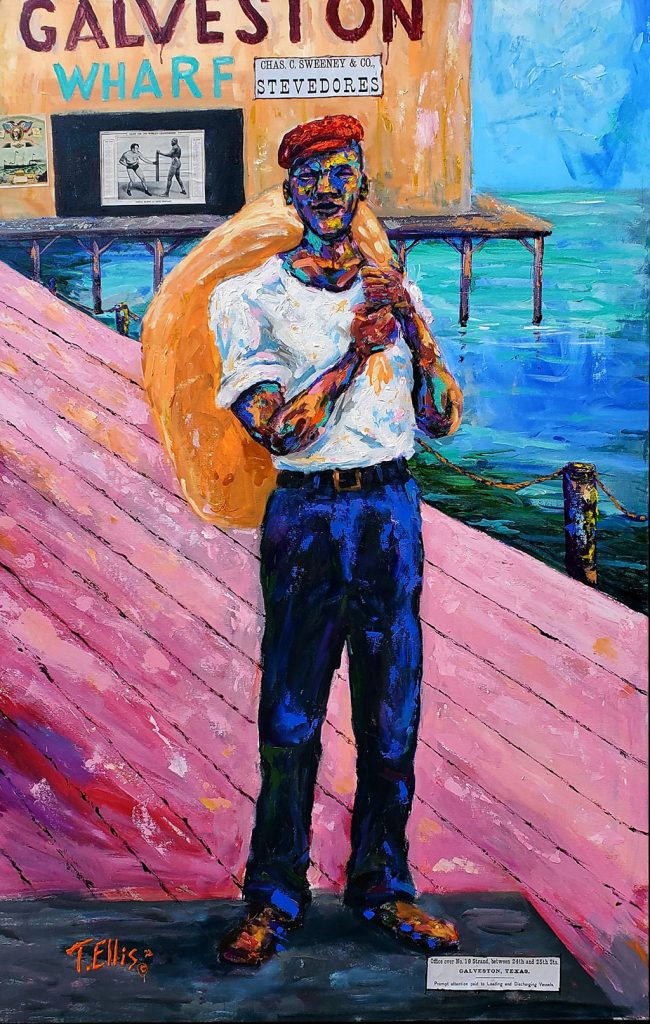
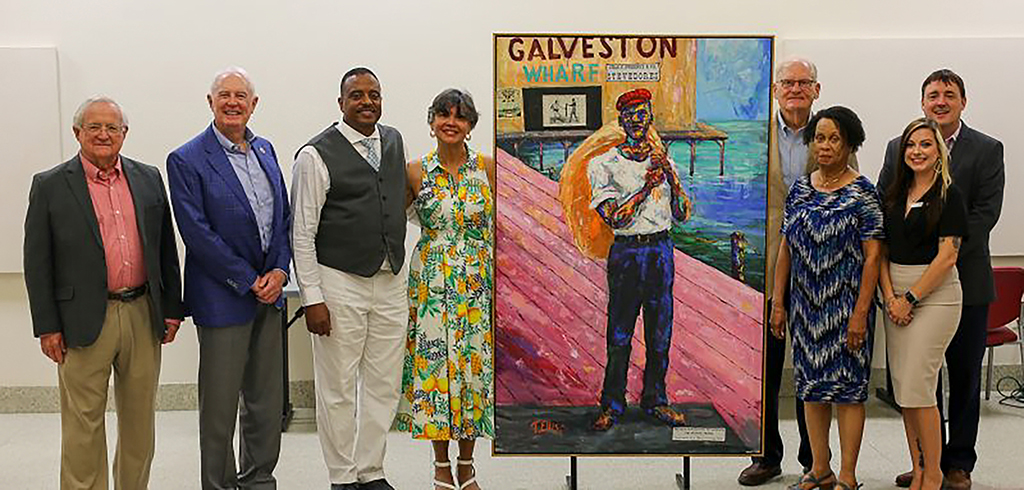
Ellis’ most recent piece, Jack Johnson, the Galveston stevedore, was sold to the Rosenberg Library for $75,000 and is now housed in their permanent collection. Explaining what drew him to want to paint the famous early 20th-century pugilist in his former occupation, a formidable knowledge and understanding of the exigencies of American history is apparent. “Jack Johnson, prior to him becoming the world heavyweight champion, he was a Galveston Stevedore. He was a longshoreman. and worked on the docks, so he had a tremendous amount of endurance. He had a tremendous work ethic, and I think that helped propel him to become heavyweight champion and to show that, during that time, African Americans were industrious and they were active in the economy of the United States.”
There is always a discernible higher purpose to Ellis’ art, one far beyond the merely aesthetic, no matter how colourful, compelling or captivating that aesthetic is. As Ellis has said elsewhere, “For twenty five years, I have been painting and pictorially documenting African-American culture, and using art as an instrument of preserving our culture.”
As Ellis proudly and explicitly declares on his website, affirming his belief in the consciously didactic role of the artist in society, “I paint subjects that are representative of the many facets of American life, particularly African-American culture and history, as I know it. I like to think of myself as a creative historian. I was put here to record history…all aspects of American culture and heritage. My sole purpose has always been to educate through my art.”

Museum Director
Like all true polymaths, Ellis is nothing if not wildly protean. His latest incarnation is that of museum director at Southern University in New Orleans – a new direction which came about entirely serendipitously. Having decided to return to school to get his Masters in Museum Studies, that qualification opened up many new doors and opportunities for him. As he recounts, “After twenty years, from moving from chemist to full time artist, I decided to go back to school and get my master’s in Museum Studies. And that opened up a plethora of opportunities for me. I became not only an artisan resident, but a scholar resident at Old Dominion university.”
Then, during the immediate aftermath of the death of George Floyd in 2020, Ellis had just finished his painting Our Time Has Come – a canvas addressing the reality of the social and racial inequalities that African-African communities were dealing with at the time, in particular the highly contentious and perennially emotive subject of policing. That painting led to a discussion and engagement with students and faculties, so that Ellis became a scholar resident at Old Dominion University. Then, while he was taking coursework at Southern University, Ellis was approached by Dr. Eid and asked if he would be interested in running the museum.
An ardent believer in the power of art to heal, Ellis’ vision and mission for the museum at Southern is a powerful, profoundly civic minded one, “centred on community engagement and activism.” He is keen for the museum “to become a social change agent, that can uplift people, that can heal and that people can learn from.” As he concludes, “That’s so important, because (that way), we uplift our human worth, our human capital.”
His ultimate goal for the museum is explicitly about the role of art in enlightenment: “The goal is to share the local talent, to nurture those folks who are coming through the museum studies programme, to show that this museum is a laboratory for you to learn practically on how to engage communities, how to enlighten.” His highly laudable, noble and community-spirited aim is to be able to use the museum and its four galleries as “an instrument for learning, for sharing and for healing.”
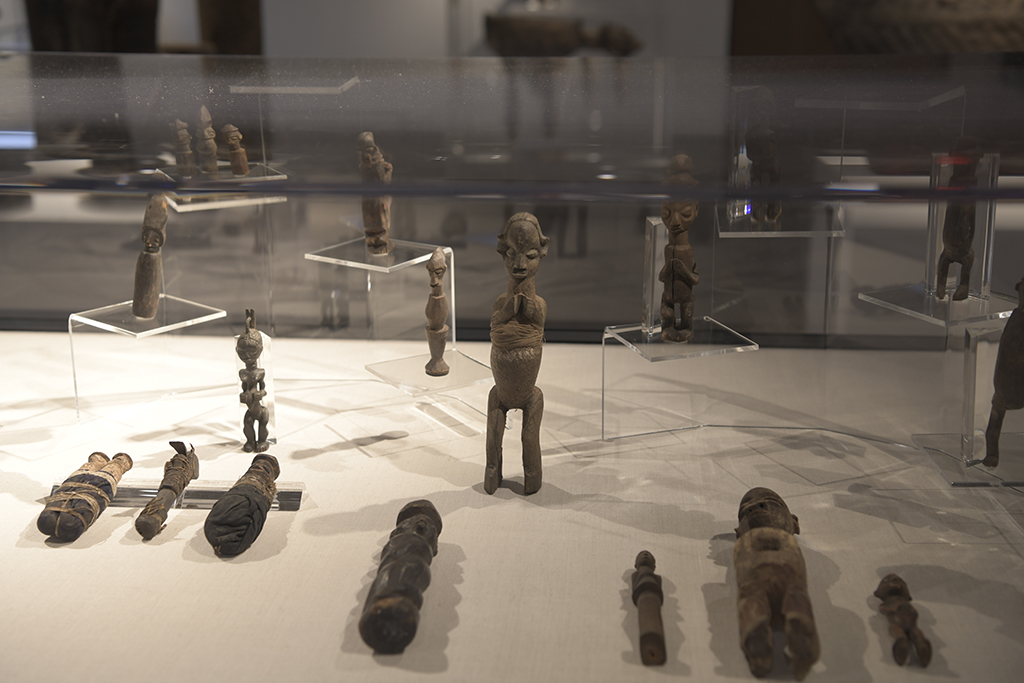
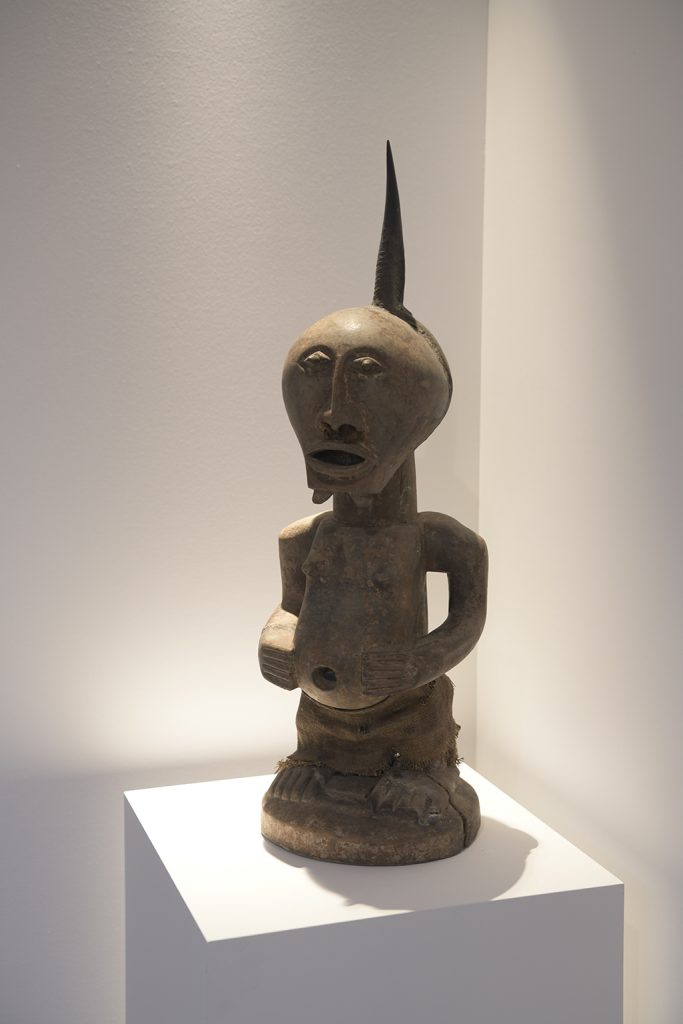
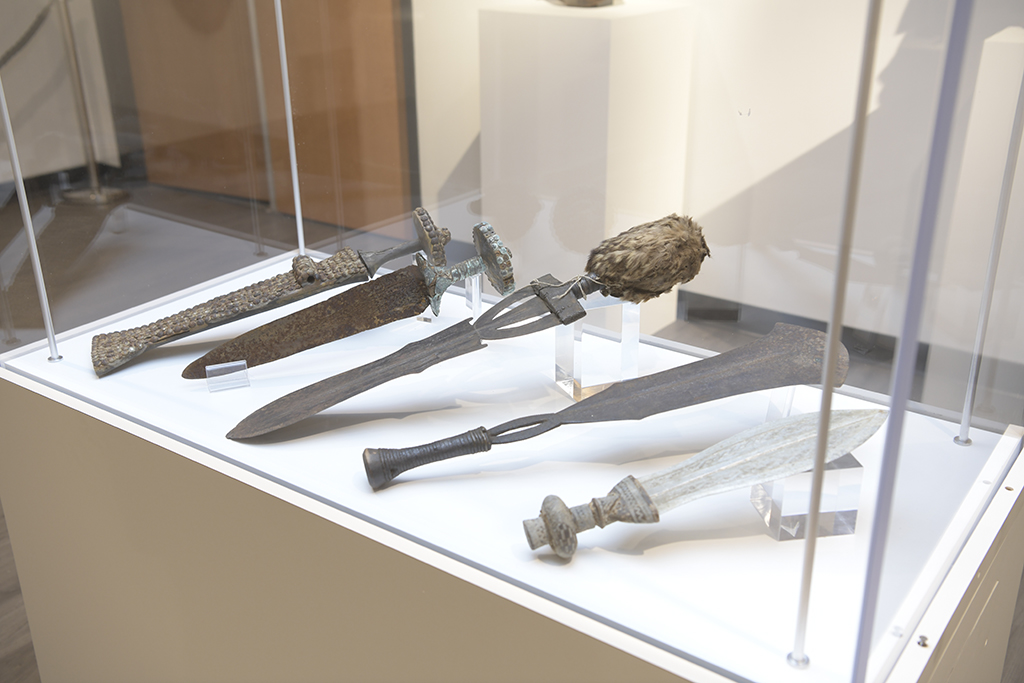
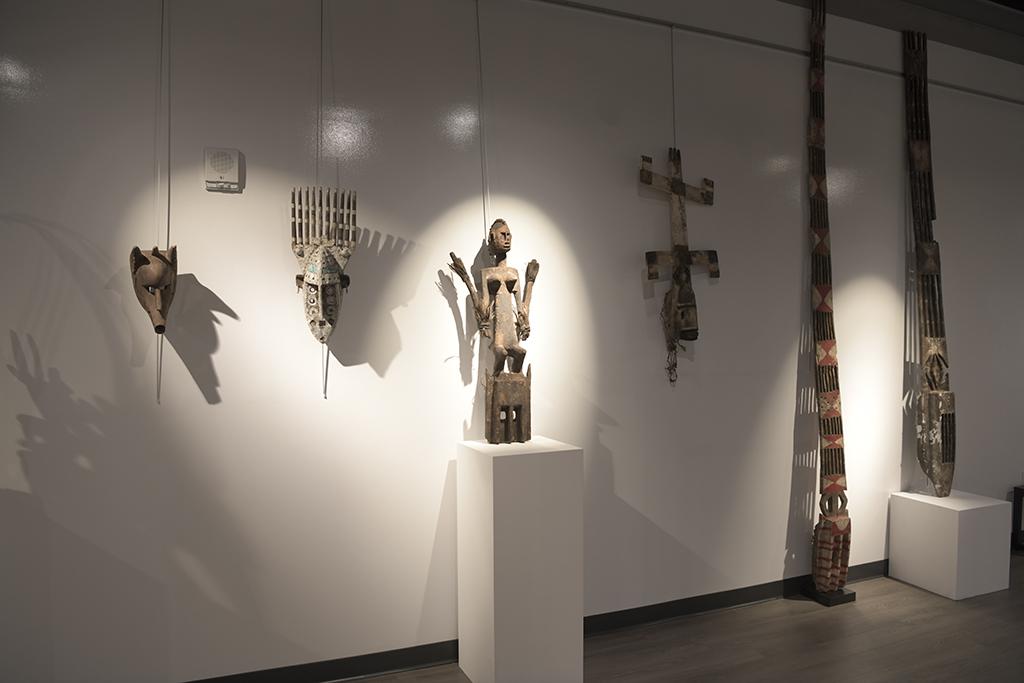
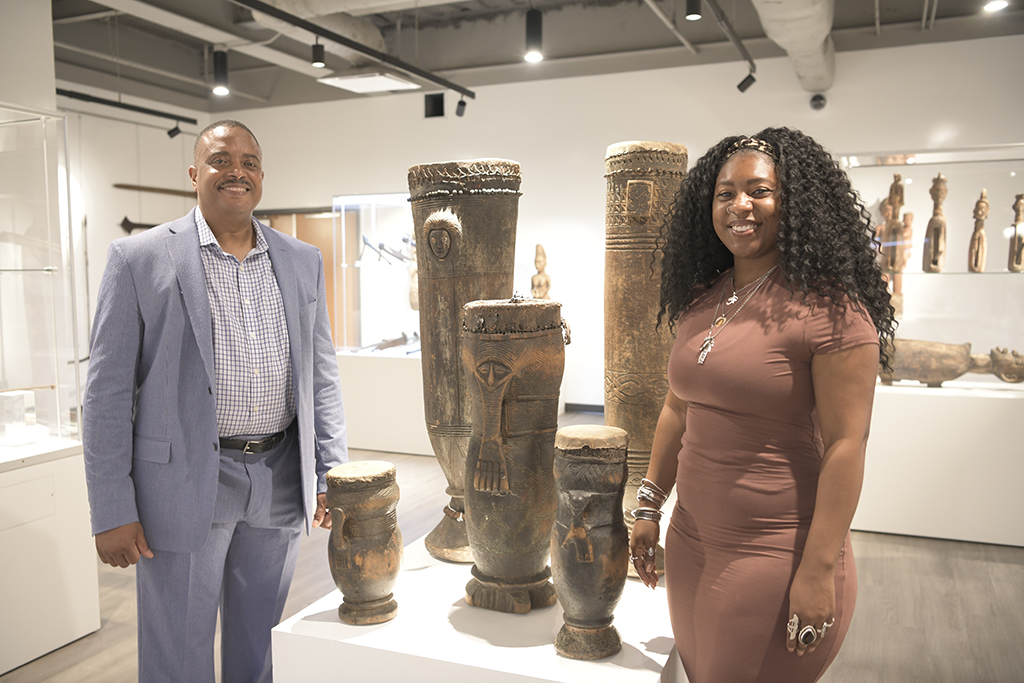
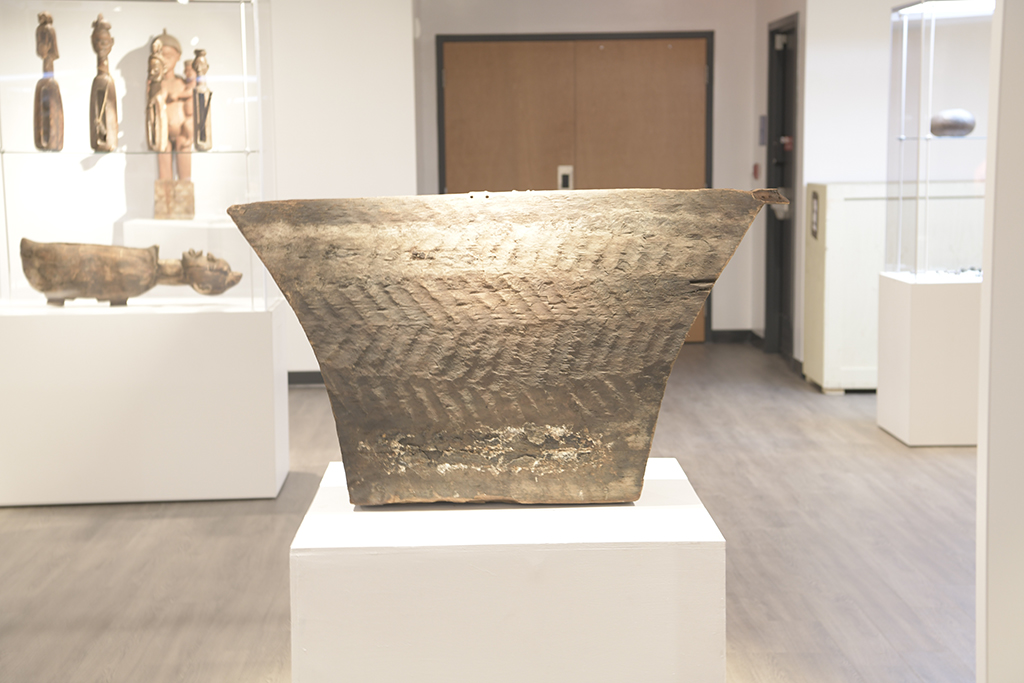
With four galleries spread over 15,000 square feet, there is plenty of scope for local creatives and students to exhibit. However, Gallery Three is permanently reserved for the museum’s astonishing collection of African artefacts, namely 250 African objects, primarily from Nigeria and the Congo, that were used for religious ceremonial and utilitarian purposes. It is a story told from the 2,500 artefacts that the museum has.
Ellis’s passion for his new role, and what can achieved through the museum, is self-evident, and spills out in his infectious, almost garrulous tone, “Thirty years as an artist, but now I’m doing this thing and I’m excited about it. In this cultural, urban laboratory, there’s fun in pushing it forward. I want to be an example for other academic institutions. I want to be a partner with those who are already established with best practises. And be in an institution as a change maker in this space.”
Ellis concedes, when thinking of his good fortune in obtaining this new role, “In my wildest dreams, I never thought I’d be a museum director. I always knew I wanted to have my art in the permanent collection of a museum, but never knew that I would be a museum director who would influence others and help advocate what’s important to us, to all of us. And using art as the instrument to make that happen.’
He concludes, a wide, effulgent grin on his face, his satisfaction evident, “I’m happy. I’m blessed. It’s a lot of responsibility and I don’t take it lightly, but I tell folks, for me, it’s not a business, it’s my livelihood. This is who I am, so I’ve hit the lottery jackpot.”


Juggling Painting with Running the Museum
Ellis concedes with a wry smile that being a servant to two muses (or mistresses, perhaps a better analogy) – namely excelling in his own art and excelling at running the museum – is not always easy, and that the two are not natural bedfellows, but that he is learning to master the very different skill sets required for both roles. “It has been over three months and I have not picked up a paint brush. Prior to that, it had been not a week that I had not painted.”
As he explains, laying bare the creative artistic and curatorial dichotomy, “There’s the discipline in your (artistic) craft, but I equally understand that my responsibility as a museum director is important. At some point in time, I may be able to get a chance to pick back up (my paint brush) and paint and tell stories, but to be programmatic, the mindset has to shift and the application has to be a little bit different. When I paint, I’m telling my story. In a museum director’s position, I have two curators and they have ideas on what they want to present and how they want to showcase. And I have to be mindful of that.”
The plethora of administrative tasks involved in running the museum are currently lessening the time he has to paint, but Ellis holistically sees the bigger picture and what is required of him in his new role. “I have to take help take down the art. I have to make sure that the artists are happy and that my curators are happy. I have to make sure that the message and the intent aligns itself. I have to look for patrons. I have to look for sponsors.” As he concludes, “The passion to paint is still there and very high. I’m just placing (the emphasis) on the administrative, programmatic side right now.”
Humanistic Philosophy
As can be readily evidenced by looking at the rich humanity with which he has imbued his subjects over a thirty year career, Ellis articulates a powerful, cogent and deeply felt humanistic philosophy of life, both in his own art work and now in his role as museum director, one which ardently seeks for people to transcend the vagaries of race and racialised thinking. He asks, trenchantly and with a wisdom and a conviction often all too rare nowadays in our increasingly polarised society, “At the end of the day, why should colour divide us? We’re all human beings. How do we live like kids who are always happy and always having fun and don’t see colour?” It is undoubtedly a seminal rhetorical question.
Painfully cognisant of the transience of human existence and the fragile, tenuous nature of our grasp on it, Ellis is positively teleological in his outlook and what he must do with his time on earth. “Life is relatively short. In the blink of an eye, we’re here today and we’re gone tomorrow. So, what will your legacy be? Improving humanity.”

Greatest Achievement so far
When asked about is greatest achievement to date, Ellis is unequivocal, eloquent and impassioned, stating with consummate pride, “Being an example to others. Thirty years as an African American artist, taking care of his family, a high level of engagement, and never knowing where your next dollar’s going to come from, all predicated on unapologetically talking about your history, your heritage, advocating the importance of my culture, my identity.” He adds, “Being a father, mentoring, mentoring not only my kids, but others, through my work, being an excellent example of taking ownership and being prideful and having purpose in what you love doing.”
On his Creole Heritage and Identify
When asked how he identifies – that most pressing and occasionally contentious of questions de nos jours – Ellis replies quickly, laconically and powerfully, “I identify as a human being.”
Rightly wary of labels, he continues with caveats, “Now, by the constructs of society and what they have placed on me, I have African origins, that’s a piece of it, and I’m African American.”
But he swiftly acknowledges that as human beings, we continually evolve and grow and that question – as to who we really are – is a complex and nuanced one, often fraught with social conditioning.
In terms of his precise Creole heritage, although he has not researched it in depth or ever done a genealogical study, he believes there’s “a little Spanish, a little French, a little Italian, a little European and a little African” in his mixed ancestry.
Whilst he undoubtedly takes pride in his Creole roots, Ellis is arguably more interested in exploring and asserting his common humanity. As he says sagaciously, “We grab whole identities so that we can find worth in ourselves. It gives us something to grab hold of, something to study and to learn from. We’re looking for something that’s common in all of us.” He continues philosophically, and with an acute anthropological acumen,
“We walk, we eat, we sing, we dance, we love, we get angry. There’s some common threads in all of us, beyond geography. And how do we move beyond geography? I think there’s some common core – one kind of human being, one of love, one of happiness.”
On Being Appointed a Federal Commissioner
In 2018, Ellis became the only artist ever to be appointed to a Federal Commissioner role, under the Department of Interior. Appointed by the federal government, he is currently acting chair of the Federal Commission on 400 Years of African-American History (probably the most important Federal Commission since the Freedmen’s Bureau Commission of 1865) – set up with the explicit aim of commemorating and celebrating the activities of African Americans in the 50 contiguous states. An unpaid position, Elis sees it as big responsibility, and has been proudly doing it for the last three years.
Three Wishes
Had he three proverbial wishes, Ellis thinks hard, then replies genially, “Firstly, that I’m able to attain the goals and desires of elevating my position as museum director, as a best practise for all institutions. The thoughts I have on speaking to the significance and importance of our identity, our culture, messaging that through art, making it programmatic that others learn from.”
Secondly, he wishes that people could embrace their inner child and thus find their purpose to help others. “I wish we would be like little kids all day long, engaging each other, and we could find a purpose in what we do, in everything that we do. Everything that we do is about helping others. When we’re building a car or we’re building a house, and we are not so much thinking about just profit driven. Are we really enlightening people lives?.”
In terms of his legacy, Ellis is again clear on what he would like. “For my community to understand their value and their work through struggle, and that there’s power in that. And that you take ownership in that. That’s why I paint what I paint.”
He continues, eloquent, considered and painfully perceptive on the role of the artist in society, with his third wish: “Every artist speaks to heal. The visual artists, the poets, the writers, they all speak to heal. There’s an innate sense to nurture, to take care of, as creatives. That’s a major calling. And I see it at every level. Even if they can’t manifest that and articulate that in words, I see it in the work. It’s like, they’ve thrown aside everything to uplift humanity, to uplift others.”
Thus Ellis is a strong advocate for society nurturing and taking care of its artists: “So, listen and take care of your artists. It’s just like watering a tree or a plant. It’s significant in the way we live. And if society can see that and understand that and support that, like Maslow headed at the top of the hierarchy of needs, then my wishes are fulfilled.”
His Message to the World
As for “message to the world”, Ellis advises honesty, passion and integrity which will in turn lead to self-knowledge and contentment. As he wisely states, “You have to be honest with yourself. You have to find what it is that you love doing and you’ve got to pursue that. You’ve got to own that, you’ve got to own that unapologetically.”
He adds, in relation to what it required to achieve success, “It takes sacrifice. You personally need to have a big dream and a big vision.”
Conclusion
A consummate creative, an uncompromisingly “engaged’ and racially conscious, best-selling artist, a pioneering museum director, a Federal Commissioner, a deep thinker, a humanist and a human being who seeks to heal and uplift through the medium of art, Ted Ellis has come a long way from that little kid in Jackson Square at the weekends, observing and learning. He has striven to create an artistic and scholarly legacy – intensely beautiful, meaningful paintings which tell the myriad stories of his people, their suffering, their strengths, their resilience and their humanity – at a time when many seek to deny that aforementioned humanity and rob them of it, on account of their own bigotry and prejudices.
The tradition of African-American artists pictorially bearing witness to the trials and tribulations of their communities – especially against the backdrop of nefarious racial discrimination – is a long, fine and noble one. Be it Jazz Age Chicagoan Archibald Motley, Jr., Jacob Lawrence, Romare Bearden or more recently former NFL professional Ernie Barnes, the lineage is august, nay spectacular, belying gargantuan talents and also mass appeal. Now Ellis himself can be, and increasingly often is – mentioned in the same breath – and with the same respect, veneration and adulation – as those artistic greats of yore.
As he freely admits, with a disarming humility and a strong sense of disbelief, mixed with self-belief and palpable gratitude, “I’m a little kid who grew up in the lower Ninth Ward of New Orleans, who was very passionate about art very early, and who found a way to pursue that, to take care of himself, to take care of his family and to enrich the lives of others through his passion.”
Indeed, what more could a man ask for than that?