

Willie O’Ree was just 14 when he had the honour of meeting his childhood hero Jackie Robinson. Robinson was sport’s man of the hour and was fresh off breaking the baseball colour barrier.
Unbeknownst to them both, O’Ree would go on to perform an equally impressive feat just a few years later – in the process earning himself the nickname ‘The Jackie Robinson of Ice Hockey’.
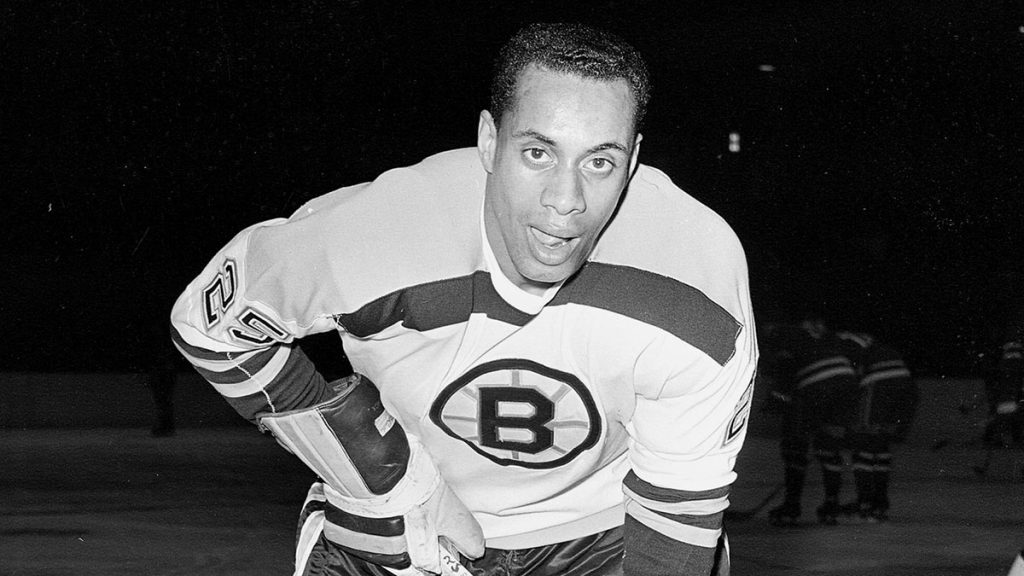
This moniker was first was earned on January 18th 1958. This was the date in which O’Ree laced up his skates and made his debut as a winger for the Boston Bruins. It was a history-making moment because O’Ree became the first black player in the National Hockey League.
Just as his idol Robinson had done when he debuted for the Brooklyn Dodgers in 1947, O’Ree set the stage for other non-white athletes to follow in his footsteps and overcome limitations forced upon his race. To understand how he got there, we need to go back to the start.
Willie O’Ree was born in New Brunswick, Canada on October 15th 1935. While his career would propel him into the world of racial tension experienced in America, O’Ree revealed in his autobiography, The Willie O’Ree Story: Hockey’s Black Pioneer, that racism wasn’t particularly a formative issue in his childhood years.
He wrote:
“The fact that I was black never came up when we played as kid. It was only later, when I became older, that I learned what ‘colour barrier’ meant.”
O’Ree – who was the youngest of 13 children – first took to the ice when he was just three. He instantly discovered that he had a gift and pursued ice hockey throughout his youth. It was, of course, near impossible for O’Ree to make it to the all-white NHL – but that didn’t stop the youngster from setting his sights on a career in hockey.
By 1956, O’Ree was establishing himself in the minor leagues as a player for the Quebec Aces. Opportunity, however, would unexpectedly come knocking in 1958 when two injured players needed to be replaced by the Boston Bruins. An up-and-coming O’Ree was chosen for the team – instantly shattering a colour barrier that had been in place since the NHL’s formation in 1917.
It’s a moment that people are still talking about more than 60 years later, but for O’Ree – who was accomplishing a lifelong dream – the impact wasn’t realised until after the game was over and done with.
In an interview with Fine magazine in 2016, he remembered:
“I didn’t realise at that time that I broke the colour barrier and became the first black player to play in the NHL. It wasn’t until the next morning that I read it in the paper.”
This isn’t to say that O’Ree didn’t face an uphill battle. The young upstart was actually dealing with a serious injury at the time. This occurred when a puck hit him in his right eye, ultimately leaving him with just 3% vision. Willie withheld this information from the team’s doctors because he knew it would cost him the once in a lifetime opportunity to play for the Boston Bruins.
During an interview with the National Post in 2018, Willie recalled keeping his eye injury a secret. He said:
“I went up and made the team, but I didn’t disclose that I couldn’t see out of my right eye. I said, ‘if I’m good enough to make the team with one eye, just don’t tell them.”
O’Ree was making huge strides for his race by playing in the NHL, in the same way that Jackie Robinson did during his tenure in Major League Baseball. Unfortunately, it wasn’t without its trials and tribulations. O’Ree was often the victim of racism during his time playing for the Boston Bruins between 1958 and 1961.
In 2019, O’Ree would speak freely about the racial slurs that had been directed at him during his time in the NHL. He said:
“Besides being black and being blind, I was faced with four other things: racism, prejudice, bigotry and ignorance.”
This unique experience is surely one of the aspects that made him the best man to take on the position of NHL’s Diversity Ambassador. O’Ree assumed this role in 1998, with his duties taking him across North America to promote messages of inclusion, dedication, and confidence with different hockey-related programmes. This has given O’Ree the platform to ensure that the impact he has on the world stretches beyond his history-making stint in the NHL.
Earlier this year, as racial tensions flared up across the United States following the death of George Floyd, O’Ree reaffirmed his commitment to defeating racism as he promoted the NHL’s new programme called Hockey Is For Everyone.
Speaking to CTV News, he said:
“Racism… it’s not going to stop overnight. I experienced it when I was playing and a lot of these boys and girls I come in contact with the Hockey Is For Everyone programme, they’ve had racial remarks directed towards them on the ice, on the bench or in the dressing room.”
Now 84, it’s clear that O’Ree is more adamant than ever that he’s remembered as a man who routinely pushed racial boundaries and opened doors for others to follow his lead. While it’s uplifting to look back on that milestone moment where he broke through the colour barrier, it’s important to remember that he’s also dedicated decades to peacefully campaigning for racial equality.
This was perhaps best exhibited when he accepted his place in the Hockey Hall of Fame in 2018. Rather than promote his own impact on the world of sports, he urged others to join him in helping others experience similar success.
He said:
“We have barriers to break and knock down, opportunities to give. I leave this with you: When you return to your communities, take a look around, find a young boy or girl who needs the opportunity to play hockey and give it to them.”