
Some buildings ask to be admired. St George’s Hall asks something harder. It asks you to stop, to look up, and to understand what a city believes about itself when it decides to build something that will outlast everything it knows. Liverpool was the second port of an empire, and that empire’s wealth moved through these docks in every direction, including ships that carried enslaved people across the Atlantic long before the Hall’s first stone was laid. Later, nine million more would pass through by choice, carrying music, faith, and memory from Ireland, West Africa, China, and the Caribbean, and some of it never left. This is the story of the building Liverpool raised to hold that weight, and of the Creole city it became without ever using the word.
The light comes off the stone a certain way in the morning. It does not matter what season it is. Stand at the top of Lime Street and look across at St George’s Hall, and what you feel before anything else is scale. The columns rise forty feet from the ground. There are sixteen of them along the front face alone, each one carved from red sandstone and limestone, each one older than most of the nations that share the world today. Above the roofline, the Union Flag moves in the wind off the Mersey. And there, on the plateau in front of the main steps, Prince Albert sits on horseback in bronze, his gaze fixed on the city his wife’s reign helped build.
Liverpool is not a city that asks you to be quiet in its presence. It has always been loud, layered, and alive with other people’s stories. But St George’s Hall asks something different. It asks you to stop. To look up. To understand, if only for a moment, what a city believes about itself when it decides to build something that will outlast everything it knows.
This is that building. And this is that city.
A Temple Built for the People
St George’s Hall was completed in 1854, though its story begins earlier, in the ambitions of a city that had grown wealthy beyond anything its founders could have imagined. Liverpool in the first half of the nineteenth century was the second port of the British Empire. Cotton, timber, sugar, and tobacco moved through its docks in quantities that shaped economies across the Atlantic world. The city’s merchants built themselves grand houses in Rodney Street and Abercromby Square. And then, as the money accumulated and the population grew, they decided to build something for everyone.
The commission was awarded to Harvey Lonsdale Elmes, a young architect barely thirty years old when he submitted his design in 1839. What he proposed was a civic complex that would combine a concert hall, two crown courts, and public assembly rooms under a single neoclassical roof. It was an extraordinary ambition. Elmes drew from the ancient Greek temples of Athens and the great public buildings of Rome, and he set them down on a sandstone ridge above the city as though they had always belonged there.
Elmes did not live to see his building finished. He died of tuberculosis in 1847, and the work was completed by Charles Robert Cockerell, one of the finest architects of the Victorian age. The interior of the Great Hall, with its barrel-vaulted ceiling, Minton tiled floor, and Willis organ, is regarded by many architectural historians as the supreme civic interior in England.
Stone and Story: The Architecture of Civic Pride
The Grand Exterior
The facade of St George’s Hall faces east toward Lime Street Station, the point at which most visitors arrive in the city for the first time. This was deliberate. The building was designed to be the first thing of consequence you encountered. The portico columns, drawn from the Corinthian order, carry a pediment inscribed with the city’s motto: Deus Nobis Haec Otia Fecit. God has granted us this leisure. It is a motto that has aged with complexity, given the history of how Liverpool’s wealth was accumulated. But the building itself stands above that complexity, a monument to what civic architecture can mean when a city chooses to invest in shared space rather than private gain.
The Great Hall and the Concert Room
Inside, the Great Hall is breathtaking. The floor alone is a masterpiece. Minton tiles in patterns of ochre, blue, terracotta, and cream stretch the full length of the hall. They are covered except on special occasions, protected from the footfall of daily use, but when they are revealed they stop people mid-sentence. The Willis organ, installed in 1855 and rebuilt several times since, is one of the finest concert organs in Europe. Handel was played here. Dickens gave readings here. Jenny Lind, the Swedish Nightingale, performed here to an audience that had queued through the night.
The Concert Room on the south end is smaller in scale but no less refined, with its gilded ceiling, classical pilasters, and intimate proportions. It was built for the kind of music that required you to sit still and listen. Liverpool has never been entirely comfortable sitting still, but it learned to inside these walls.
The Crown Court
The north end of the building housed two crown courts, and it is here that the building’s duality becomes most apparent. The same structure that welcomed Dickens and Jenny Lind also sent men to transportation and to the gallows. The dock, the judge’s bench, the public gallery: all of it remains largely intact. It is a sober room. It reminds you that civic architecture is not only about celebration. It is about the full weight of collective life.
Prince Albert and the Victorian Vision
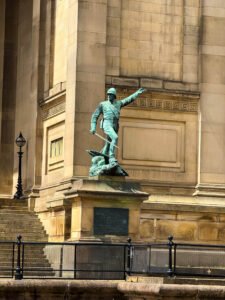
The equestrian statue of Prince Albert that stands before St George’s Hall was unveiled in 1866, five years after his death. Thomas Thornycroft, who had already made his name with a celebrated statue of Queen Boadicea, created the figure. Albert is shown in military dress, mounted on a powerful horse, his bearing composed and formal.
The choice to place him here was significant. Albert was the patron of the Great Exhibition of 1851, the event that positioned Britain as the workshop of the world. He was a champion of education, science, and the arts at a moment when Liverpool was building its own institutions in those fields. The statue was a statement of alignment. Liverpool saw itself as part of the same Victorian project of progress and improvement that Albert had embodied.
The irony is that the Victorian
project was built, in part, on the labour and suffering of people whose stories were not yet being told in bronze. Liverpool knows this. The city has grappled publicly and sometimes painfully with its role in the transatlantic slave trade, and the statue of Albert stands in the shadow of that reckoning. What it means now is more complicated than what it meant in 1866. That complexity is part of why it remains.
A City That the World Passed Through
Liverpool’s greatness was never only about what it built. It was about who arrived. Between 1830 and 1930, an estimated nine million people left Europe through the port of Liverpool, bound for the Americas and beyond. They came from Ireland, fleeing famine. They came from Wales, from Scotland, from Eastern Europe, from West Africa, from China. They came from the Caribbean. They brought their food, their faith, their music, and their memory, and they deposited some of each into the city before they sailed on or decided to stay.
Liverpool’s Black community is one of the oldest continuously settled Black communities in Britain, with roots going back to the eighteenth century. The city’s Chinatown, established in the 1800s when Chinese sailors settled near the docks, is the oldest in Europe. The Welsh streets of Everton still carry the names of those who built them. The Irish diaspora shaped the politics, the culture, and the faith of the city for two centuries.
This is the ground from which Liverpool’s culture grew. Not from one source. From many.
The Sound of a City: Music, the Beatles, and Beyond
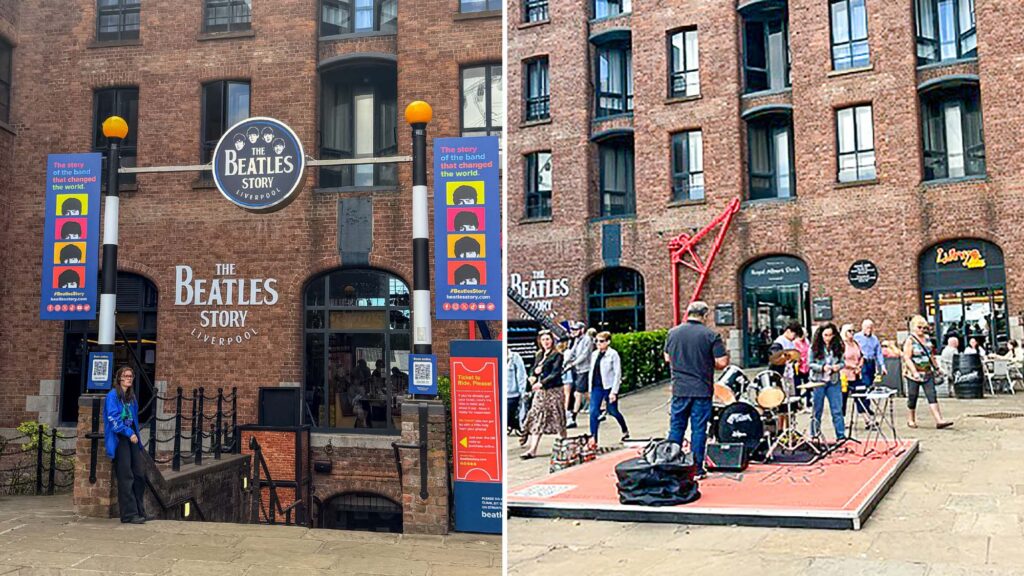
If St George’s Hall represents Liverpool’s civic soul, Mathew Street represents its creative one. The Cavern Club, where John Lennon, Paul McCartney, George Harrison, and Ringo Starr played nearly 300 times between 1961 and 1963, sits a short walk from the Hall. The Beatles did not come from nowhere. They came from a port city that had been absorbing American rhythm and blues from the sailors who worked the Atlantic routes, a city where music moved through the docks as freely as cargo.
The sound that the Beatles made was partly Liverpudlian and partly the world arriving in Liverpool and being rearranged. It is not a coincidence that the city which produced them was the same city through which nine million emigrants had passed. The culture of exchange runs deep here.
Liverpool’s music did not stop with the Beatles. It produced Echo and the Bunnymen, The Wombats, Cilla Black, and a lineage of soul, gospel, and folk performers whose names are less known internationally but no less significant locally. The Royal Liverpool Philharmonic, based a few streets from St George’s Hall, is one of the oldest professional orchestras in the world. The city plays. It has always played.
Creole Connections: Migration, Memory, and Identity
For readers of International Kreol Magazine, St George’s Hall carries a particular resonance. The Creole experience, wherever it has taken root, is an experience of confluence. It is what happens when cultures meet, mix, and make something new from the encounter. Liverpool is a Creole city in all but name.
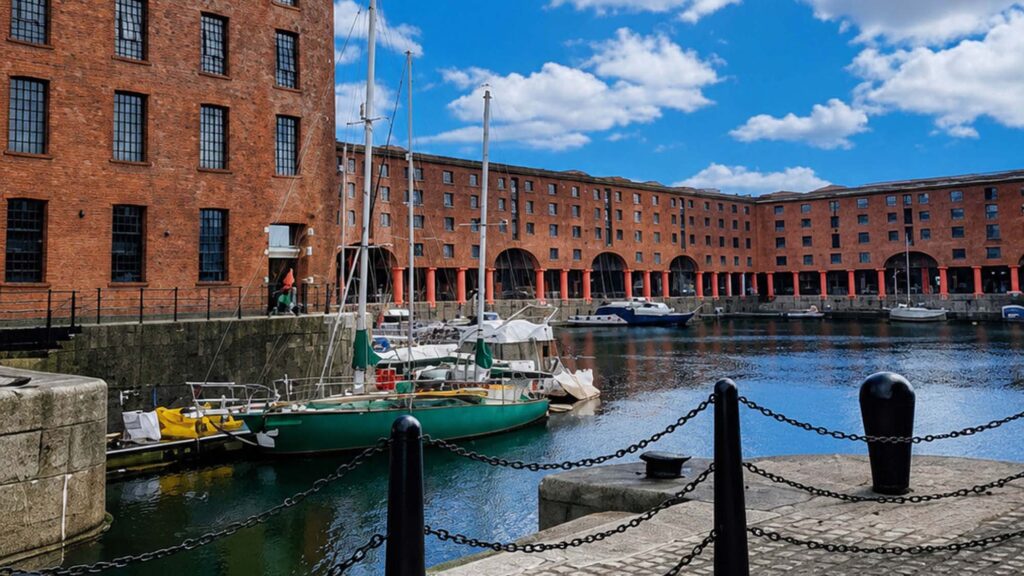
The port drew people from Louisiana, from Haiti, from Martinique, from Mauritius, from the Seychelles, from Trinidad, and from every island in between. Some stayed. Some passed through. All left something. The rhythms of the Caribbean entered Liverpool’s music. The flavours of West Africa entered its cooking. The faith traditions of the Atlantic world entered its churches. The result is a city whose identity cannot be reduced to any single origin story, because it has too many of them.
The themes that Creole communities around the world carry, resilience in the face of displacement, the preservation of culture across distance, the creation of new identity from old materials, are Liverpool’s themes too. When you stand in front of St George’s Hall and look at what this city built, you are looking at what people build when they are determined that the place they have made their home will last.
Dr Laurence Westgaph, a Liverpool historian specialising in the city’s Black heritage, has written about the way Liverpool’s diversity shaped its civic character from the very beginning. The port did not just move goods. It moved people, and ideas, and ways of being in the world. The city that emerged from that movement is richer for every strand woven into it.
St George’s Hall Today: A Living Landmark
St George’s Hall is not a museum. That is the most important thing to understand about it. It is a working venue, a public building, a civic space that continues to be used for concerts, exhibitions, weddings, civic ceremonies, and community events. The Great Hall hosts Christmas fairs and brass band competitions and spoken word nights. The Concert Room holds chamber music performances. The steps outside have been the gathering point for every significant public moment in Liverpool’s recent history, from vigils and celebrations to protests and homecomings.
In 2004, the building underwent a major restoration programme funded by the Heritage Lottery Fund and Liverpool City Council. The Minton tile floor was uncovered and restored. The Willis organ was refurbished. The exterior stonework was cleaned and repaired. The building that emerged from that restoration was the same building Elmes and Cockerell had designed, but returned to something closer to its original glory.
Liverpool was named European Capital of Culture in 2008, a designation that brought the city international attention and investment. St George’s Hall stood at the centre of that year’s celebrations, as it has stood at the centre of the city’s life for a hundred and seventy years. Some buildings outlast the purposes they were built for. St George’s Hall has kept finding new purposes without losing its original one.
More Than a Building
There is a moment, if you time it right, when the sun drops low over the Mersey and the light comes back across the city from the west, and St George’s Hall turns gold. The columns glow. The flag above the roofline catches the last of the afternoon. The pigeons that have lived on the building for as long as anyone can remember settle back onto the pediment. And the people of Liverpool move past it on their way home, barely glancing up, the way you stop seeing something that has always been there.
That familiarity is not indifference. It is belonging. The Hall is theirs. It was built in their name, and they have never entirely let go of it.
For those arriving in Liverpool for the first time, perhaps from across the Atlantic, perhaps from one of the islands and coastal communities that share Creole culture’s long reach, St George’s Hall offers something that is harder to name than history or architecture. It offers proof. Proof that people who came from somewhere else, who built something here by the mouth of a great river, who survived the upheavals of industry and empire and loss, left something behind that still stands. Something the wind off the Mersey has not yet moved.
Prince Albert looks out from his bronze saddle across a city he visited but did not live in. The columns hold the weight of seventeen decades. The flag moves above it all.
And inside, somewhere in the Great Hall, the tiles are still there, waiting to be uncovered.
St George’s Hall, St George’s Place, Liverpool L1 1JJ, is open to the public and available for tours, events, and private hire. For visiting information and upcoming events, visit liverpoolcityhallandstgeorgeshall.co.uk