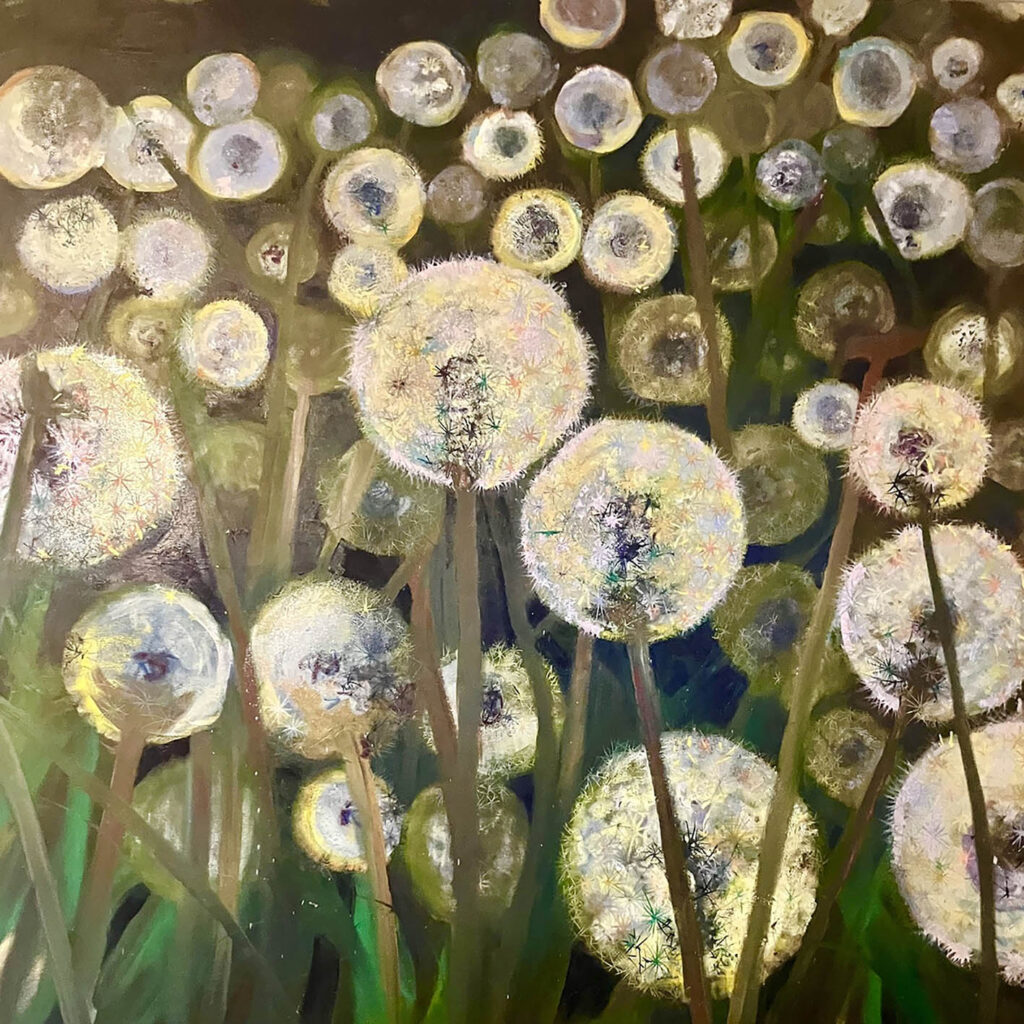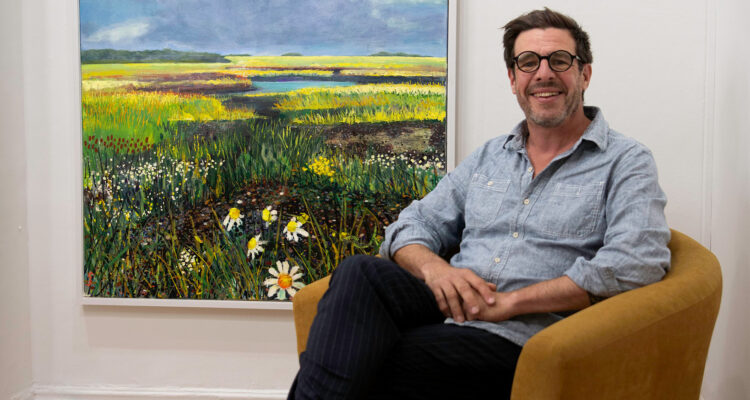
Ben Wardle’s art is rooted in his deep connection to the British countryside. A mixed-media landscape artist, he transforms his love of wild spaces into bold, immersive works. Painting from memory and driven by emotion, Ben embraces the unpredictability of the creative process. While he acknowledges the challenges of self-promotion, he remains passionate about the human touch in art, believing it offers something no digital tool can replicate.
Ben Wardle’s journey as an artist began in the city but was always destined for the countryside. Born and raised in South London, in the Croydon area, Ben describes an early longing for wild spaces that shaped the course of his life. “Even from a very young age, I loved the countryside and wild spaces,” he shares. As soon as he could, he left the city behind, relocating to East Anglia, where he immersed himself in the outdoor life he had always craved, working with animals and spending his days on farms.
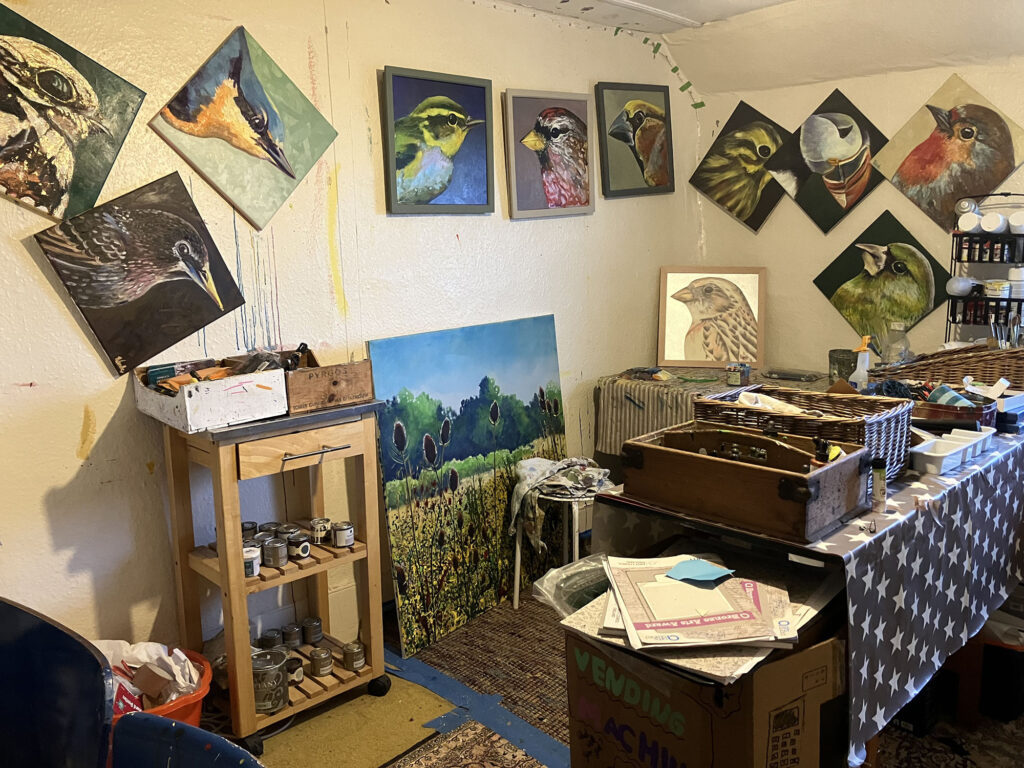
Art was also present from the start, thanks to his father, who worked as a commercial artist creating artwork for brands like Matchbox cars and Airfix models. Ben recalls, “I’ve always loved drawing and considered it a real therapy. It’s a place where I find relaxation and escapism.” Despite pursuing a scientific path, studying zoology at university and working outdoors with animals, drawing remained a constant companion, a personal retreat into creativity that reflected his enduring love of nature.
While his early career followed his love for animals, studying zoology and working outside, the pull toward art never faded. “I’ve always had this itch to translate what I love about the countryside into paintings and drawings,” Ben explains. This desire became more than a pastime about a decade ago when he decided to formalise his artistic practice by completing a master’s degree in fine art.
The experience deepened his understanding of his connection to nature and art’s broader role in raising awareness. “It was a way of expressing my frustration at how sometimes we don’t look after the wild, and also to celebrate it,” he reflects. Through his studies, Ben explored not just technique but the emotional and ecological narratives behind his landscapes, giving his work a new sense of purpose and urgency.
Today, Ben lives on a working farm in East Anglia with his wife, an arable farmer, surrounded by the fields, trees, and hedgerows that inspire his work. His commitment to his art has seen him exhibit regularly, staging several solo shows a year, alongside group exhibitions. It’s a simple philosophy for Ben: “I very much believe that you should find something you love doing and then spend your life doing it, which is what I’ve always done.”

Ben has now firmly established himself as a full-time professional artist. Over the past decade, his work has found its place in galleries across London and East Anglia, where he regularly exhibits both solo and as part of group shows. “I’ve never exhibited abroad yet,” he admits. “I had an exhibition lined up in the Netherlands last year, as my mother was Dutch, but the practicalities of getting the paintings there, and the post-Brexit tax complications, made it tricky. Maybe I’m not rich enough yet to do that.”
While the challenges of international logistics remain, Ben’s focus stays rooted in his local environment. His art has also reached collectors far beyond England, finding homes in Dubai, New York, and Africa, proof that his portrayals of the English countryside resonate globally. “It’s nice to know that in Dubai, New York, and Africa, there are paintings of my little bit of England,” he says with quiet pride.
For Ben, the joy of his career lies in the balance between passion and livelihood. “Art’s a funny thing,” he reflects. “Lots of people think, oh, my stuff’s not good enough, or maybe it’s too difficult a way to earn money. But I love what I do, and I believe nobody will buy your paintings unless they see them.”
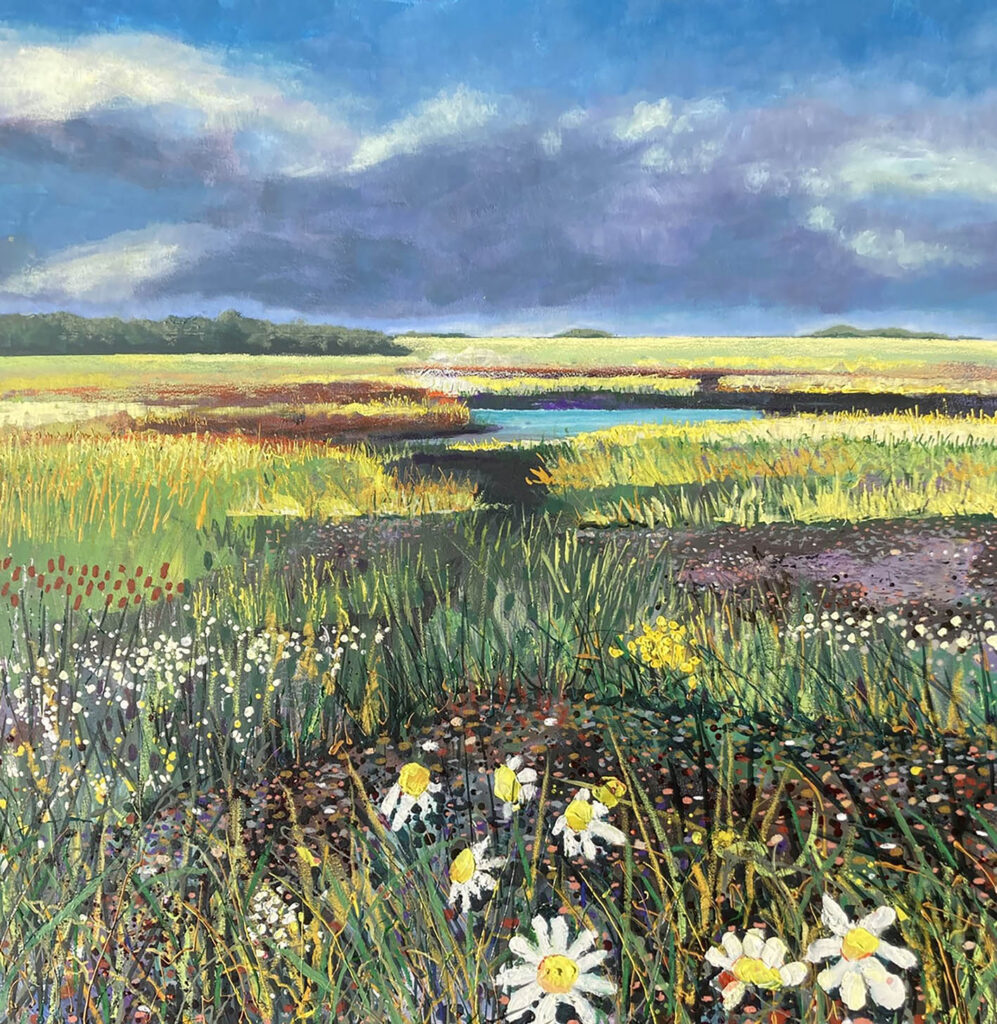
Ben’s work is as much about process as the final image. His paintings are created using a mix of materials, reflecting his desire to capture the textures and moods of the natural world most authentically. “The ones I’ve got downstairs are mostly acrylic paint, acrylic ink, and pastel pencil. All of the paintings are mixed media,” he explains. For the subject dictates Ben, the choice of medium, the gloss of a blade of grass or the softness of mist. “Sometimes I will paint grasses with household gloss paint because when you paint nature, if you copy it, it doesn’t look like nature. There has to be some freedom in how you apply the paint.”
Inspired by the abstract expressionists, Ben applies paint with freedom but always with purpose. “A man came into one of my exhibitions, and he said, ‘Your paintings are like Jackson Pollocks, but with purpose,'” he recalls with a smile. “I apply it with freedom, but I want it to tell a more specific story than purely abstraction. I want people to feel like I feel in those spaces.”
His preference for large canvases, often one meter by one meter or more prominent, adds to the immersive quality of his work. “I like to do squares because if you do a landscape shape like that, you immediately tell someone it’s a landscape. If it’s square, it’s up to them how they perceive it,” he explains.
Ben’s current obsession is with capturing mist, a new challenge in his ongoing exploration of landscapes. But at the heart of it all, the act of painting drives him. “The process of painting is what I love. The actual process is what makes me happy. I’ve learned not to mind too much what they look like.”
Despite his confidence in his art, Ben openly acknowledges the personal hurdles of being an artist, particularly the demands of self-promotion. Living with ADHD, he finds social situations and large groups overwhelming. “I find groups of people very hard, and sometimes art is about saying the right thing in the right space, and I’m not very good at that,” he admits. “I get very shy and go to other people’s exhibitions, I feel very much like an impostor.”
Though painting comes naturally, the business side of art, selling, marketing, and networking, demands just as much effort. “People say, well, lucky to do what you love, but being an artist is just hard work like anything else. You put the effort in, you get results. But the painting is sometimes the easiest bit,” he says candidly.
Still, Ben has learned to accept rejection and embrace constructive criticism. “Sometimes you have to go, okay, they don’t like it, fine, move on,” he says. His family, especially his wife and daughter, must provide honest feedback. “They know what I do. And that was the great thing about doing my master’s in fine art: you learn to accept constructive criticism from other people. They see something completely different to what I’ve painted. And that’s interesting.”
Ben sees his work not just as paintings, but as starting points for conversations about nature and our connection to it. Whether someone loves or dislikes his work, he values the dialogue it creates. “If somebody says, I don’t like these, and I can say, Why don’t you like them? That still starts a conversation.”
With the rapid rise of AI-generated imagery and digital art, Ben remains philosophical about its place in the creative world. While he acknowledges the inevitability of new technologies, he firmly believes there will always be a place for handcrafted, traditional art. “There will always be a place for it,” he says. “Many of my paintings, for example, are landscapes that somebody is familiar with. So they’re paying for provenance, they’re paying for me, loving where they love. And that would be quite difficult to do with AI.”

For Ben, it’s about the connection between the artist, the place, and the viewer, something he feels cannot be replicated by technology. “When people step away from their workplace, they don’t necessarily want to do everything digitally. They want to go for a walk, buy something that has a history, they want real life, not on a screen,” he reflects.
He recognises that AI may have a role in accessibility and perhaps even education, but he draws a clear line regarding art. “When you look at a painting that a person has painted, it has that energy of that person there with it. You can almost feel it and sometimes you can smell it,” he adds. “You see a Picasso, and you can see where his thumbprints are. That’s uncopyable.”
In Ben’s view, the imperfections, the thumbprints, the mess of an artist’s studio contribute to an authenticity that cannot be simulated. He hopes that people will still crave that tangible, human connection that only handmade art can offer in an increasingly digital world.
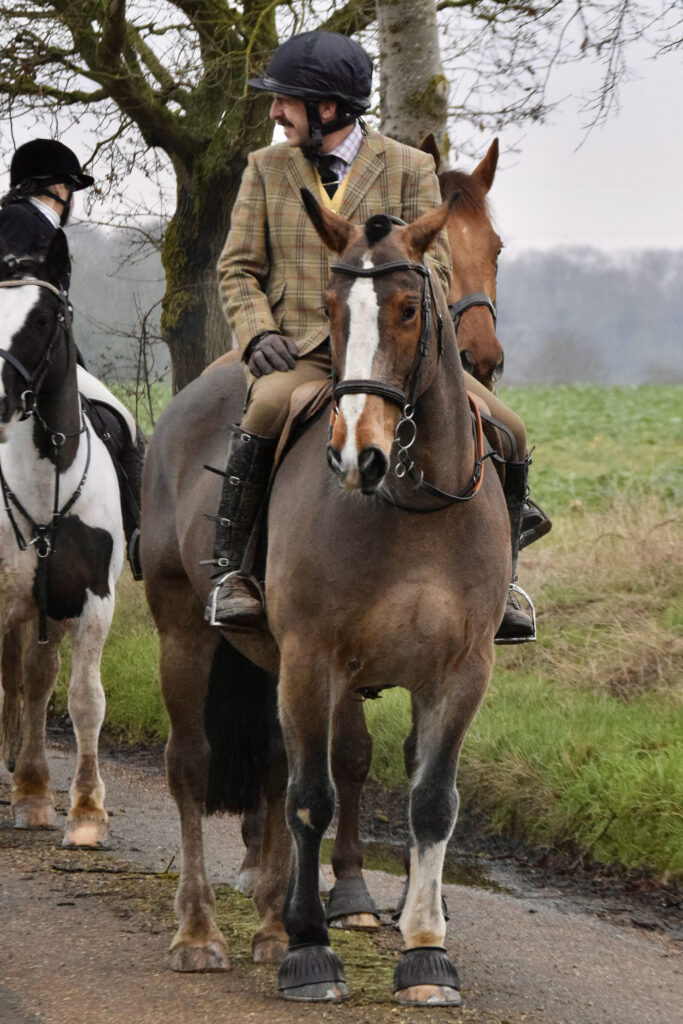
Outside the studio, Ben finds inspiration in the same landscapes that fill his canvases. Horse riding and running are central to his daily life, offering fresh perspectives on the countryside he loves to paint. “We do a lot of horse riding, my wife and I, and running. I’ll always go out down the footpaths and see what I can see,” he shares. He enjoys capturing the hidden vibrancy of the British countryside, even on its greyest days. “There’s so much colour in the UK, but you wouldn’t know unless you look,” he says.

Increasingly, Ben relies on his memory rather than photographs for his paintings. “More and more, the last 10 paintings I’ve done have just been from memory,” he notes. While he occasionally snaps photos on his phone for reference, his work comes predominantly from imagination, shaped by years of experience and observation.
Ben also embraces the wisdom that comes with age, which has given him the confidence to trust his instincts and embrace decisiveness in his work. “I like being the age I am because it’s given me the confidence to do what I love,” he reflects. For him, the paintings are as much about the journey as the final product. “People say your paintings are costly, but that’s the journey, they’re paying for the journey, not just the thing.”
Grounded and content, Ben says he has few wishes beyond continuing to do what he loves. “I love my family, I love my job. Everybody would like to earn a little more, but being happy is more important to me,” he smiles. “I’m fortunate to do what I do.”