
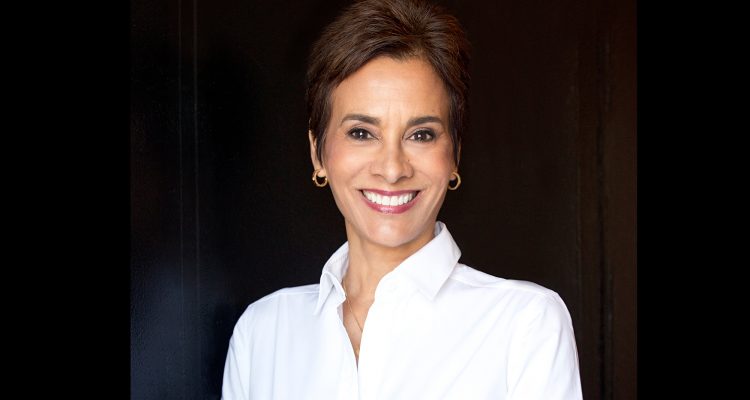
Angela Vallot – Louisiana Creole Success Story
As she stepped to the podium, squinting into the bright lights to make out faces in the audience of some 700 makers and shakers assembled in the famed Cipriani Ballroom in New York City, a rush of memories flooded Angela’s mind. Here she was, about to introduce honorees like John Legend, Eric Holder, and Bryan Stevenson to a room filled with celebrities, media figures, law firm partners, corporate CEOs, the great and the good of the philanthropic and civil rights worlds. How distant the glamorous scene in front of her seemed from her childhood in rural Louisiana, growing up under the shadow of Jim Crow, on a road dotted with sugar cane farms and the houses of cousins, aunts and uncles. Angela Vallot thought of how proud her late father would have been to watch her welcome guests to this star-studded annual dinner of the NAACP Legal Defense and Educational Fund (LDF), where in one night they would raise $3 million dollars to continue the fight for civil rights and social justice in America!
Born in the racially segregated Abbeville, Louisiana of the 1950s, Angela’s very first day on earth foreshadowed the direction her life would take as an advocate for social justice, diversity, and inclusion. The nurses had placed baby Angela in the “coloured” nursery of the hospital, but her father, Peter Vallot, protested so vehemently that they relented and moved her into the more spacious, windowed nursery meant exclusively for white babies (they positioned her behind the door to hide her from public view). He loved telling the story of how his baby girl integrated the hospital the day she was born. Over the course of her life, Angela would continue to push boundaries often being the first, the only, or one of the few African Americans “in the room where it happens”.
Growing up in the shadow of Jim Crow
The third of seven children born to Peter and Irene (Porche) Vallot, Angela can trace her Creole ancestry back several generations on both sides. The Porches of Lafayette took pride in their French ancestry, which traced all the way back to the 1800s and included one ancestor who, according to family lore, was elected to the Louisiana state legislature during Reconstruction. Irene grew up in Lafayette and was a high school classmate and close friend of Norman Francis, who would go on to become the legendary educator and longtime president of Xavier University in New Orleans. Peter’s family traces its roots back to the Vallots of Burgundy, France who settled in Vermillion Parish in the mid-1800s. The Creole side of the Vallot family is descended from the mixed-race children born to Alfred Vallot, (one of three Vallot brothers who emigrated to southwest Louisiana) and his creole mistress, Sylvan. Their children inherited the family farmlands around 1900. The Vallots were devout Catholics and tended toward large families. Angela’s great grandfather was one of six children, her grandfather one of nine, and her father one of six.

Angela grew up among patois-speaking Creole farmers from the Vallot side of her family, many of them, including more than 20 first cousins, living within walking distance of her home on Gross Isle Road. Her relatives on the Porche side were masons and lived in nearby Lafayette. Flanked by farmland on all sides, the extended Vallot family revelled in the old Creole traditions. Gumbo and crawfish etouffee were hallmarks of their frequent family gatherings. Whenever a hog was slaughtered, there would be boudin and cracklin and “debris” (a stew made with organ meats). Family celebrations were abundant and multigenerational, an endless stream of birthdays, weddings, anniversaries, and holidays marked by lively conversation, jokes, stories, and a smattering of French (used by older family members to keep secrets from inquisitive young ones).
But hanging over all of this revelry was the dark cloud of Jim Crow. Peter Vallot, a veteran of the U.S. Air Force and the first in his family to earn both a bachelor’s and a master’s degree became a leader in the fight for racial equality. He would go on to lead the Head Start Program in Southwest Louisiana and a host of other community action programs advancing the cause of integration in a place where segregation, though outlawed in 1964, was still the norm. In the midst of already tense times, personal tragedy struck. In 1966, a few days after giving birth to her seventh child, Irene died. An indifferent white doctor had dismissed her complaints of shortness of breath, chiding that it was probably just her “imagination.” She died the next day of thrombosis, an easily preventable postpartum condition. Knowing their small black church was not big enough to hold the crowd of family and friends expected, Peter fought to have her funeral held in the larger white church in town. The church deliberated for three days, going so far as to consult the local bishop before finally deciding to allow the funeral.
Peter remarried a year later and Angela and her six siblings gained a step-mother. Because she was white and interracial marriages were outlawed in Louisiana, the couple had to travel to Indianapolis to be married. Despite threats from the local Ku Klux Klan, Peter didn’t give up on the cause of integration. When he brought the family to see Sidney Poitier in “Lilies of the Field” at the local movie theatre, he broke with custom by insisting the family sit on the ground floor with the white patrons rather than in the balcony designated for coloured moviegoers. At the doctor’s office, he and the family refused to use the door marked “coloured entrance” and instead came through the main door. When Angela was ten, Peter moved her and her siblings from their black Catholic school to the local white one, where she spent her middle and early high school years.

It was then that Angela began to understand the depth of prejudice that existed in their community. Among the only black students at the school, she and her older sister, Michelle, struggled to socialize, especially in their teenage years. Going on a date with a white classmate, as Michelle once did, scandalized whites in the community. Eventually, Peter moved Angela and Michelle to the local public school, attended by more of the area’s black families.
There too, Angela and Michelle encountered racism. Black students were effectively barred from student leadership positions, so much so that a violent race riot broke out at the school in 1972, garnering national media attention. The Vallots and other local black families boycotted the school for more than a month, until negotiations with the school board, led by Peter, yielded an agreement. For the first time, black students would be represented in student government. Angela and Michelle went on to serve on the student council, debate team, homecoming court, and cheerleading squad. But it was never easy.
“In the room where it happens”
Peter had high expectations for all of his kids and emphasized the value of education and hard work. Once, when Angela brought home a report card of all A’s and one B, her father replied, “When are you going to get that B up to an A”? Always a good student, Angela shared her father’s drive and ambition. She entered public speaking competitions from an early age, winning several local and state awards. But in the background, Angela yearned to explore the world outside Louisiana. She applied and got accepted to Mills College, an elite women’s college in ethnically diverse Oakland California, a world away from the Jim Crow south and the farm country of her youth. She studied government and took an accelerated course of study that allowed her to graduate in just three years. A summer internship in Washington, D.C. with California Congressman Pete Stark, Jr., a rising member of the House Ways and Means Committee, ignited her interest in government and public service even further.
In 1977, Angela gained admission to Georgetown Law School, where she met and befriended other gifted African American students, some of whom went on to be luminaries in their fields. She spent one summer term in France studying international law—her first time abroad. The experience deepened her connection to her French ancestry and the Francophone aspect of her cultural inheritance as a Louisiana creole.
Throughout her 17-year legal career, Angela would often find herself as the only African American woman in rooms dominated by white men. Early on, she represented commercial real estate developers, who were almost exclusively white, and helped them to gain the necessary approvals of the District of Columbia Government and the local community residents. Later, she began representing Fortune 500 companies, foreign governments, and municipalities on a wide range of issues, including some that took her back to her native Louisiana, where she worked with former New Orleans Mayor Marc Morial representing the City of New Orleans on federal regulatory and legislative matters. She served for 22 years as the first and only African American on the board of a prominent mutual fund. In 1992, she was brought on as a member of the Clinton-Gore transition team, where she served as Acting Director of the Office of White House Liaison for the Department of Commerce under the leadership of the late Secretary Ron Brown.
But it was in her capacity as a trustee of the District of Columbia Retirement Board (the public employees’ pension fund) that Angela experienced some of her most memorable moments. In 1993, she was among a group of trustees who travelled to South Africa to consider investments in the new South Africa, following the release of Nelson Mandela and the legal end of apartheid. It was there that she met Mandela in person, a man whose fight for racial justice had been such an inspiration to Angela in her own struggles under Jim Crow. But it was Mandela’s effusive warmth that she remembers most fondly. Whenever they met, she recalls, he would press her hand and, with a twinkle in his eye, insist “We must have lunch!” Angela would return to South Africa many times over the years on behalf of clients like Anheuser-Busch and Estée Lauder Companies.

Being the only African American in the room wasn’t always easy, but Angela drew inspiration from these encounters, and a close network of friends and mentors, which included members of the House and Senate, democratic South Africa’s first ambassador to the U.S. Franklin Sonn and his wife Joan, and Clifford Alexander, the civil rights leader and former Secretary of the Army and his wife, Adele Alexander.
Taking on TEXACO
The mid-’90s brought major changes for the small-town girl from Louisiana. While working in D.C. at the law firm Arent Fox, Angela met and married her husband Jim Basker, a Barnard College professor in New York who specializes in the history of slavery and emancipation. He would go on to found the study abroad program, Oxbridge Academics and head the Gilder Lehrman Institute of American History. The couple was still commuting between DC and NYC when they had their first daughter, Anne. The following year, Angela relocated to Arent Fox’s New York office.
Within a year of moving, Angela was recruited by the CEO of Texaco to become the first Chief Diversity Officer in the company’s history. It was the first step in the company’s efforts to overcome a major scandal, including a widely publicized racial discrimination lawsuit and a tape-recording of a company executive deriding minority employees as “black jellybeans” and worse. In assuming this role, Angela became the first African American senior executive hired from outside the company. To address entrenched institutional bias within the company, she partnered with leading civil rights organizations, including the National Urban League, the NAACP, and the Leadership Council on Civil Rights. She worked closely with the CEO, the board, and a court-appointed task force chaired by former Justice Department official Deval Patrick. She was later joined by other senior African American executives and
Deval Patrick himself, who became the company’s general counsel. Angela helped bring about a complete corporate makeover that, within four years, transformed Texaco’s culture and image from corporate pariah to model for diversity and inclusion. Back home, her father, now an entrepreneur with his own oil field contracting business—the first in the region to be founded by an African American—was bursting with pride. He knew all too well the racial dynamics that pervaded the oil industry.
There was more work to do at Texaco, though, and Angela wasted little time. After the birth of her second daughter, Katherine, in 1999, she returned to work after a brief maternity leave. Soon after, she was asked to travel to Houston to participate in an important meeting for which she served as chair. She was still nursing at the time but, rather than miss the meeting, she had her baby and nanny accompany her to Houston. In the middle of the meeting, to the shock of some of the executives around her, Angela pushed back from the table and quietly nursed her baby while the meeting continued. The audacious “breastfeeding incident,” as it came to be known, became instant water-cooler fodder, and Angela’s quiet stand for working mothers rapidly became part of Texaco lore.
Launching her own consulting business
In 2001, Texaco merged with Chevron and moved its headquarters to California, but Angela opted to remain in New York where she and her family had settled. Having gained visibility through press coverage of her time at Texaco, she was promptly recruited by the CEO of Colgate-Palmolive to be its first Director of Global Diversity and Inclusion. The work was exciting and challenging, but it also involved extensive travel to the company’s global affiliates in South Africa, Brazil and the UK.
With two young children at home, Angela had a growing desire to build something of her own, an entrepreneurial spirit that she had inherited from her father. Leaving the cushy corporate life behind and building on the work she had done for companies like Texaco and Colgate-Palmolive, she made the decision to start her own diversity and consulting business. With just a part-time assistant and a single client, Angela co-founded (with another lawyer, Mitchell Karp) what would become VallotKarp, now one of the leading diversity and inclusion consulting firms in the nation.
For the past 16 years, VallotKarp has worked with major law firms like Paul Weiss, Sullivan and Cromwell, and Skadden Arps, global corporations like ViacomCBS, Estée Lauder Companies and S&P Global, and flagship museums like The Metropolitan Museum, The Whitney, and MoMA to help them create more diverse and inclusive organizational cultures. To do that, Angela and her team help clients develop initiatives to attract, retain, and develop more people of colour, women and other underrepresented groups. Her work has taken her all over the world, from Europe and Africa to Latin American and Asia.
In the wake of the police killing of George Floyd and the rise of the Black Lives Matter movement, VallotKarp’s work has increased exponentially with new clients from a wide range of industries turning to Angela and her team for guidance during this time of racial reckoning.
Joining the NAACP legal defense fund board

In 2010, Angela was asked by her longtime friend and mentor, Vernon Jordon, to join the board of the legendary NAACP Legal Defense and Educational Fund (LDF). Founded in 1940 by the pioneering civil rights lawyer, Thurgood Marshall (later the first African American Supreme Court justice), LDF is the nation’s leading voice for civil rights, having successfully litigated the landmark 1954 Supreme Court case that unanimously ruled racial segregation in public schools to be unconstitutional. Motivated by her lived experience of Jim crow segregation, Angela quickly took on an active role, working alongside LDF President and Director-Counsel Sherrilyn Ifill and others to advance the organization’s work, which includes combatting voter suppression, housing and employment discrimination, unconstitutional policing practices, and discrimination against formerly incarcerated citizens.
Angela chairs the development committee and the organization’s annual fundraising gala, which raises money to support LDF’s important work. 2020 marked LDF’s 80th anniversary, a milestone for the organization and an unprecedented year of racial unrest that amplified the importance of LDF’s work and allowed the organization to far exceed its’ $80 million anniversary campaign.
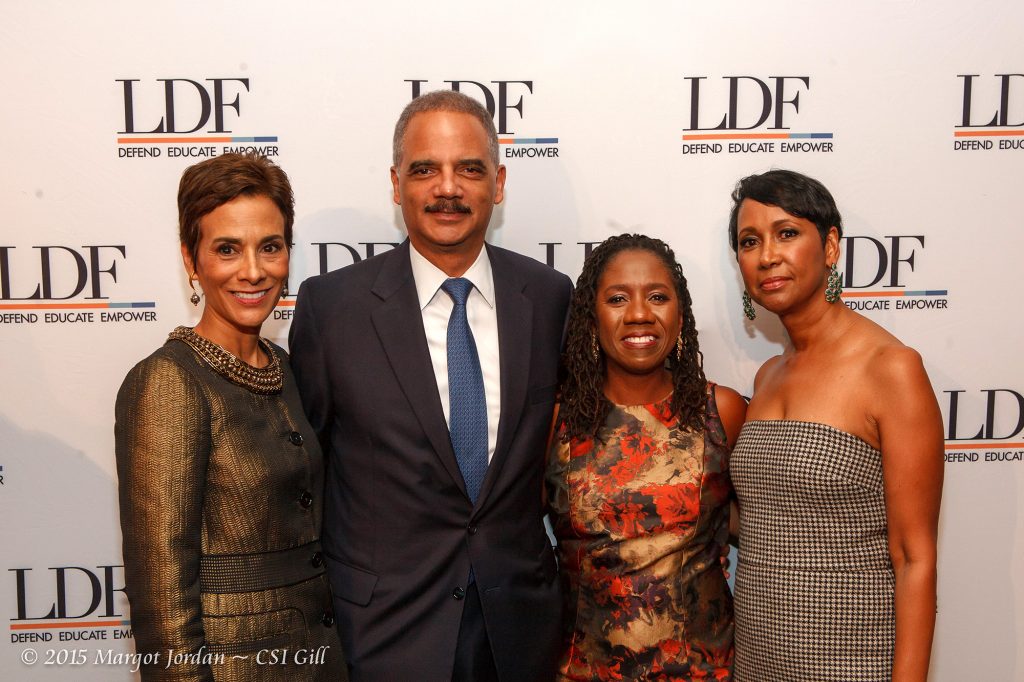
For Angela, this work has brought both triumph and heartbreak. She participated in the 50th anniversary commemoration of Bloody Sunday and the subsequent passing of the Civil Rights Act. She and the LDF board celebrated the 50th anniversary of the landmark Supreme Court decision Brown v. Board of Education at the White House, where they met President Barack Obama and members of the Brown family. But she also watched despairingly as the Supreme Court struck down section 5 of the Voting Rights Act, a decision that has breathed new life into efforts to suppress the black vote.

Continuing the legacy
Scanning the sea of faces seated in the ballroom at Cipriani’s, Angela’s mind harkens back to her childhood in Louisiana. Looking out at honorees like Bryan Stevenson, the legendary head of the Equal Justice Initiative, Angela can’t help but be reminded of her family’s unrelenting quest for justice in Louisiana where she grew up. In that spirit, she recently joined the Board of the Xavier University of Louisiana, the only Black Catholic HCBU in the Country, to support their mission of promoting a more just and humane society through the education and advancement of Black students.

That sense of purpose has been passed down through three generations of Vallots, from Peter to Angela and her siblings, and from Angela and Jim to their daughters, Anne and Katherine, who have grown into fierce advocates for disenfranchised people in their own rights. Anne, a world traveler like her mother, just completed a master’s degree in Middle Eastern studies and Arabic from the University of London.
When she was a student at the American University of Paris, she led a project for Syrian refugees to help them tell their stories. It culminated in an art exhibition and publication of a book of personal stories with parallel texts in Arabic, French and English. Katherine, a senior at Harvard, led the effort to create more inclusive activities on campus as the Director of Diversity and Outreach for the College Events Board. At her high school, Milton Academy, she co-founded a club for mixed-race students like herself. Both young women, like their mother, are in their own ways pushing the boundaries and working to make the world more equitable and inclusive. Of all Angela’s achievements—her many firsts as an African-American woman, her work supporting the Legal Defense Fund, building her own diversity and inclusion business—raising her two daughters and seeing them continue the legacy are what makes her most proud.